Laxlife Revolutionizes Coaching With Story-Based Practice Plans

Over the past 8 years Laxlife has been tackling the issue of how to engage youngsters 3-6 years old in sports, on our quest to introduce the game of lacrosse to as many young folks as possible.
Back in 2016, Laxlife co-founder Chet Koneczny was enrolled in the NCCP Advanced Coaching Diploma and upon returning to Lacrosse Nationals in Whitby, Ontario, met up with his childhood lacrosse buddy Mike Rollings. As they always do, the two began exchanging stories about their coaching experience of the past summer, when Michael broached the subject of themed practices he had been running in a program geared at introducing lacrosse to 3-6 year olds.
Like any respectable practitioner, he had run 360 feedback at the end of his program (which many are scared or ignorant in doing) and he mentioned that one parent had commented on how they really loved his Star Wars themed practice and that he should do more of that in the future. In this practice he had these "peanut" lacrosse players running around the floor with their arms linked on the “starship,” pulling up to different galaxies and practicing “shooting stars” that he had taped against the fall of his school gymnasium. The kids had a blast and the practice had really captured their imagination, as well as the interest of Koneczny who had been learning about best practice in visualization in his coaching program, noting that stimulating the 5 senses of sight, sound, smell, taste and touch, could enhance the story-practice concept even further.
From that point forward the idea of building out a series of practices that utilize practical stories that kids can relate to and which stimulate the 5 senses, was born.
With lacrosse being an Indigenous sport and story telling (oral tradition) being such an integral part of Indigenous culture, most lacrosse players are familiar with the Haudenosaunee story about when the land animals played the birds in a game of lacrosse.
When Koneczny moved back to Ontario to teach at Toronto Prep School and make a return to the NLL in 2018, after a 4 year hiatus as Technical Director of Lacrosse Nova Scotia, he was invited to team up with Rollings and offer a 6 week program on Georgina Island First Nation, located on Lake Simcoe in Southern Ontario. Upon arrival, Chief Rachael Big Canoe presented them with a pamphlet titled “A Fish Story” which highlighted the oral tradition of the Chippewas of Georgina Island. They asked Chief Big Canoe how she felt about them turning the story into a practice plan and she thought it was a great idea and a way to share their bands history with the local youth and also non-natives from off reserve.
The program was a great success and Koneczny and Rollings continued to refine the process in subsequent years, creating a series of stories utilizing stories that most young kids are familiar with: The Land Before Time (Dinosaurs), The Lion King, Super Mario, Dora The Explorer, Krusty the Clown and others.
All 8 story-based lacrosse practice plans, in what Laxlife has branded it’s totLax series of practices, are available for free at laxlife.ca and within their recently released app available in The App Store. The plans come fully equipped with an Apple Music Playlist that provides audio clips for every drill, suggested foods for after practice, tactile and visual elements to pass around and share pre & post practice, alongside corresponding youtube videos and reading suggestions for parents to engage in with the child pre-practice.
Check out the concept in action, with Lacrosse New Brunswick Technical Director Chris Burgess telling the story of Kluskap vs. Winpe, Kluskap being the cultural hero of the Mi’kmaw who reside on unceded territory across eastern Canada.
We feel strongly that this concept of story based practices is a revolutionary concept to introduce kids to all sports, not just lacrosse; give it a try! If you would like more information on best practices on introducing story-based practices in your community, feel free to inquire through our support@laxlife.ca email address.
Sixes Lacrosse: The Future of Inclusion
Monday, October 16, 2023 will forever go down in history Olympics changed the rhythm of Lacrosse. Beginning with a few enthusiasts’ firm belief that the fastest game on two feet needed to get back into the Olympics, inclusion into the Los Angeles Games of 2028 gives the game an at least four year long boost of unprecedented visibility and therefore opportunity for 90 member nations, double the number of members since 2008. Meeting the wider requirements of the Olympic event, Lacrosse will now be played in a new Olympic discipline of six-a-side.
Some countries are implementing well defined plans on how to maximize impact whereas other, typically smaller countries (from a player participation standpoint), are still assessing the costs and benefits of spreading their ever thinner resources into another version of the game. The single largest organization in Lacrosse, US Lacrosse, aims to double their participation numbers to 4 million by 2030 (as per their Elevate 28’ commitments). Other initiatives are presently far and few (for instance England’s “Olympic Aspirations). This is against the backdrop of a once in a generation opportunity; this event is, in the words of World Lacrosse CEO Jim Scherr. “It is a platform like no other” that will expose the game to “more than 4 billion people.”
“It’s a platform like no other,” said World Lacrosse CEO Jim Scherr, “more than 4 billion people will see some or all of the Olympic Games” and “that exposure both as a brand and exposure for our sport internationally is just something that you can’t get elsewhere.”
In Canada, where lacrosse is our national sport and Sixes champions are built, many provincial associations are still waiting for Lacrosse Canada to lead the way ahead in terms of coaching & officiating. To date there appears to be no formal budget position for anything sixes related. Many European countries have taken a similar stance, waiting for official acceptance of sixes into the Olympics before contributing any substantial time and resources into its development. Arguably for some of these nations with substantially smaller budgets and almost exclusively player financed international teams, this was the only available choice. Others have taken a leap of faith supported by volunteer efforts and minimal player-sourced financing, developing a sixes roadmap of development and infrastructure. Some teams have at this point had dedicated sixes programs since as early as late 2021 when the first Eurolacrosse tournament for 2022 was announced. Japan winning the bronze medal at the World Games in Alabama certainly didn’t happen by accident.
One thing is for certain, players, coaches, referees and administrators seem to be getting a lot more serious about sixes lacrosse since the October 16 Olympic Inclusion announcement and according to Jim Scherr “Olympic sports (should expect) a 15-25% surge in participation.”
The NLL has some experience in enhancing exposure of the game. Establishing franchises in new markets offers a similar 20-30% boost in participation. In many cases, the necessary support infrastructure in the form of coaching, officiating and administration was not available in time, leaving the growth opportunity passed and largely underutilized due to a lack of capacity in one or more aspect.
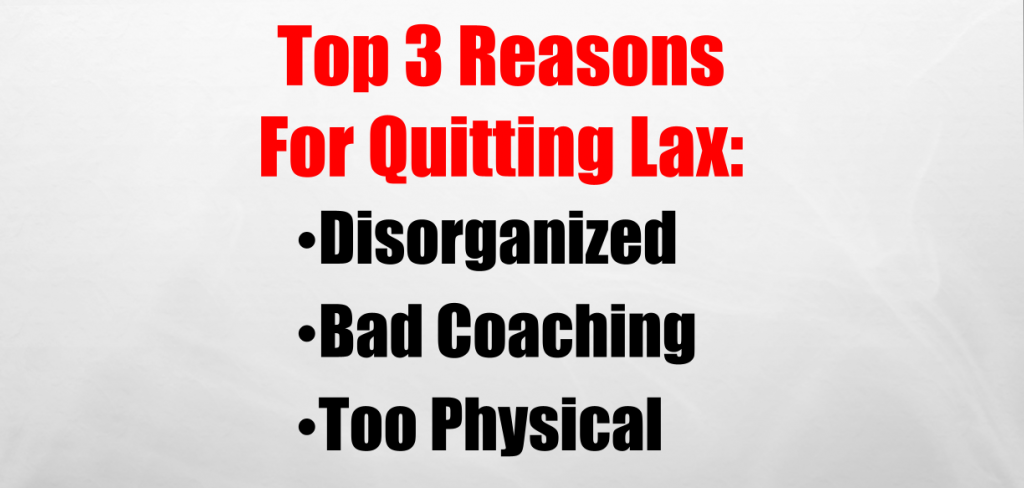
The Alberta Lacrosse Association commissioned a retention study in 2016, disappointed that although they had a net 100 players more than the previous season, they had still lost 1200 players while gaining 1300. The net gain disguised a loss rate of over 90%. The study noted that the top 3 reasons players were leaving Alberta Lacrosse were: 1 - Disorganized, 2 - Bad Coaching, 3 - Too Physical (which is also a product of reasons 1 & 2).
The fastest game on two feet now has precious little time to make the most out of the opportunity presented. The future of olympic lacrosse beyond 2028 depends on how ready the sport will be for this surge in participation. Players from grassroots to the international level need to see progress by their National Sport Organization (NSO) in providing the necessary infrastructure for the sport to become big enough to win the case for continued Olympic inclusion in 2032 in Brisbane (Australia) and beyond.
Grassroots:
Sixes is more than just an Olympic version, it holds the key to more and more sustained growth of the game by lowering barriers to participation at the international, regional and local level. Regardless of whether sixes got into the olympics or not - sixes would have remained attractive for many reasons, especially for smaller emerging countries that are decades away from qualifying for the Olympics and smaller provinces/states/districts/territories looking to grow lacrosse locally. Here the participation in international tournaments is fully playerfunded, volunteer organized and relies on player pools with marginal scope for selection. A player pool of 30 players means taking 16-18 players (perhaps all 30 if sending 2 teams) to an international event. Half the challenge is the player pool, the other half is the finance and required organization.
The ELF/PALA/AAL and others would have been remiss not to make sixes their baby, with many countries having less than a few hundred total players (at best) to begin with. Some have argued that many of the 90 member countries in World Lacrosse are just shell corporations (copy & paste), with almost no real traction or growth prospects. This points at the conundrum some countries face. Without using non-resident players there cannot be an international team. Non-resident eligible players also limit the number of players returning to the nation with the wealth of experience international competition offers. Smaller roster sizes will allow these nations to faster establish locally resident rosters that elevate the local play beyond token tournament participation. Even this is no guarantee, as any NSO can field players as it pleases within the confines of eligibility. Sixes offers the chance to use more resident players. For some NSOs this might become a tough trade off between competitiveness from using non-resident players offering the chance of improved rankings versus the long term growth possibilities from using less competitive resident players.
Sixes is the tool that’s needed to grow the sport at the grassroots level. Practically speaking, it can be played any time, anywhere, and at minimal cost outside of initial start-up equipment. Getting rid of the long poles, reducing the size of the rosters and the number of players on the field, allows for a sixes style that is packed with action and much more attractive to participants (also far less tactical than field lacrosse).
This applies especially to school Lacrosse. A Phys. Ed. class of 20 could barely offer the chance to scrimmage during sessions, whereas sixes requires less space and easily accommodates two teams in a group of 20 players with at times wildly different levels of ability. For anyone interested, I made a video on what it would take to arm the Phys. Ed. teachers with everything they would need to do a lacrosse unit and be able to make a grade, with supplementary work products alongside skills development protocols and assessment.
Despite provisional Olympic acceptance, getting sixes lacrosse into grassroots programming has been no easy task thus far. While technical director of Lacrosse New Brunswick, I was pushing for high schools to switch over to sixes lacrosse in place of field for the 2022 season. The stakeholders voted against this recommendation, citing coach capacity issues, which was a fair concern. High School field lacrosse has been a modest recruiting tool in New Brunswick and they have every right to want to continue doing things the same way they always have.
Yet, sixes lacrosse makes for much better skills development. It also makes it easier for schools to enter a team into a league where they technically only need 6 players to play a game. My official stance is that elementary schools should play intramural sixes lacrosse all the way up to junior varsity in high school, with varsity lacrosse players playing traditional field lacrosse in an effort to attract NCAA scholarship money (perhaps with division 3 varsity still playing sixes).
Where New Brunswick is a microcosm, World Lacrosse is figuring things out on a macro level. Sixes lacrosse needs to provide meaningful competition and developmental pathways for the non-elite countries, more than the elite ones. Associate World Lacrosse Members countries like Luxembourg are often an afterthought. They need a template for how to run intramural leagues, club and provincial leagues and tournaments; this would work wonders for uptake of the game. Speaking to Canadian Lacrosse, we need sixes to be played at the Summer Games for every province and should even consider playing it at the Canada Games instead of box lacrosse; although I am also sensitive to the fact that the box lacrosse discipline is a uniquely Canadian cultural contribution to the game.
Lacrosse needs guidance and training for teachers, coaches and referees. Lacrosse Canada has thus far made an optional module for sixes and don’t want their level 1 officials jumping right into sixes, so they’ve said. By 2024, it was suggested that there should be a full clinic to get certified as a sixes official. They are also seeking a coaching module to be mandatory by January 2024.
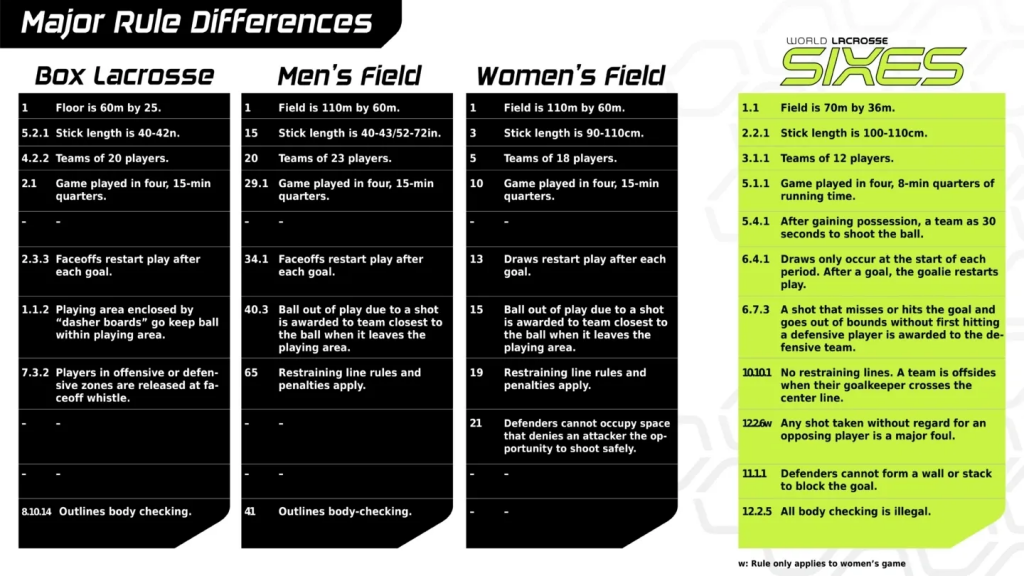
Below is a graphic with the major differences between the 3 disciplines of box, field and sixes lacrosse for anyone who is interested.
High Performance:
“We will grow sixes as a discipline, help our teams become more proficient at sixes and provide support for coaching, strategy and development to have as many competitive teams as possible in the discipline while also reducing the gap between elite and emerging nations,” added Scherr. “Not only that, the qualification cycle – whether it’s team selection, world championships or the Olympic qualification process – takes on significantly more important public visibility given the fact that it’s now the road to the Olympic Games.”
As of right now there are 6 men’s and women’s teams slated to compete in the Olympics, with World Lacrosse pushing to have that number raised to at least 8. It is the ultimate carrot for any 19 to 25 year old lacrosse player from one of the top 12 ranked countries in the world at sixes (the top 8 are based on World Sixes Championship results):
Men’s
1 CANADA
2 UNITED STATES
3 JAPAN
4 GREAT BRITAIN
5 HAUDENOSAUNEE
6 AUSTRALIA
7 GERMANY
8 ISRAEL
9 JAMAICA
10 ITALY
11 PUERTO RICO
12 IRELAND
Women’s
1 CANADA
2 UNITED STATES
3 AUSTRALIA
4 GREAT BRITAIN
5 ISRAEL
6 JAPAN
7 HAUDENOSAUNEE
8 CZECH REPUBLIC
9 PUERTO RICO
10 NEW ZEALAND
11 IRELAND
12 GERMANY
If you are a european country, the run up to the Sixes World Championship in 2026 (in China my sources are telling me) is huge for qualification, particularly the 2025 European Sixes Championship. It remains to be seen how many teams from Europe will be eligible to compete in the World Championships, but qualifying from Euro’s to World’s will undoubtedly be a major accomplishment. In the interim, the annual EuroLax Sixes tournament in February in Faro, Portugal, remains the major competition, with Ghent offering another intermediary opportunity to compete internationally in June. Participating teams should have at least a 2-year plan in place in an effort to qualify for the Worlds at this point…
The national teams at these tournaments, up until now, in many cases have been stocked with non-passport holding hand-me-down pro/ncaa Americans such as Italy, France, Israel & Jamaica. While on the other end of the spectrum there are teams such as Belgium, Denmark and Germany who have entirely domestic rosters. Germany took only players who were hard workers and team players - in their athletic prime, ones that would be around for the Olympics, so I’m told. Certain countries are also more adept as passport printers (Italy, Ireland), which will certainly play a role in the depth of some of the countries at the qualifiers and most certainly for the Olympics itself. I’m told that the nature of the eligibility requirements will be publicly released in a few weeks time.
One just as meaningful conversation has to do with how to provide meaningful competition for emerging (tier 2) countries that perhaps can’t even field a team without the help of non-passport holding imports? When I played in World events in the past you were allowed 4 non-passport holding players as long as they had at least one grandparent having documented proof that they were born in the country they were competing for. I believe that this rule will be abolished as the gravity of these euro/world championships evolve. However, I’m told that the current rule will still be in effect for the 2024 World Box Lacrosse Championships.
It’s expensive to attend these types of tournaments and most countries (along with their top players) can only attend a finite amount. Furthermore, nobody wins when games are a blow out. A tiered system where tier 1 is passport holders only, all olympics rules and you meet those requirements and you are in; versus a tier 2, where you filter out the nations that don’t have all of the requirements and still provide them a platform to engage in developmentally appropriate competition, has got to be the way forward.
Jim Scherr said “we will grow sixes as a discipline, help our teams become more proficient at sixes and provide support for coaching, strategy and development to have as many competitive teams as possible in the discipline while also reducing the gap between elite and emerging nations.” I guess time will tell to what degree that these resources are provided...
Interdisciplinary Cooperation:
Aside from these warm-up tournaments being an expensive undertaking (currently - who knows if they will be subsidized moving forward), the next big complaint I have been hearing is about athlete burnout, and rightfully so. In Canada, box and field lacrosse provincial programs are already competing for the same elite players to represent for their province at Nationals; adding sixes to that equation can make the physical and mental strain even more demanding for these players. What is needed is interdisciplinary cooperation in the form of a yearly training plan (YTP), provided by World Lacrosse or Lacrosse Canada, which allows everything to co-exist.
In working my way through most of the lacrosse coaching courses available in Canada, one of the primary components from one level to the next was building out your “YTP.” You eventually submit it to Lacrosse Canada during your evaluation process and they give you feedback, making you do corrections until it meets their standard, or accepting it as is. The problem is that nobody knows what the standard is because Lacrosse Canada doesn’t even have a YTP of their own. Competitive conflicts continue to be a problem between box and field, provincial and national associations, to this day and will be even more so now that we’ve added sixes to the mix.
How much box is the right amount? How much field? How much sixes? Field already takes a backseat to box in Canada, with rep box lacrosse generally running from May to August (4 months). Monthly field lacrosse provincial team tryouts get mixed in during the second half of the season alongside a few practices after box provincials/nationals have ended and then it’s off to field lacrosse national championships in early September (usually Labour Day Weekend). Let’s call that 4 months of box lacrosse and 1 month of field lacrosse. In the USA and most European countries, it’s upwards of 6 months of field lacrosse from Spring to Summer, with box (or some hybrid form) being played indoors during the winter months (November to March) for 1-5 months depending where you are and how much appreciation they have for box lacrosse. England, for example, only has one month of box lacrosse in December, while the Czech Republic plays something similar to a Canadian schedule.
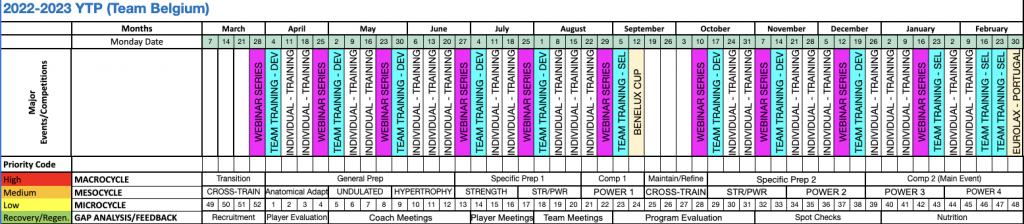
As an assistant coach for Team Belgium Sixes Lacrosse from 2021-2022, we took on the task of building a YTP for Belgian Sixes Lacrosse that could co-exist with field and box. The 2-year plan included the 2 major sixes competitions per year that I mentioned, Faro & Ghent (5 months apart), with one in-person sixes training camp day per month during which box & field lacrosse were forbidden to practice. 8 out of the 12 camps per year were to be geared toward technical/tactical development, whereas the other 4 would be geared towards team selection and preparation for the upcoming tournaments. In the weeks in between those monthly camps, we planned monthly online webinars and also expected players to complete the weekly individual and small group training protocols we laid out for them. Of course, not everything went exactly according to the “utopian” plan, but we did our best to accommodate the plan within the political and economic realities of the time (that being a time when sixes hadn’t really taken a foothold as a result of the Olympic announcement).
I was recently speaking with one of my favourite coaches of all time, Team England Box Lacrosse Head Coach and Victoria Shamrocks legend, Walt Christianson, who says he never tells guys not to play field, for instance. All that he tells them is that if they play box, they will be better at field and 6’s.
We can’t get overprotective based on the fear that sixes may somehow cannibalize the other disciplines. What we should be fearful of is conflicting programs being put out within community, territorial/provincial/state and national organizations. We need to work together! Decisions need to be made with the intention of not letting that cannibalism happen, while finding solutions and best practices for their co-existence. It’s no different from allowing for the coexistence of the multi-sport athlete.
It gets hard to schedule any type of sixes in spring and then they jump right into box, for Canadians, as the facility available (fields & arenas) generally doesn’t allow for it. In fall you get hockey, basketball and football opening up, which is hard to compete with at the grassroots, but c’est la vie. If we are speaking to “high performance” and what fits best in a YTP, the easy solution for me is to host any annual provincial/state and national sixes tournaments in the fall, on Canadian & American Thanksgiving Day weekends.
Conclusion:
In high performance, we really should only be talking about U17+ for national championships, according to the science. Lacrosse Canada voted against its own committee's recommendations at the 2023 SAGM in Vancouver, after a scientific panel clearly delineated that U15 shouldn’t have anything higher than Region Championships and U13 nothing more than Provincial Championships. Internationally, they will only be hosting sixes tournaments for as young as U20 for instance, which is what they do for all other disciplines as well. This makes scientific sense.
Stepping back from the science for a second, we need to get it right politically as well. I’ve heard people say, “what about the Haudenosaunne problem.” First off, I don’t see it as a problem, I see it as an opportunity that our leaders need to come up with the right solution for. Another thing I’ve heard is that allowing one sovereign Indigenous Nation opens up the door for all other Indigenous Nations not recognized by the IOC. Great! If the IOC wants to get it right the IOC needs to #decolonizetheolympics and be true champions of INCLUSIVENESS.
#DECOLONIZETHEOLYMPICS
Lastly, controlling what we can control, we have to be able to get it right here in Canada if we are ever going to get it right internationally. Yes, the Canada Games Council included lacrosse in 2022 as an alleged gesture of reconciliation, yet they also eliminated team Haudenosaunne themselves in the process, forcing these athletes to play on the candian provincial teams if they wanted to participate. If you want a true National Championship in the country we call Canada, here’s my solution. Teams from Indigenous Territories within Canada should take their NAIG (North American Indigenous Games) ranking and be able to qualify for the Canada Games based on certain defined criteria. If team Eastern Door qualifies over New Brunswick, so be it. Let the top 13 provinces/Indigenous Nations qualify. Otherwise, perhaps raise the stakes and allow 15 or 16 teams?
If we want to be allies to Indigenous folks in Canada, and in this case get the Haudenosaunee in the Olympics, it starts right here in Canada with Lacrosse Canada and the Canada Games Council getting it right. So far they have failed. I can say that as a guy who has failed many times before. Time to own it and get better.
Sixes Lacrosse: The Science of Sixes
In this blog we will discuss the science behind the cardiovascular requirements to play sixes lacrosse and how they differ from box and field lacrosse, as well as the art (science?) of picking your team based on those physiological requirements; alongside skill requirements.
Let’s start by looking at the differences between the Canadian, USA and Haudenosaunee rosters from the 2021 Super Sixes tournament versus what they put out on the field at the World Championships in 2022 in Alabama.
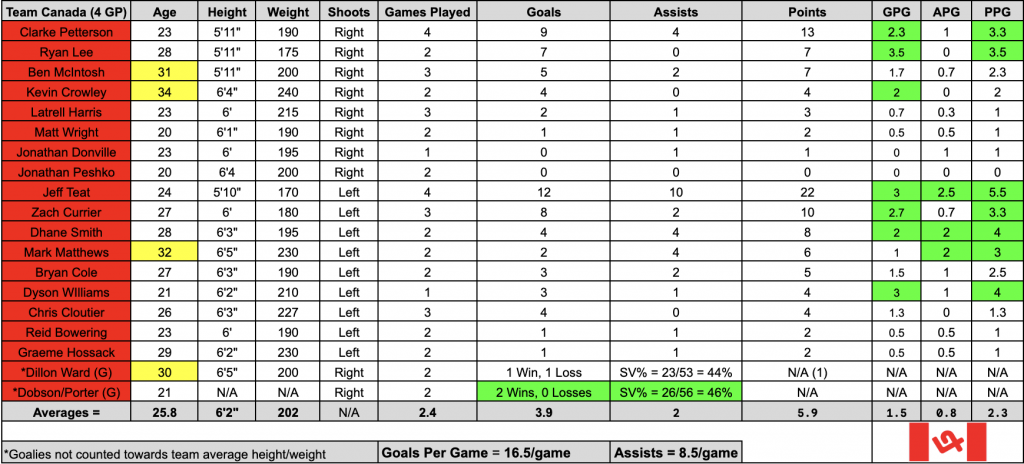
Looking first at Canada, having spoken with one of the team management personnel, he told me outright that 2021 was essentially a tryout and experiment for 2022. What was the experiment? It was whether to pick offensive/defensive specialists and how to use them, versus utilizing the proverbial two-way (transition) player. From the 2021 roster you see below only 3 “offensive players” made the 2022 team: Clarke Petterson, Jeff Teat and Dhane Smith; alongside 3 “transition players” Josh Currier, Bryan Cole and Reid Bowering. If you look at Canada’s 2022 roster, in the end there were 5 “transition players” and 5 offensive specialists. The players who didn’t participate in 2021 who made the team in 2022 were: Josh Byrne & Wes Berg (Offensive Specialists), as well as Challen Rogers & Jordan MacIntosh (transition players).
What does this suggest? Despite having impactful offensive production in 2021, offensive specialists like Mark Matthews, Kevin Crowley and Ben McIntosh all didn’t make the 2022 roster. Despite 2 goals a game on average, it wasn’t enough to secure a spot on the roster. Ryan Lee wasn’t there in 2022 either, however, that was due to injury; Dillon Ward also wasn’t there because of an injury sustained in the PLL; Dyson Williams because of school commitments.
Looking next to the Americans, from the 2021 roster you see below 6 players (+ both goalies) made the 2022 team: Ryan Conrad, Connor Kirst, Liam Byrnes, Zach Goodrich, Justin Guterding and Ryan Tierney. The 4 players added in 2022 were: Tom Schrieber, Matt Brandau, Brian Tevlin and Colin Heacock. Interestingly, Brad Smith and Ryder Garnsey were the only two “attack” or offensive specialists at the 2021 tournament and neither of them made the roster in 2022. It makes you wonder when the last time these guys ever played any defense was, as at least box lacrosse offensive specialists have to run back and play defense a couple shifts a game. All players on the USA 2022 team are listed as midfielders in the PLL.
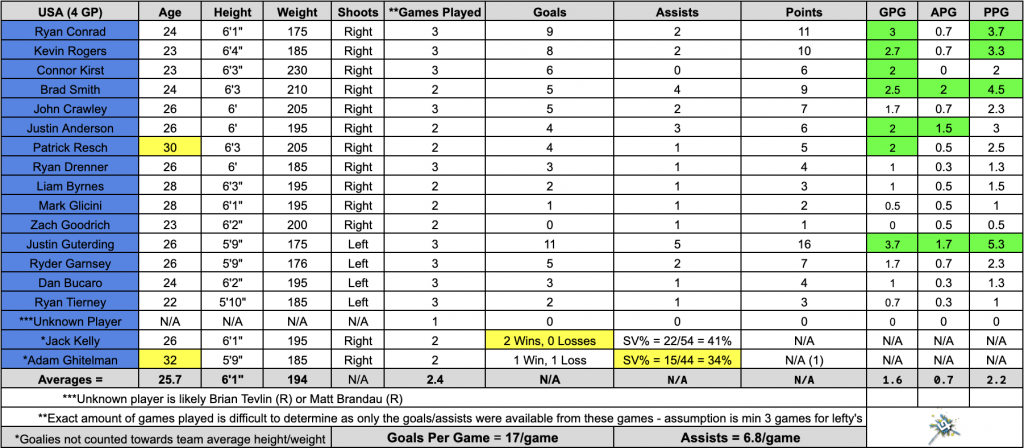
As for the Haudenosaunee, from the roster you see below all players that made the team in 2022 were there in 2021 except for one, Cody Jamieson. Cody took the place of the backup goalie Jack Van Valkenburgh, who got lit up in 2021 with an abysmal 19% save percentage. The 2022 Haudenosaunee roster contained 3 “offensive specialists,” in Kyle Jackson, Jake Fox and Jamieson, with Fox and Jamieson having very mediocre production at the tournament. As I mentioned in my “Defense Wins Championships” blog we know nothing about how well they did on the defensive end, outside of anecdotes.
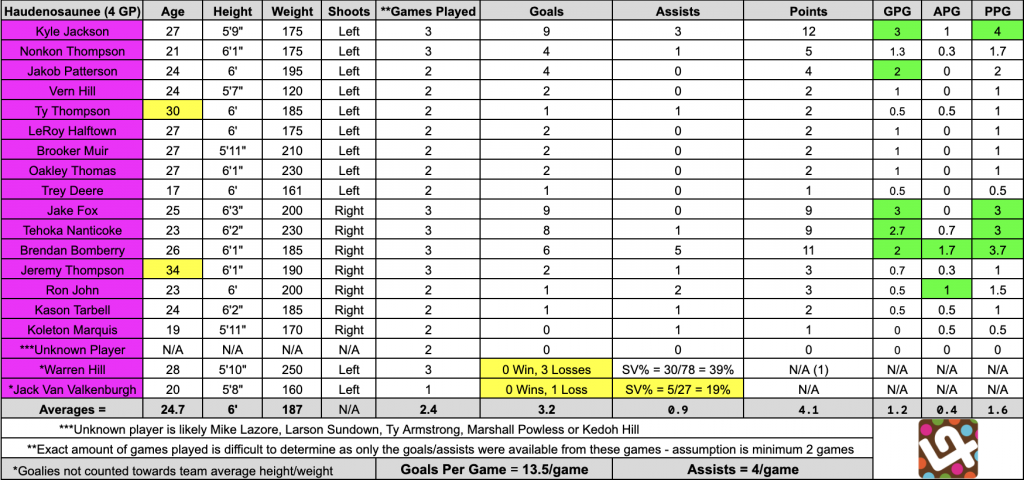
The consensus seemed to be that sixes lacrosse is a young man’s game. The Haudenosaunee were considerably younger in 2021 with two teenagers on the roster (as well as a 20 and 21 year old). However, in 2022 the average ages on each team were: Canada 26.8, USA 26.3 and Haudenosaunee 27.2. If you consider that a man’s physical prime is between age 26-30 (with a 1% average decrease in muscle mass until death), it makes total sense. If these teams were thinking ahead to 2028 and the possibility of Olympic Inclusion, then perhaps it would have made the most sense to bring a roster of 20-24 year olds, as they are the ones who would be 26-30 in 2028. However, undoubtedly everyone was competing to win in 2022, with no guarantees for 2028 at that point. Likewise, the majority of 30+ year olds still ended up getting cut from 2021 to 2022, for one reason or another.
Is a 30+ year old with upwards of 10 years of professional lacrosse experience as hungry to continue training at an elite level as a 20+ year old with lots more to prove? Not likely. There are a few exceptions, but when you factor in full time work outside of lacrosse and young families to take care of, the job of remaining in tip-top shape gets harder from year to year as you enter your 30’s; I say this from experience.
One of my biggest competitive advantages as a player and one of the main reasons I made it to the NLL was because of my knowledge and understanding of the strength and conditioning requirements to play box lacrosse at the highest level. Having graduated in kinesiology and going on to obtain a CSCS (Certified Strength & Conditioning Specialist) title, I am technically one of a handful of people in box lacrosse to truly understand the sports science of this discipline of lacrosse.
As a career bubble player who was in and out of the line up, I wasn’t there because of my skill per se, it was the intangibles. Shut down defense, loose balls, toughness and strength and conditioning was my game, in all reality. I always came into training camps a step ahead of the rest and dominated in the physical testing components of camp.
One of the other things I did as a bubble player was make the best use of my time when I was out of the line-up. One game I studied an elite offensive player (Casey Powell) and another an elite defensive player (Jeff Moleski) to chart their average/median shift lengths and recovery periods. What I found was that the median shift length of both players was 25 seconds, with a median recovery (rest) period of approximately 50 seconds (a 1:2 work:rest ratio), with every 3rd shift having an extended rest due to TV timeouts, regular time-outs, injuries, etc. Total shifts were 49 per game. These are the conditioning intervals I used for training for box lacrosse for the remainder of my career and to this day when I train/coach my athletes.
Where the actual science of training for lacrosse is a very broad subject, I will focus on the conditioning of Sixes for the remainder of this blog. The first thing to appreciate is that with only 10 runners on a roster generally speaking (unless you are like Haudenosaunee and go with 11), the work:rest ratio in Sixes lacrosse is 1:1.
You can see why teams wanted “transition players,” used to less rest and longer shifts than the rest of the NLL/PLL players. As the Americans were primarily midfielders in field lacrosse, they would be more used to longer shifts and playing in both ends than the majority of NLL players. However, field lacrosse teams often have 4 lines of midfielders, bringing their work to rest ratio into the 1:3 range, allowing for much more time for complete rest. In a 1:1 work to rest ratio, players are often hopping back out onto the field with “incomplete rest” bringing them deeper into the realm of what we would call HIIT training (High Intensity Interval Training).
The other consideration is opportunities for rest when you are on the floor/field. In box lacrosse, the old saying goes, you should always be running when you are on the lacrosse floor (something which we hold in esteem in practice as well). In all reality, you might have a brief 2 seconds here or there where you are relatively stationary, perhaps able to take the opportunity to take a few deep recovery breaths while on the floor (many players don’t even know how to do this). In field lacrosse, especially when there’s no shot clock and with all of the around the horn action they do before actually attacking the net, the intensity while on the field is much less than box and the opportunities for informal rest on the field are much more frequent. If you look at attack and defensive players, they barely even enter considerable states of fatigue, not needing to work on their anaerobic capacity like the midfielders, or offensive/defensive specialists in box lacrosse.
Despite a game of sixes lacrosse being half the length of a regular box lacrosse or field lacrosse game, the relative workload and specifically the aerobic power required to play are substantially higher during that time. World lacrosse reports that the average distance covered in a Men’s field lacrosse game is 2436m vs. Sixes which is 2384m, again in half the amount of total time. That translates to 209m/minute in sixes lacrosse versus 172m/minute in field lacrosse.
How does this look in a practical sense, when it comes to training for Sixes lacrosse?
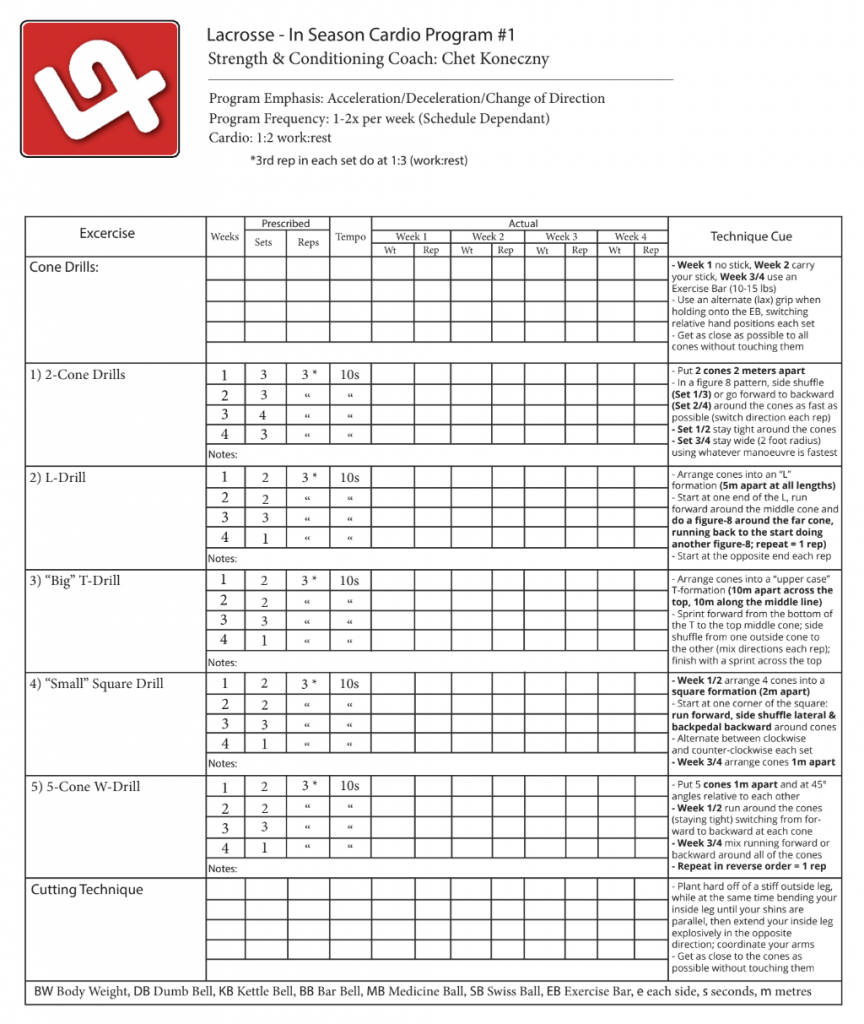
Below is program 1 (month 1 of the season) of an in-season anaerobic conditioning program (and video to follow) that I used to do for box lacrosse at a 1:2 work to rest ratio, as mentioned. Each drill takes approximately 10 seconds to perform and therefore in order to stay in line with a 1:2 work to rest ratio, the athlete would then take a 20 second rest before they perform their next rep through the drill. There are 33 total reps of 10 seconds in week 1 and by week 3 (the highest volume week) there are 48 reps of 10 seconds. Remember the total shifts that Powell and Moleski had was 49.
Building up from program to program, by program 3 (month 3 of the season) each drill takes approximately 25 seconds to perform and therefore in order to stay in line with a 1:2 work to rest ratio, the athlete would then take a 50 second rest before they perform their next rep through the drill. This is what they do in week 1, for 12 reps, which in all reality is only the equivalent of approximately one quarter of an NLL game. However, the intensity increases in week 2 and week 3 when the athlete is asked to complete reps at a 1:1 work to rest ratio and later a 2:1 work to rest ratio. Week 2 and Week 3 is performing what is known as HIIT (High Intensity Interval Training) and for box lacrosse would be a form of “special endurance” where a player has to “double shift” for instance, which is much more common for offensive specialists than defensive specialists.
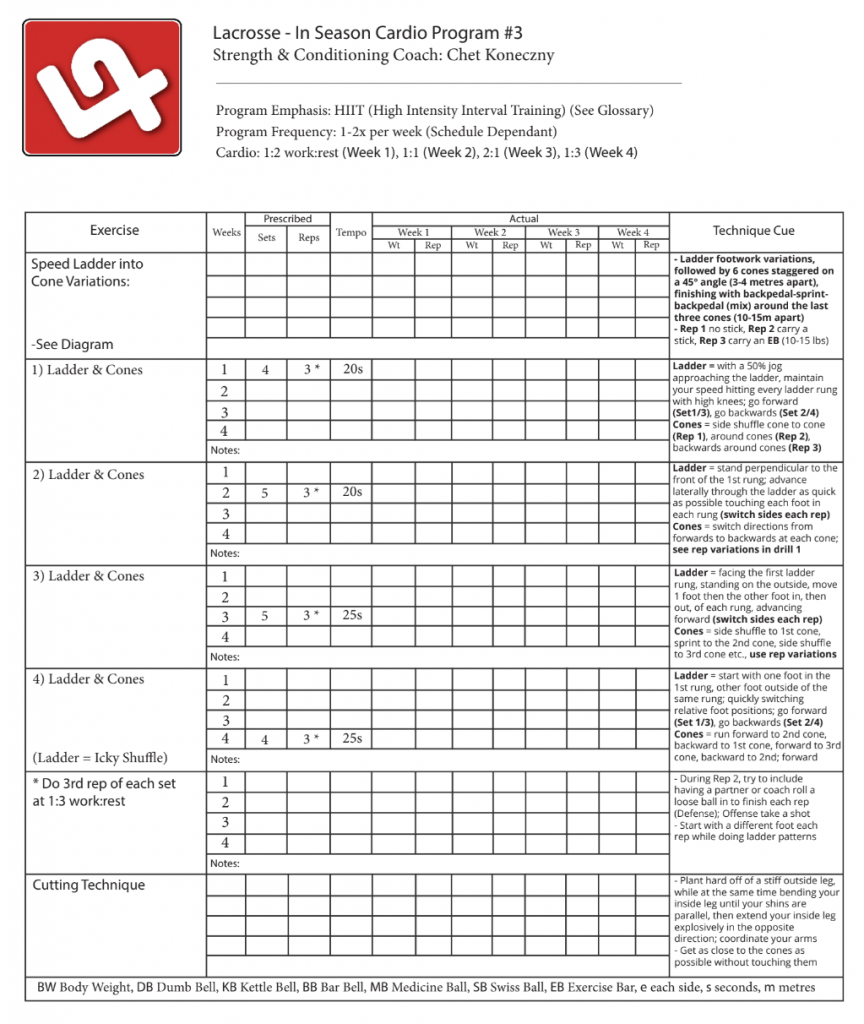
Sixes lacrosse arguably has an average shift length of 50 seconds, which was the average combined defensive and offensive shift in the NLL when I did my study. That also means that players have roughly 19 shifts on average per game in sixes lacrosse, if you divide that by the total length of the game, which is 32 minutes (running time). So these HIIT intervals for box lacrosse shown above, being performed at 1:1 work to rest ratios, are actually just the standard ratio for sixes lacrosse. HIIT intervals for sixes lacrosse would thus need to be done at the 2:1 work:rest ratios, although a strong foundation of 1:1 work:rest ratios should be built before venturing into these types of high intensity intervals. In fact, in off-season training for box lacrosse, or sixes in this case, players should actually build a strong aerobic (continuous “steady state” cardio) foundation, gradually transferring to majority in anaerobic (sprint) training by the time they reach the season. This allows for optimal recovery when resting.
Having now superficially broken down cardio training considerations for box and sixes lacrosse, the fact remains that two-way players that are capable on both sides of the ball, alongside offensive specialists with defensive upside, are the ideal players to make a team in sixes lacrosse. All must be in superior cardio-vascular shape. Players that are in their athletic prime, ages 26-30 years old come the 2028 Olympics, are the most likely to make up the core of the best teams at the tournament. Other countries attempting to qualify are best to take note and start focusing on the sports science of lacrosse if they hope to compete for a spot on the big stage; the same for those with medal aspirations. This science is not just to do with cardio-vascular science, which team Japan clearly exemplified in their monumental bronze medal win in 2022, but also with injury prevention, the development of sport-specific power (via resistance training & plyometrics), mental performance, team cohesion and further with the technical/tactical development of box lacrosse skills and systems.
Sixes Lacrosse: The Canadian Offense
In this video, we will primarily examine the Canadian offensive attack from the World Sixes Championship final in 2022, also looking at some of the tendencies of team USA. We will also look further into the ways in which the majority of the goals in this game were scored.
An “offensive set” is a settled even strength situation involving 5 players on the field, initiating a set of principles/rules/guidelines for players to follow in order to add structure and make things flow.
Generally speaking, Canada used a “freelance” offense, with a few set plays mixed in, early and late in quarters. Although to freelance literally means “to work for yourself, with no allegiance to anyone,” in order for this offense to be effective, all players on the field were involved; there were no spectators.
In a freelance offense, there should be options to choose from, along with freedom to use individual intuitiveness, all in an effort to exploit weaknesses and break down the opponent’s style of defensive play. Offensive players need to force the defense to respond to their actions, thereby creating separation for themself and time & space for teammates.
Superior team offense promotes swinging the ball, plenty of "motion" pick & rolls and pick & pops; in other words “pass, pick, pop, roll, replace, cut, shoot,” as Casey Powell used to describe it. Offensive players need to spread the defense by staying wide, while also adjusting their position to help create open passing lanes. You can’t allow the off-ball defenders to sag and stand in help positions; you have to keep them engaged with hard work and tenacity. “Always Be Cycling (ABC’s Of Offense),” Team Canada Sixes General Manager Eddie Comeau used to say, referring to players continuously making meaningful/purposeful movement, both on-ball and off-ball.
Sometimes, a predetermined set of actions can be executed by an Offense in a settled situation, whether even-strength or on the powerplay, developed and practiced to create an advantage or opportunity during a game; these are otherwise known as a "set-plays" or "focus plays." Usually teams will try a “set-play” on offense after a time-out, dead ball, or the first possession of a period/quarter, which was often the case for Canada in their lopsided 23-9 victory over the USA in this game.
The offensive set-play that Canada seemed to continue to exploit was an empty-crease setup primarily on the “weak-side” or 2-player side (sometimes “strong-side” or 3-player side), with an east-west pick & roll attempt at the shooter position.
In my last blog on "Defense" in sixes lacrosse, I identified the tendency of the American defenders to “stay” on their check instead of switching in a pick & roll situation, which Canada must have also realized at the Super Sixes warm-up tournament the previous year…let me break it down for you.
Empty Crease: East-West Pick & Roll
Clip #1/#2:
These first two clips were analyzed extensively in the sixes defense video but the main thing to notice in this and all preceding clips (which are in the order they appeared in the game) is that both American defenders are continuously jumping out at the ball on an east-west pick and leaving the roller wide open behind them.
If you watch the Super Sixes tournament the year prior, this set-up seemed to get used impromptu a few times within a freelance offense, but it seemed to generate a great opportunity the majority of the time. If you note how early in the game that these first two clips are, it’s obvious that this empty crease set-up was a big part of the Canadian game plan going into this one.
Clip #3 “Empty Crease On The Strong Side For A Bomb from Byrne”
This third clip shows an empty crease set-up on the strong-side, with one player stationed behind the net in order to create space for the other two. The last clip was also on the strong-side and the third player just ran their check to their wrong-side in that case. Here, the american defender #1 Kirst, is inviting Teat #51 top-side instead of denying it, which could have negated the whole situation. Instead, the low defender #25 Goodrich, fires out anticipating a switch that wasn’t there, leaving #22 Byrne, the leading scorer of the tournament, wide open for a mid-range bomb.
Clip #4 “Berg With The Crease Dive In Tight”
Here it is again with Dhane Smith #92 sweeping over top of an east-west pick from #14 Berg, who is wide open on the roll and makes no mistake with one short-side fake and a crease dive finishing low to the far-side on American Goalie Jack Kelly, who had no chance.
Clip #5 “This Is What Happens When You Don’t Fire Out”
This last clip shows what happens when you don’t fire out, with an easy mid-range bounce shot from Smith coming overtop of the pick (which is option #1 in any pick & roll situation). If you re-watch the last few clips you will also realize that #1 or #25 were involved in the last 5 breakdowns in this situation, which makes you realize that Canada was likely purposefully exploiting these weak defenders (“pigeons” or “fish”) in the “two-man game” aka “two-player game,” when they got the opportunity.
Junior says we’ve got more to give!!!
Crease Vacate or Clear Out
Clip #1 “ #28 Bowering Triggering The Crease Vacate”
The other set play that Canada repeatedly went to was a crease vacate or clear-out, primarily on the strong-side, timed with a hard run underneath by the ball carrier. Watch closely how as soon as #28 Bowering on Canada touches the low crease position he vacates into the middle, "triggering" the high ball carrier #51 Teat to take a hard run underneath. Most set-plays have predetermined triggers that signal the start of the play, developed in practice, starting first against no defense, later against a live defense and then in games.
Notice that Teat also had the east-west pick option from #55 Cole, which may have also gotten Teat open overtop, adding even further apprehension to the decision making process of the American defenders.
Clip #2 “Another Vacated Crease For Teat”
The same group of players go right back to the same play on their very next shift. They start in an empty crease east-west setup for the righties, which actually allows #92 Smith to get top-side, however he elects to swing the ball to the lefties and this time Bowering & Cole both clear out as soon as Teat receives the ball. #26 Schreiber actually has good top-side position at first, but the two lower defenders abandon him without him knowing it leading to an uncontested run underneath, with a crippler shot five hole on the goalie.
As I mentioned repeatedly in the sixes defense video, somebody needs to tell Schrieber he’s alone so he can angle his feet and deny the underneath lane, otherwise making the high-low switch. However, neither happens leading to an easy goal for Canada.
Clip #3 “MacIntosh Takes His Check For A Loop”
Here it is with the righties. Petterson #42 is already spread nice and wide at the point position, standing slightly on his wrong side. MacIntosh #24 clears out from the crease for Smith and if you follow him, he takes a loop around Pettersons defender and then cuts hard to the net, getting left wide open but robbed by Jack Kelly in tight.
Clip #4 “Cole With The Swim Underneath For The Crease Dive”
Finally you have two consecutive hard underneath cuts late in the 3rd quarter. This first one, Cole can see that he has a straight up “iso” situation at the crease, with no other American defenders around to help. The other two Canadian lefties stay clear in recognizing the opportunity, with Cole ultimately taking a jab-step top-side and swimming the much smaller defender, taking him hard underneath and to the rack with full extension on the crease dive.
Clip #5 “Currier Taking What He’s Given”
Same thing with #77 Currier on the very next possession, Teat gives a little pick and pop action off of the up-pick and Currier takes the low defender hard underneath for the g-note. It is an invitation to go underneath when the defenders are checking this far out (“aka over-checking”) as well as not denying the lane underneath.
Hard Underneath & Curl Out:
1st Clip: “It’s Always Worth Trying Your Check Underneath”
It’s always worth trying your check underneath within a “freelance” offense or any other time they aren’t playing with proper defensive positioning and footwork. Many good looks were created during this game in this fashion, including the first possession of the game for the Americans, which makes me wonder why they never continued to go back to the well as the game went on.
2nd Clip “Rogers Taking The Space At The Crease”
Look at all of the room there is at the crease for Challen Rogers to try the underneath on the strong-side, on this one. This defender needs to stay tighter and not check so far out. Nonetheless, Rogers attracts attention in the form of an adjacent slide, easily hitting the adjacent pass which leads to a wide open opportunity in front.
3rd Clip “Exact Same Thing On The Very Next Shift”
Here you have the exact same play on the very next shift from the same group; hard underneath, curl out, two passess and in the net. That’s the thing about offense, if it’s working keep going to it and you saw that pattern from the Canadians in this game.
Around the Horn & Dodge From the Shooter:
As I mentioned at the beginning of the video, on any given offensive-set, teams usually have a set of guidelines/rules for players to follow in order to add structure and make things flow offensively. For the Americans, their go to play was to pass it around the horn, meaning around the net from one shooter to the other, then attack the net. I’m not sure why they kept going back to it because it never worked, not once. It was literally wasted movement and precious time. In fact, it led to two fast-breaks the other way (one for a goal), as you can see.
The other set play the Americans seemed to do was the alley dodge, which I broke down extensively in our Sixes: Box on a Field blog. In wrapping up on 5-on-5, I will not even acknowledge the alley dodge as a fundamental form of team offense that should be played in Sixes. Further, it should be noted that goals scored in transition are not covered in this video.
Special Teams:
There’s not much to report on in terms of set-plays on the powerplay. It was a very basic 3-on-2 across the top for the most part, with the Candians liking the quality of looks they were getting from a relatively stationary USA box zone defense that they were playing. They were “pinching” very hard at the top on Teat and he was just playing games with them. Smith took his first couple open shots as result of all the attention Teat was getting, both of which were actually great saves by the American goalie. They used the same set up with Teat again later at the beginning of the 3rd quarter on the powerplay (a rule which I hate and I will tell you why in the rule suggestions video we do), this time giving one fake pass and shooting a short-side bouncer. Teat also showed his backhand pass from the top at the Super Sixes tournament the year earlier, where Canada again just kept it simple and had similar results.
In this game Canada was 3/4 for 75% vs. the USA who were ¼ at 25%. The biggest difference was the rotating diamond that Canada would throw out, applying pressure on the shooters and the point. The only available option was temporarily at the crease, which is where the Americans got their lone goal. Special teams as a whole remains a great area of exploration still to be seen in the evolution of the sixes game.
Shot Selection:
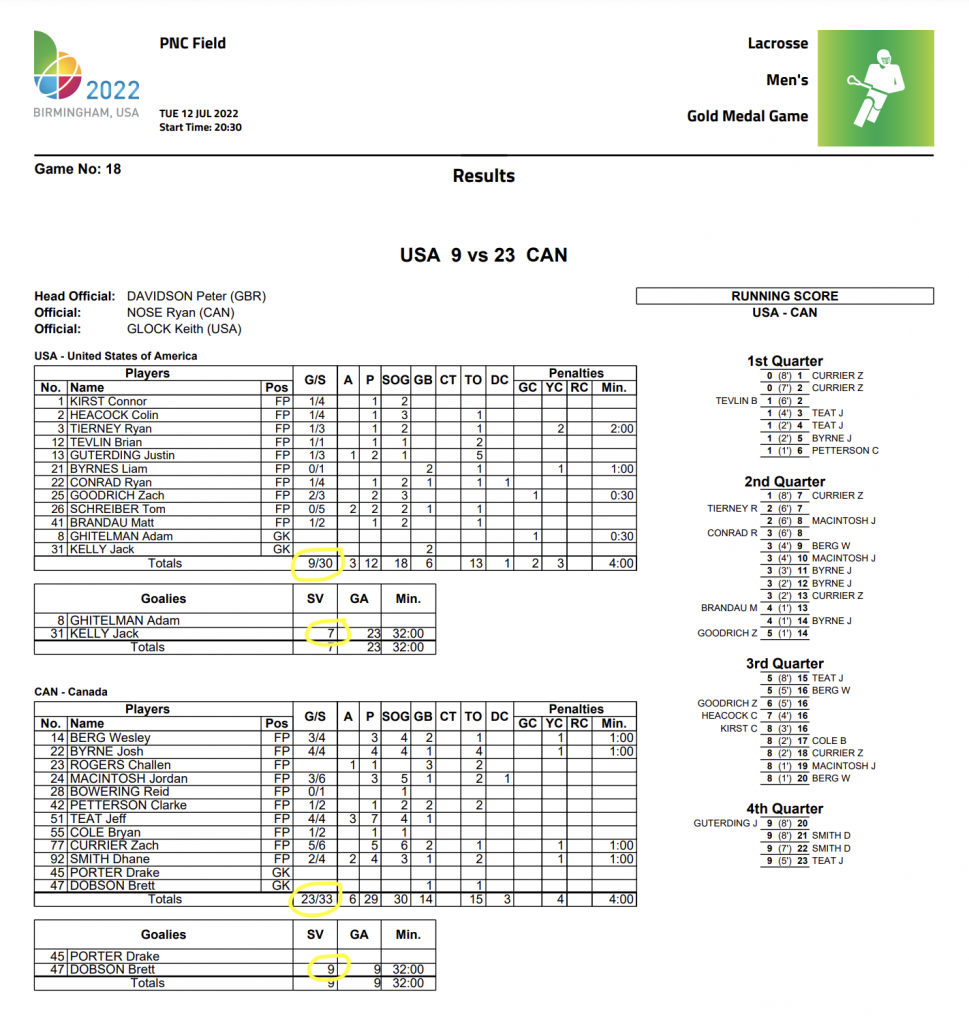
Dobson = 9/18 (50%) - USA missed the net 12 times
Kelly = 7/30 (23%) - CAN missed the net 3 times
*Full tournament stats available at https://swog2022.sportresult.com/hide/en/Pdf/GetResultbookPdf?filename=Lacrosse.pdf
Looking through the stats and analyzing all of the possessions from this Championship game, there was a big feeling out process at the beginning of the first quarter with lots of saves and turnovers and a few goals sprinkled in. Canada then scored on 4 of its last 5 possessions of the quarter taking a commanding 6-1 lead that they never looked back from.
It’s important to note how little production and how many mistakes were made in the 4th quarter, with only 3 goals from Canada and 1 for USA. It’s also critical to acknowledge how many times the USA missed the net (12), versus Canada (3).
However, as I mentioned in the last blog on defense, Canada simply got much higher quality shots throughout the course of this game. Below is a shot chart with the Canadians represented with red x’s, Americans with black x’s; goals with a green ball, saves with a white ball and shots that missed the net with no ball.
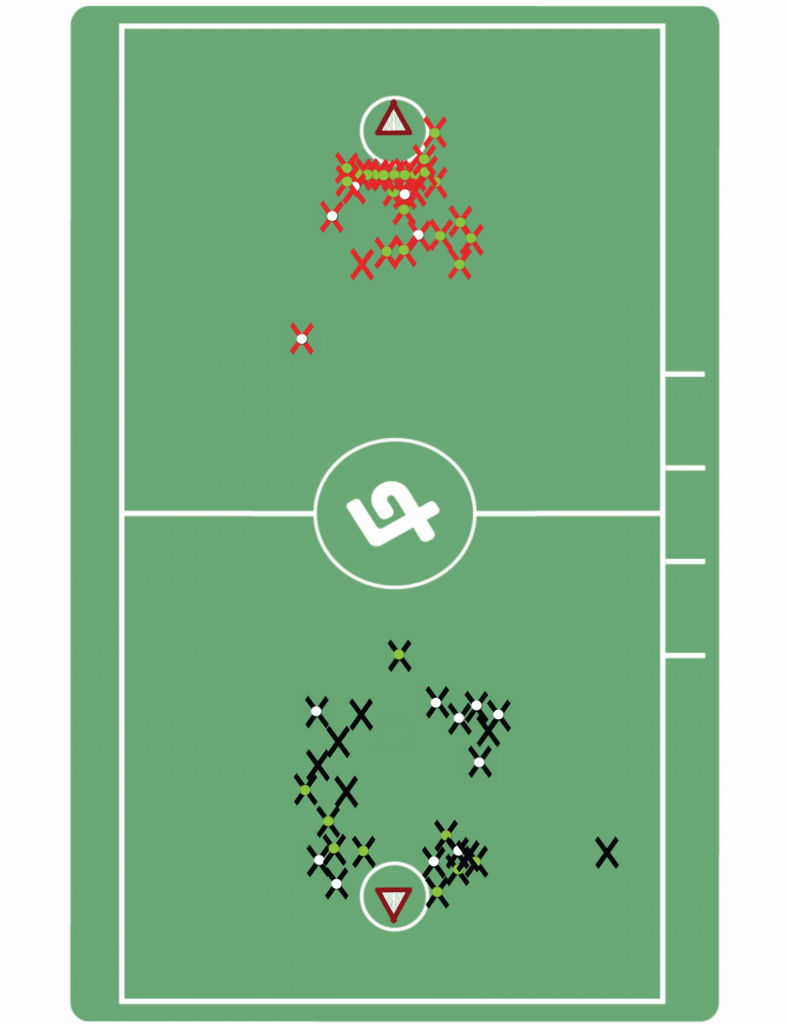
As you can see not many of the American shots were in the middle and they also settled for shots from much further out than the Canadians. Almost half of the Canadian goals came from directly in front of the net. This was due to far superior pick and roll play, as I’ve broken out at length; also, world class shooting and finishing in front of the net by the Canadians, who are used to scoring on much smaller nets with much bigger goalies.
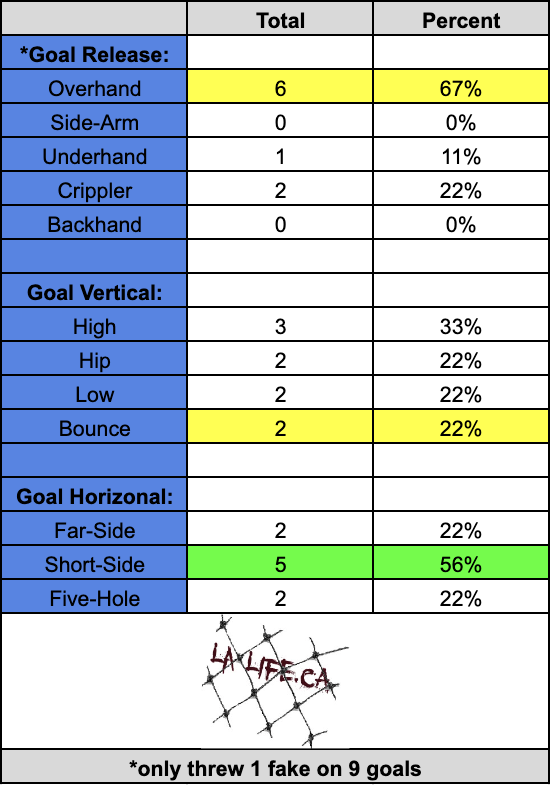
Scoring goals requires fakes, both subtle (i.e. body fakes) and overt (i.e. stick fakes); with changes in shot angle and elevation, both horizontal & vertical, changes in shot nature or style (set-shot, shot on the run, quick stick, crease walk, etc.), as well as release points, all within a variety of different game scenarios. This chart breaks it down:
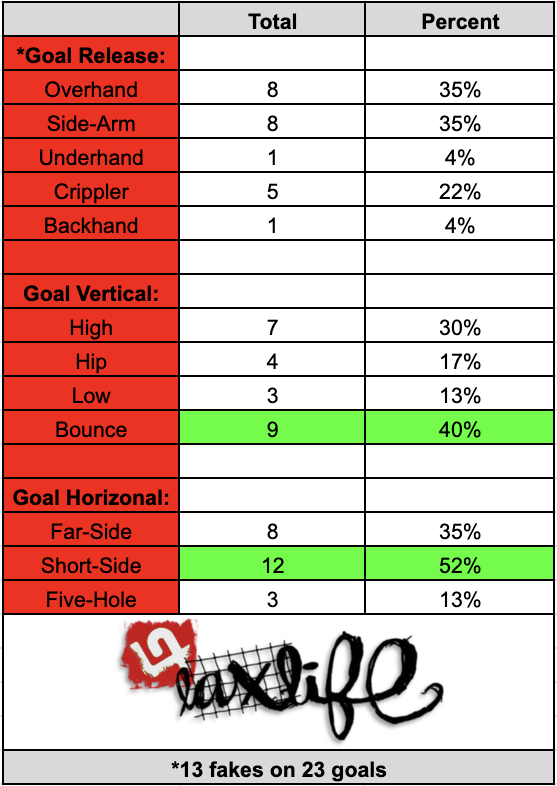
Based on the stats between both teams, an overhand short-side bounce shot was the most likely shot to go in (likely ¾ release in this scenario). A close second would be a high side-arm short to the far-side top corner, although the Americans scored no side-arm goals at all, while the Canadians had just as many side-arm goals as they had overhand.
Conclusion (What have we learned?):
As we roll the goal montage in the background for you, with every goal in sequential order as they appeared in the game, let’s think about what we’ve learned here. In summary, Canada played a principles based “freelance” offense with set plays approximately 50% of the time. If the set-play didn't present a quality shot, they just continued to work the ball around with meaningful motion and purposeful picks. The pick and roll game was the key to creating separation and 2-on-1’s in the offensive zone, primarily on ball, but in some cases off ball.
Canada had two set plays: the crease vacate and empty crease east-west pick, both of which were geared toward the best attributes of their players. After that it was just trust your instincts and take what they give you.
The Americans had guys operating on their wrong-side all over the place, which is a big mistake when the two-man game was what was getting guys wide open in the middle for shots. The picks set by the Americans were rarely east-west, seemingly always north-south. When they were set east-west I was still seeing them go underneath (i.e. not using the pick properly), which is a mistake. You should be using the picks 90% of the time! On a north-south pick you go underneath, on an east-west pick you go top-side; that’s just the way it is…
In saying that, it’s pretty hard to play 2-man game when you only have two lefty’s on your roster!!! This is also a problem in American field lacrosse. If you look back at our first sixes blog showing the player stats from the tournament, it’s quite clear that the USA’s entire offense was coming from their righties. Perhaps the lefties were fatigued? They did have the most turnovers, less assists and a lower shooting percentage, which is surprising because #13 Guterding lit it up at the Super Sixes tournament the year prior.
When guys get tired late in quarters there is little time to settle into your offense, you need to look for a great shot right off the bat on most possessions and Canada was one or two passes and attack, one swing pass then re-attack. And lastly, you won’t see anyone celebrating a goal out there, as it’s immediately off the field or hard back to defense.
To view the full Vlog related to this article please visit our youtube channel: https://www.youtube.com/watch?v=JKdRfBmfVFc&t=6s
Sixes Lacrosse: Defense & Transition Wins Championships
There is certainly a case in sixes lacrosse for the old adage “the best defense is a good offense” when you consider the 23-9 drubbing Canada put on the USA in the Gold medal game of the 2022 World Sixes Lacrosse Championship in Alabama, USA. However, the old saying “defense wins championships” also checks out and for me, combined with elite Defense to Offense transition, which was the secret sauce in the Canadian blow out in Alabama.
Defense starts as soon as you lose the ball and there were many times, including after a goal or a missed shot in a settled offense or a powerplay, where Canada and the US went into a 2-player or full field press depending on the situation. It was seemingly very effective when they did, as both teams were barely able to get a shot off by the time they got to the offensive end. The US threw up the first press 5-on-5 two minutes into the first quarter after a Dobson save - resulting in a turnover from Challen Rogers (although the Canadian coaches recognized he was in trouble and called a time out first so they got the ball back). Canada threw out the next press a minute later after Cole missed the net (5-on-5) on a shot. It took the USA 15 seconds to clear half and ended up with no time on offense and a turnover, with the American player having no option but to try to get to the net 1-on-2 with under 5 seconds remaining in the shot clock. All three 5-on-5 pressure situations resulted in turnovers, with Canada not allowing a shot on 3 out of 4 powerplay pressures and the USA not allowing a shot on 1 out of 2 (both shots allowed were short-handed goals that should have been saves in my opinion).
In saying that, most of the time Canada laid off the press and instinctively got back to defense, covering reverse-transition (which is their primary responsibility) and relying on their top notch defense and goaltending. The best defenses start and end with quality goaltending and Canada had no shortage of that at this tournament, with a 60% save percentage and 6 goal/game average posted by Brett Dobson (2023 PLL Championship Game MVP).
Quality goaltending is then reinforced with good foot and body positioning by the players in front of the goalie. “On-ball” positioning should be a few steps back to the middle, hips parallel to the side boards, in line with the offender’s top shoulder; between their stick and the net. The on-ball defender needs to stand in the “shooting lane,” willing to block a shot, trying to keep the shot in front of them not behind them (i.e. no screen shots - no screening the goalie).
This is all within the framework of what’s historically known as a “helping man-to-man” (player-to-player in gender neutral terms) defense. The key is to know when to “go” and when to “show” in terms of helping. "Off-ball" defenders should position themselves further away from their check, ready to help in the “prime scoring” area, also to stay “tight” as a unit. Off-ball and “adjacent” (same side) defenders need to “sag” over “showing help," but also be able to recover to their check if necessary. If a teammate gets beat towards the net then the next closest defender should “slide” over and help out, with other all defenders "helping the helper," if need be. The thought is that the offense has to beat all 5 defenders in order to score a goal; another analogy would be that you must cover 1.5 players at all times, your check and half of someone else's. The ultimate goal is not to get scored on, defending just your check isn’t good enough!
Once you’ve made the defensive stop and scooped the loose ball, players should run up-floor at full speed and "push the ball" up to any players ahead of them if possible. If a numerical player advantage (one or more player advantage) exists in transition, players should attempt to get to their proper floor side as early as possible and the aim of any fast-break scenario should be to break down a 4-on-3 into a 3-on-2, into a 2-on-1, and onto a breakaway, unless a quality shot in the prime scoring area presents itself first.
It’s worth noting that 2 out of the first 3 defensive sets were fast break goals for Currier, also that the first 3 offensive possessions from the Americans were outside shots and two of them “alley shots” (3 saves).
For the remainder of this blog I will break down 10 defensive shifts from the first quarter which were indicative of the outcome of the game, starting first with the first four from Canada.
Clip #1 (Canada - Defensive Set #1): “Currier Makes USA Pay In Transition”
In this first one, Canada is a little bit too spread out for my liking, much further out than they would be in traditional box lacrosse. This is probably due to the size of the net which makes the defenders have to push out a bit further to protect against a longer range uncontested outside shot. Regardless, usually we don’t push out to the low corners like this defensively, likely they’ve done this to try to take away the effectiveness of USA’s superior dodging ability early when they were fresh early in the game; also something that Canada stopped doing as the game progressed. In this case, #42 Petterson on Canada is lunging instead of sitting back in the chair as we say, which allows #13 Guterding on USA to swim him and drive hard underneath. This forces Cole (#55) to give the adjacent slide for support, at which point Guterding curls out and hits the adjacent pass (which USA should have done more of generally speaking), forcing the rest of the defense to “rotate” in order to recover.
Currier does a good job of having his head on a swivel and recognizing the situation, but unfortunately closes the gap on #2 Heacock's low shoulder when he slides, allowing him to get top-side. If Heacock steps into the this one instead of doing the jump shot he would have gotten closer to the net and might have scored and the stats also show that it should have been a bounce shot which ill show you in the next blog/vlog on "offense and special teams." Currier, knowing he was already beat, just took off “cheating/leaking” they other way which is a risk worth taking in that situation and it paid off because #22 Conrad was sleeping on the far-side and didn’t do his job as off-ball high player, who needs to cover reverse-transition.
In general, the rule in box lacrosse is that the highest player on the off ball should be covering the reverse transition if there’s a shot from the opposite side of the floor (see below)...
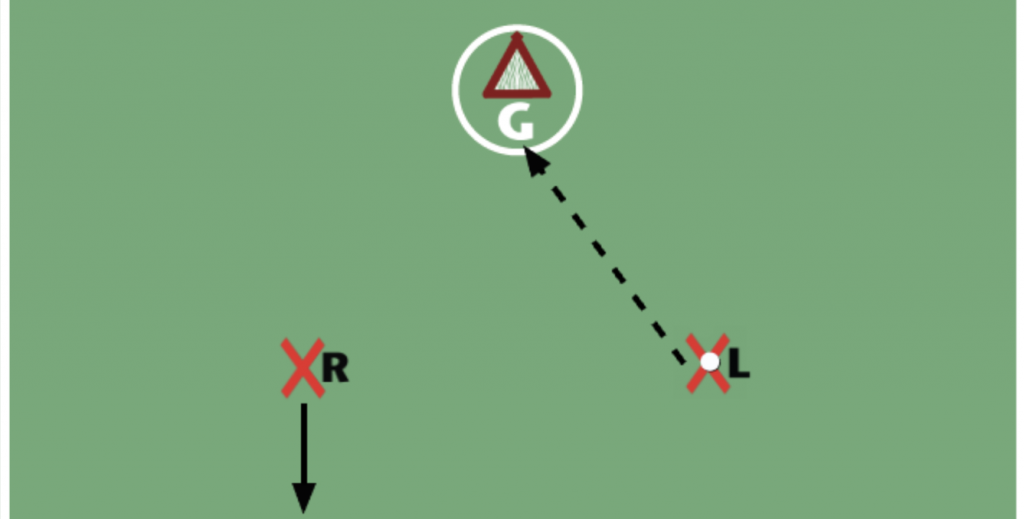
If the goalie makes the save and secures the rebound, both high players on offense should be getting back and not letting anyone behind them (see below).
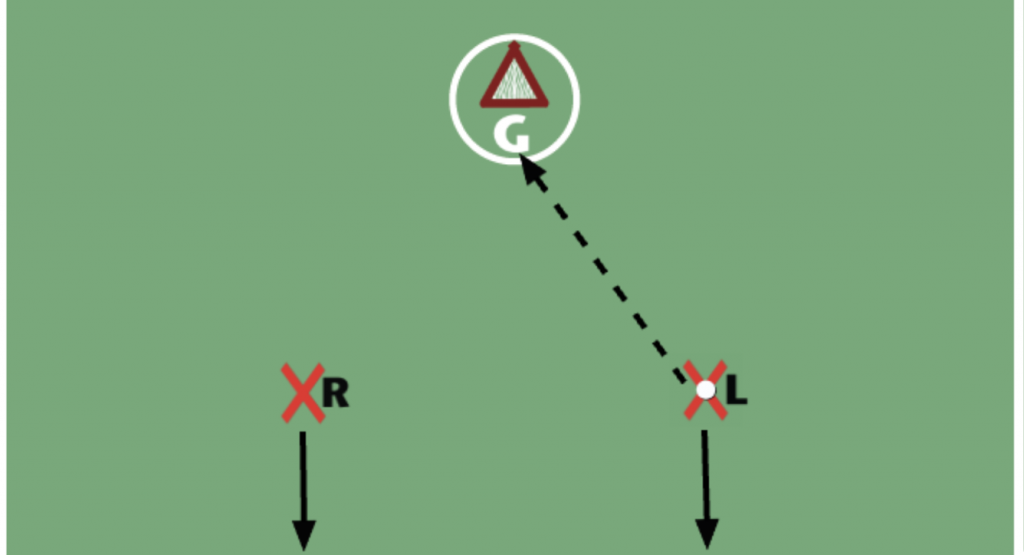
On a shot where there’s a rebound and a 50/50 loose ball on the same-side as the shooter, or a turnover on the ball-side, the off-ball high player should be getting back on defense and the on-ball high player needs to decides either to attack the rebound or get back, depending on the situation (see below).
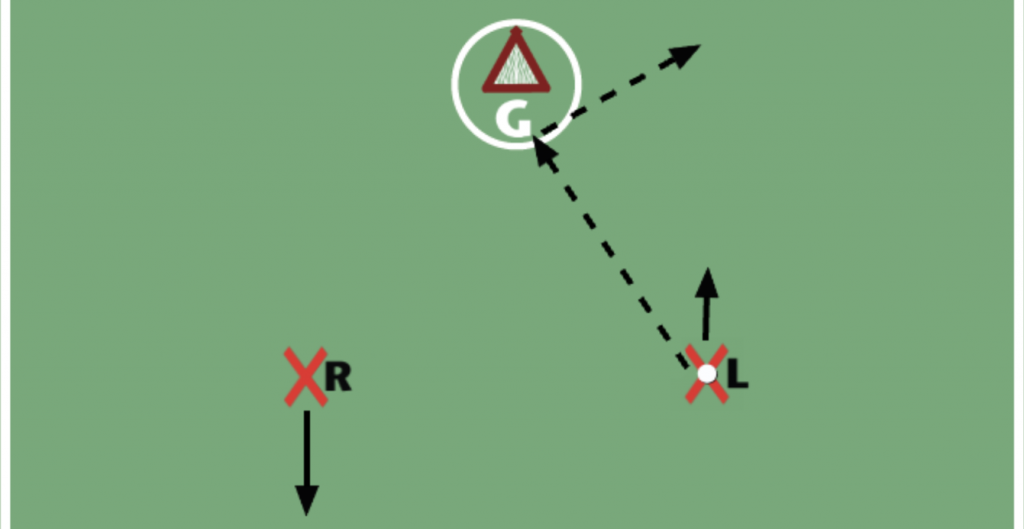
On a shot where there’s a rebound and a 50/50 loose ball on the opposite side as the shooter, the Off-Ball high player has to either attack the loose ball or get back depending on the situation; the shooter should also be getting back.
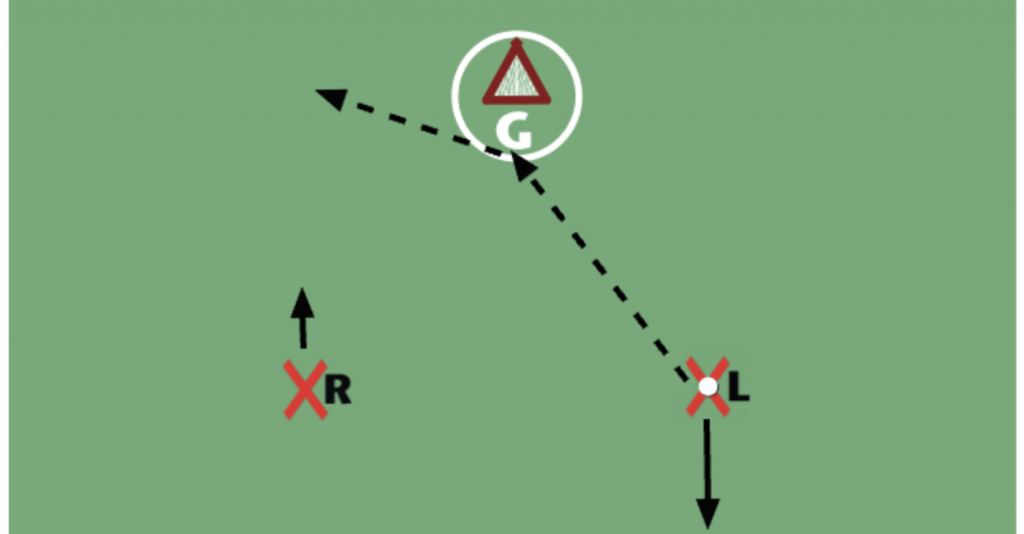
Clip #2 (Canada - Defensive Set #2): “Currier Good Show Of Help”
In Defensive Set #2, Byrne #22 was low and stayed tucked in this time, which ultimately worked out better than being pushed way out on the last clip. The Americans liked to swing it once around and attack from the opposite shooter position, which was a common theme for most of the game. Again, we have another good “show” of help by Currier, which forces #26 Schreiber (Former NLL MVP and 3x PLL MVP) to turn back and basically take an alley shot on his non-dominant hand; which is a win for the defense every time.
Clip #3 (Canada - Defensive Set #3): “Alley Shot Leads To Another Breakaway For Currier”
As offensive motion develops with ball movement, defenders need to arrive at a check in control, never over-committing or over-checking, while keeping balanced. As the opponent gets closer to a threatening scoring area, the defender should be shadowing them backward towards the goal. Defense in its most basic form is a "numbers game," you are always playing percentages in a cat & mouse-like affair.
On the third defensive set for Canada, they should have switched before the alley dodge, #22 Byrne tries to recover but #14 Berg ends up sliding up field to try to get into the shooting lane and contest the shot. It ends up being a save and 3 Americans are caught low for a faux 2-on-1 turned partial breakaway for Zach Currier who makes no mistake for his second breakaway goal in the first 2 minutes of the game
Canada ends up taking a time out there next possession and here is a clip from McCardle in Huddle talking about needing to get back “get back” and cover “the hole”...also something about an alley dodge ;).
Clip #4 (Canada - Defensive Set #4): “Classic High/Low Switch From Canada”
The general team rule in a Helping “Man-To-Man” Defense is that the “high” defenders should always deny offensive players from getting over the "top-side." The "low" defender should always “funnel” low offenders upward towards the defensive help, while also denying getting beaten “underneath.”
In this next clip, Canada is still pressed out quite a bit low, with lots of Canadian defenders with their head on a swivel looking to help. You can tell the Canadians are communicating defensively, as this is the classic “high” low switch. #42 Petterson is telling #23 Rogers he’s got low, so when Tierney #3 drives underneath, Rogers just does an inside roll back into the hole, maintaining his “high” responsibilities (also notice #92 Smith helping in front and showing no respect for his check who is behind the net). Petterson continues to lunge out a bit, I’d like to see him sit back on his underneath responsibilities as he almost got beat here, but ends up coming up with the classic low-to-high trail check in the end. The USA player really should have just pulled it out like in their first possession, he had 2 other Canadian defenders ready to help even if Petterson did end up getting beat.
Clip #5 (USA - Defensive Set #2): “USA Not Doing The High/Low Switch Leads To An Off Balance Defense”
After a first “feeling out” type of possession that ended up as a turnover for the Canadians, here is the second defensive shift by the USA where you have the American’s not doing the high-low switch properly. Two guys end up jumping out at the ball resulting in the defense having to slide or rotate to recover, which ultimately throws the defense off balance and leads to a quality top-side sweep shot by Currier. This empty crease (“high post”) set-up on the weak side by the Candians would end up being the death of the USA. They simply had no answer, wanting to instinctively stay on everything instead of instinctively switching on everything, like the Canadian Help Defense. The communication between defenders should be to “stay” if it’s a bad situation to switch, otherwise, as communication breaks down with fatigue and other factors, the natural inclination should be for the defender to switch; not stay.
Clip #6 (USA - Defensive Set #3): “Lost Again In The High Low Switch”
Here it is again on the very next possession, both American defenders jumping out at the ball carrier off an east-west dodge off a pick. #1 Kirst tries to "stay" on #51 Jeff Teat but what he really needs to do is turn and clamp the picker; the other guy Tevlin #12 played it right and fired out. However, he likely never communicated how he wanted to play the situation and neither guy was on the same page about it. Kirst could have “stayed” on his check if the low defender communicated it to him, otherwise, you need to be ready to switch any time there’s contact on a pick; which I don’t believe was an established rule on this defense.
The low defenders have a greater responsibility for communicating picks than the high defenders, as they can see everything happening in front of them, as opposed to the high defender who has a harder time seeing what’s going on behind them. Beyond all else, communication amongst defenders for picks coming, when to “stay” on a check, and when to “switch” checks, is the key to a successful team defense. Players should constantly be talking to each other. A defender's head should be on a swivel at all times, allowing them to see picks coming from both right and left, and help where required.
Clip #7 (USA - Defensive Set #5): “Not Knowing Your Underneath Responsibilities”
Here we have a great initial set-up by the American defenders, in a “wall” with each defender a “step down and in” from the defender in front of them. Consequently, the high defender (#3 Tierney) tries to “stay” on teat as he runs down the side instead of passing him down to the defenders below him in “the wall” and maintaining his high responsibilities (the most important of which being not to get beat “overtop”).
#26 Schreiber is the low defender whose actual responsibility is to be there to cut off an underneath crease dive from Teat. If Teat wanted to check up and shoot at any point the closest player in the wall would then close the gap and get a stick on the shot (in this case likely the middle defender Kirst #1). Instead, it’s in the back of the net because nobody knows their job (the Americans aren’t used to playing with 5x5 short stick D).
Clip #8 (USA - Defensive Set #6): “Great On-Ball Defensive Positioning Less The Unnecessary Adjacent Slide”
This is actually great defensive positioning by the Americans, less one unnecessary slide towards the end. Here the on-ball defender (Kirst) is by himself (“alone”) and has perfect footwork, angling his feet to invite Byrne over-top where there’s help. The ball then gets swung to the righties, where the two defenders in a wall (low defender out farther then I would like), doing the opposite of the solo defender and with the low defender denying the top-side using their footwork and the threat of pushing their check into the crease if they try to go underneath. For some unknown reason the high defender (Tierney) slides down with an aggressive adjacent help slide and considering the low defender (Tevlin) did their job perfectly which this high defender needs to trust, he should only be providing top-side support not underneath support. A great second slide puts pressure on a wide open #14 Clarke Petterson, but there is no 3rd slide ready and unfortunately for Canada Petterson handcuffs #24 MacIntosh with the pass, who was alone in front.
Clip #9 (USA - Defensive Set #7): “Empty Crease: The Death Of The American Defense”
Here again, we have the “empty crease” set-up on the weak side. Again the low American defender on the weak side is not doing his underneath responsibility, which is even more vital than in Canadian box lacrosse, because in sixes you are allowed to full out crease dive through the cylinder. In this case, the low defender (#12 Tevlin) needs to show help underneath and “split” between his check and his help responsibilities. Elsewise, he needs to tell #26 Schreiber that he’s alone (“iso”) in which case Schreiber needs to deny the underneath lane by angling his feet on a 45 degree angle (like the beginning of the last clip) and forcing his check back over top to where there’s help. There was a big trend for players getting beat underneath late in quarters.
Clip #10 (USA - Defensive Set #8): “Can’t Forget About The Best Player In The Game!”
Lastly, a classic to do with not communicating well, #8 on the American Defense Adam Ghitelman (the back-up goalie!!!), literally had nobody this whole shift. #51 Teat is just sitting there completely uncovered the whole time. This is the type of stuff that happens late in quarters when guys are tired. One skip pass ends up being enough to force all of the defenders to slide and Byrne buries a set-shot five-hole bouncer, with authority. Five-hole seemed to be a very high percentage shot in this game, something which we will break down in our next blog on "The Canadian Offense."
So what’s the The tale of the tape? Speaking to just the first quarter, Team USA did not have a single fast break (odd player break) the whole quarter - 5-on-4, 4-on-3, nothing and in fact they only had one the entire game. There’s also no excuse for not knowing your responsibilities for covering against fast-breaks by the opponent, this was very evident at the previous year’s Super Sixes. A 2-on-2 in the open field is like a 2-on-1 in box lacrosse, in terms of the type of quality shot you should be able to get in that scenario.
Outside of transition goals, Canada scored about half of their remaining goals over-top and half underneath in terms of goal distribution, whereas the US seemed to favour the underneath action. 3 players got beat for goals underneath on 3 attempts in the 1st quarter between 5:20 to 1:45; zero on zero attempts in the 2nd quarter. 3 guys get beat underneath in a row late in the 3rd quarter (2 for goals) from 2:13 to 1:08, which is when players are tired and the communication ceases or at least slows down. Canada was 1 for 1 in the 4th quarter, scoring an underneath goal on the very first goal of the quarter (blood pooling in legs at quarter time, lactic acid building up???). Another reason there was only 1 underneath attempt in the 2nd and 4th combined, could have been the distance of the changes (“long change”) and guys perpetually getting stuck on the field. However, if you can identify a “pigeon” as we call them, someone who is stuck exhausted on defense, it would still be a great opportunity for a fresher player to try to “iso” them at the crease.
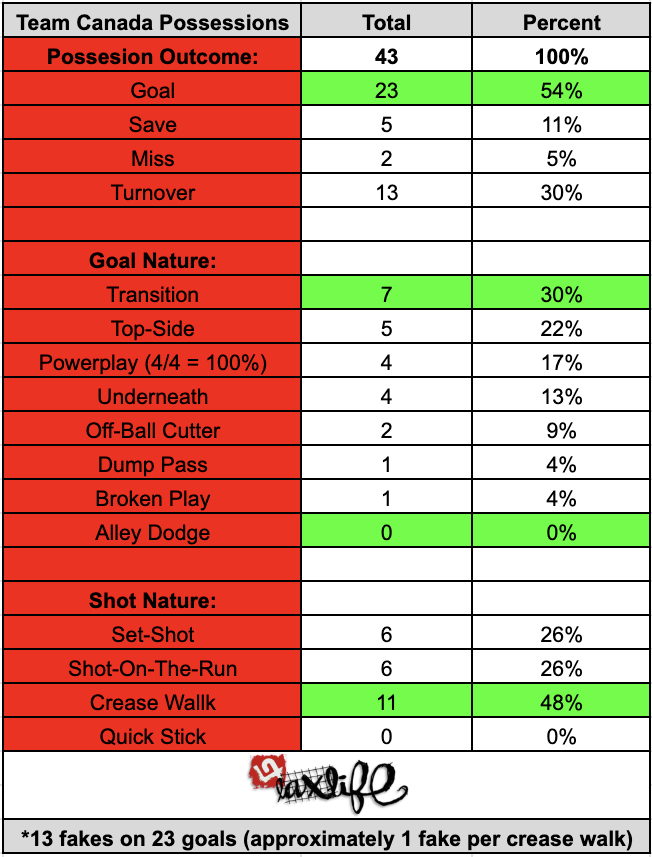
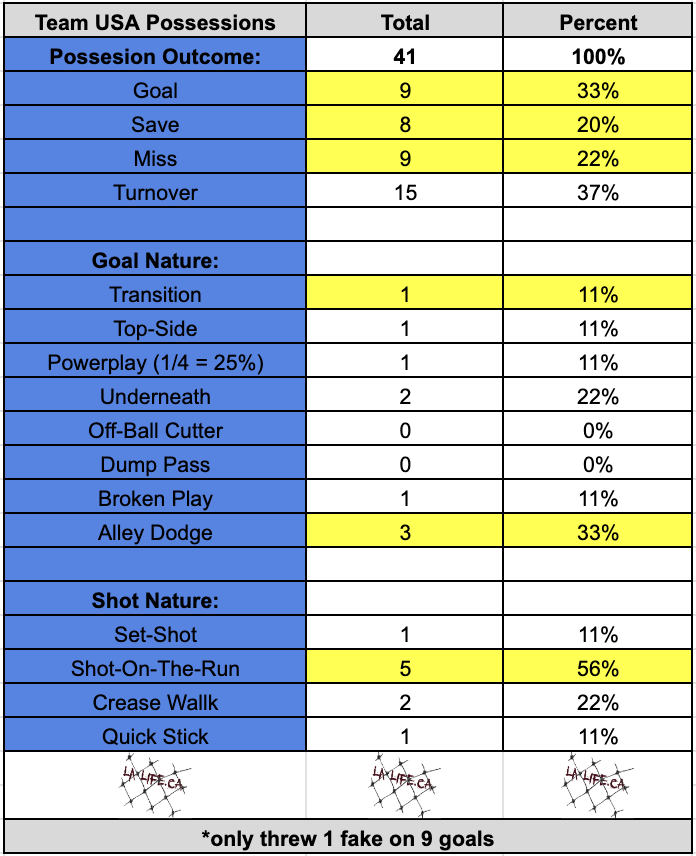
The final key to the Canadian success was their ability to get to the middle (see “crease walks”) and keep Team USA out of the middle, which is something I will give you more of a visual on within the sixes offensive blog.
Aside from how goals were scored I would also love to know how many goals certain players cost their team defensively, like the proverbial “transition player” who gets you one goal per game but costs you two. However, that would be beating a dead horse at this point. It would also be interesting to know who is covering the most ground out there in terms of how far and how fast they are running, which is something we will look at in the upcoming “science of sixes” blog.
The bottom line is, whatever you are doing out there you are best to err on the side of defense and always be thinking defense first! Also, be able to push the reset button quickly, as there’s less time to reset mentally in 6’s and the “next play” is already happening before it even begins.
To view the full Vlog related to this article please visit our youtube channel: https://www.youtube.com/watch?v=IwWh5iYnJsc&t=43s
Sixes Lacrosse: Box On A Field
As of September 24, elite lacrosse is officially over for the summer season with the conclusion of the Premier Lacrosse League playoffs and Archers LC being crowned 2023 field lacrosse champions, as well as the Burlington Blaze winning the Minto Cup and the Six Nations Chiefs winning the Mann Cup up in Canada. This got us thinking about what’s next to look forward to before the start of the upcoming NLL season in December? With all of the talk about the possible Olympic inclusion of lacrosse in 2028, the next most interesting event is the Women’s Super Sixes event being held in Oshawa, Ontario, October 6-8. In light of this event and also to celebrate last summer’s World Sixes event in Alabama, we will be doing a Six for Sixes, 6-part sixes blog/vlog series over the next 6 weeks, breaking down all things Sixes lacrosse (The Game, The Defense/Transition, The Offense/Special Teams, The Science, The Rules & The Future).
Having studied all of the material available on the Sixes game, there have been many comparisons and assertations made as to the nature of this new hybrid form of lacrosse: the intensity and physicality of hockey, the athleticism of the skill positions in football, the positioning and quick re-starts of basketball; yet there’s one unique defining feature - the skill and IQ of box lacrosse.
Literally, just remove the boards, add the 6x6 field lacrosse net, take the pads off the goalie, tone down the picks and viola, you have Sixes lacrosse. The next biggest difference is a 12 player team roster instead of the 20 players traditionally allowed per team in box lacrosse, which changes a player’s work:rest ratio from 1:2 to 1:1 (something that will be discussed at length in the “Science of Sixes” blog next week). However, the way to play defense (how we stop the other team), transition (changes of possession) and play offense (how we score) are virtually identical to box lacrosse. Two menial differences are the slightly greater allowance for cutting and shooting on the “wrong-side” and the other being the frequency and effectiveness of bounce shots. Missing the net on your shots for a turnover can also be of dire consequence, especially considering how big it is and how small the goalie is.
At the World Games in Alabama in the summer of 2022, these differences were enough to propel Team Japan (Male), powered by its raw athleticism and intelligent approach, to win a bronze medal. Team GB (Great Britain) was also able to finish 4th ahead of the perennial silver/bronze medaling Haudenosaunee Nationals (who lost 20-16 to Japan in the round robin). Even funkier, is that team Israel beat team Japan in overtime early in the round robin; also that team Germany then edged out Israel in the 7th place game at the end of the tournament.
Canada defeated the USA to win the gold medal for both male and female, with the Australian’s also notably winning bronze on the female side. It’s worth noting that the two big differences between female and male Sixes are that females still use the traditional Women’s stick and also that they don’t wear helmets in female game!
For the purpose of this Six for Sixes series of blogs I will be studying the male game, simply because I know it and its players more intimately.
Below is the official male tournament result summary, provided by the World Games at the link provided below (along with all of the tournament game sheets):
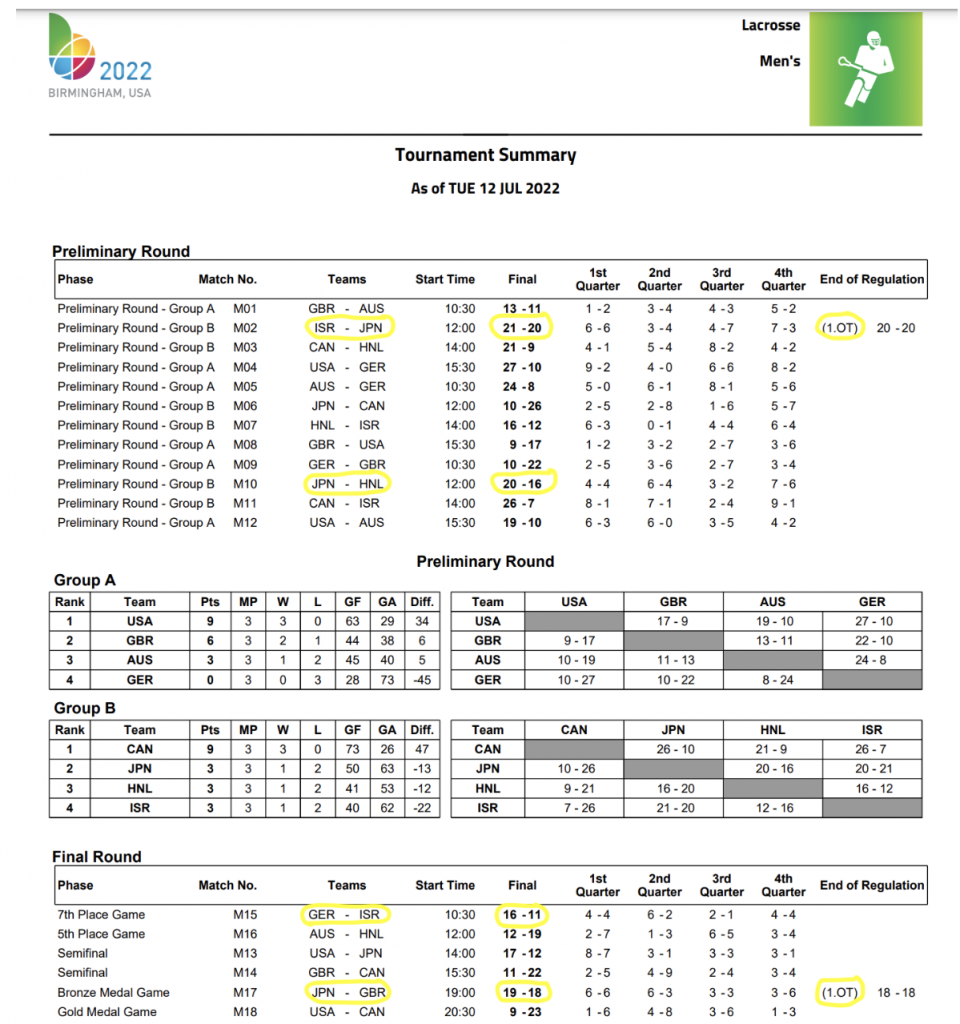
*Full tournament stats available at https://swog2022.sportresult.com/hide/en/Pdf/GetResultbookPdf?filename=Lacrosse.pdf
We also took the time to create a summary of the team stats available for the 3 traditional powerhouse teams of Canada, USA and Haudensaunee:
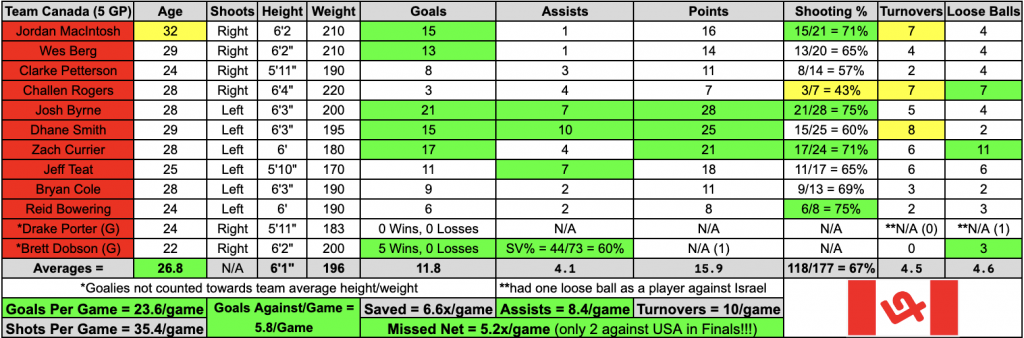
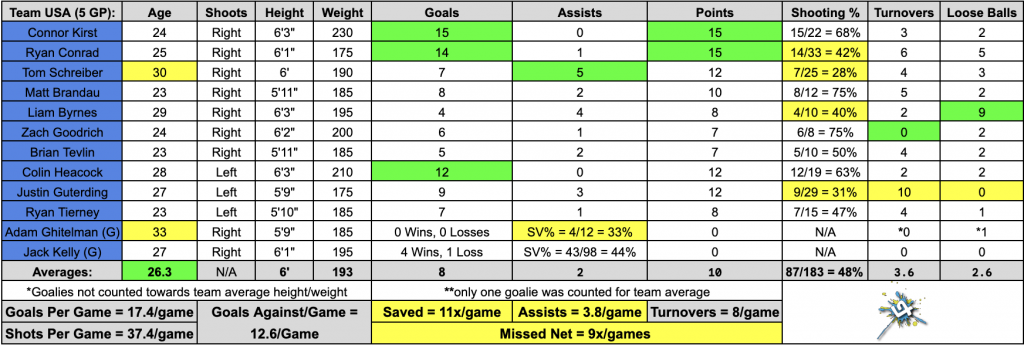
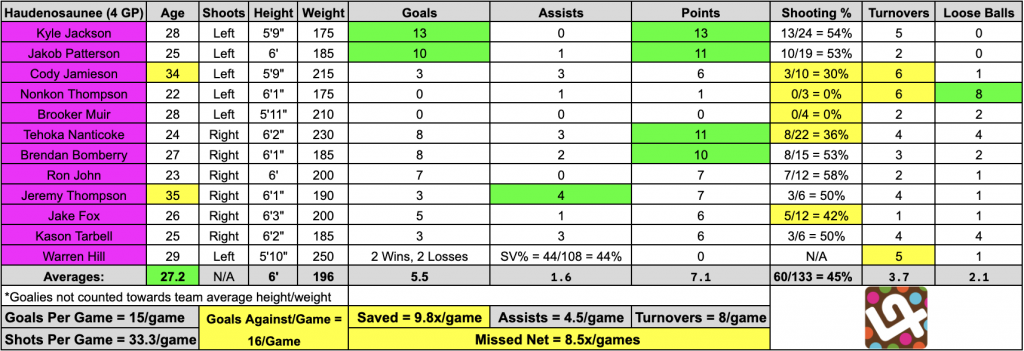
These stats are considerably inflated compared to the Super Sixes tournament the year prior (2021), in which only Canada, the USA and Haudenosaunee competed (these stat totals will be revealed in the “Science of Sixes” blog next week - where we will also discuss how Canada picked their team). They also don’t say much about who scored in the big games and more importantly, these stats say nothing about who got beat for goals or how defensively responsible players were; a subject I will touch on in the next blog on “Defense/Transition in Sixes.”
What are some of the key take-aways from these stats?
Looking to the defense, combined with save percentages of 60% (Canada), Haudenosaunee (44%) and USA (43%), you can see why Canada ran away with this tournament, especially when you consider that Canada was only giving up approximately 6 goals/game, versus USA at 13/game and Haudenosaunee 16/game. Are the Canadian numbers because of high quality defense or poor shot selection on behalf of the opponents? I would reckon it has a lot to do with both; to be discussed later this week.
Looking next at the turnover/goal ratio, legendary North Carolina Tar Heels basketball coach Dean Smith used to strive for a ratio of 3 turnovers for every 10 assists (30%), as of course you have to take some risks to create high percentage shots in sports. Relative to this figure, Canada sits at roughly 4.2 turnovers for every 10 goals (10:24), USA 4.7 turnovers (8:17) and Haudenosaunee 5.3 turnovers (8:15).
Next, when you factor in that Canada scored on 2 out of every 3 of its shots (67%), whereas USA (48%) and HNL (45%) scored on less than half of their shots (PLL Championship Series = 42%), it also says something about the quality of the shots Canada was getting, their precision shooting (highlighted by how little the miss the net) and patience in front (highlighted by the number of fakes they throw - all subjects I will broach in a blog on “Sixes Offense” coming out next week). It’s not surprising that the Canadians and also the Haudenosaunee are missing the net and being saved less often when you consider their box lacrosse background, where they are used to shooting on smaller nets and don’t get the ball handed back to them if they miss the net like in field lacrosse. Higher assist totals from these two nations also reinforces this point. I spoke with a team Canada Sixes coach in preparation for this series of articles and one of the things that he told me was that Canada averaged 4.5 passes per goal in this tournament, unfortunately I don’t have the totals from the other countries.
In doing my research, I also took the time to break down the final game of the tournament, which was the first time the Canadians and Americans had played each other since the last game of the Super Sixes event the previous year (2021) in Sparks, Maryland. The charts below break down some of the specifics of the offensive possessions from that game:
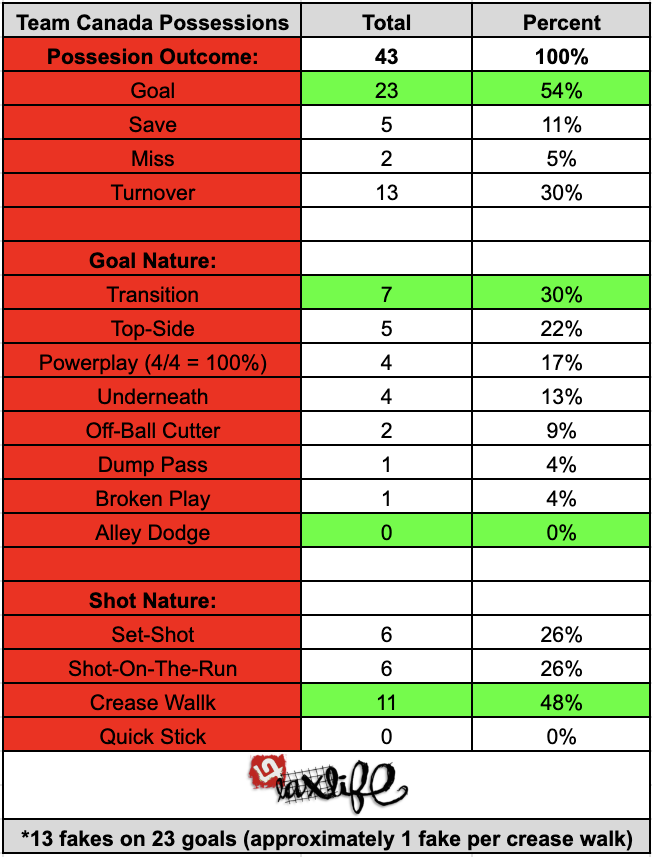
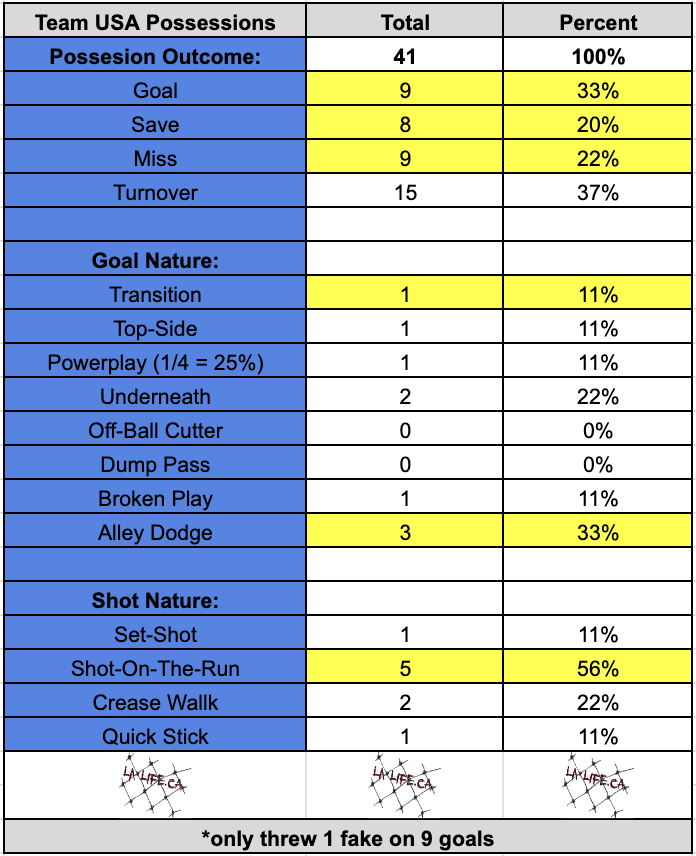
In this game, Canada scored on 54% of their possessions, with 30% of their 23 goals coming by way of transition (breakaways, fast-breaks & late transition). Why did Canada get so many transition opportunities and the USA so few? Well, for one, field lacrosse players are not used to these types of open field odd-player scenarios, which becomes problematic when you are slow to recognize these opportunities offensively and late to recognize them defensively. Zach Currier was team USA’s biggest nightmare in that respect.
The next glaring difference between Canada and the USA is how many of Canada’s shots came from directly in front of the net tip-toeing the crease on what we call a “crease walk” up here in Canada. This speaks to how effectively they were able to get to the middle of the field for high quality shots, using an “empty crease” offensive set-up, which I will break down in next week’s blog.
Conversely, the USA’s most utilized shot type (and goal type) was the proverbial “Alley Dodge” on what we call a player’s “wrong-side” of the field, up here in Canada. At first glance it looks promising that the USA scored 33% of their goals this way, but when you look further you realize that 4 Alley Dodge attempts were saved by Canadian Goaltender Brett Dobson, and 2 others missed the net for a turnover (3/9 = 33%). Considering that Canada is shooting 67% on all other shot types, that shot pales in comparison. I would note further, that when I played for the Orangeville Junior “A” Northmen in the middle 2000’s players would routinely get benched for a period or longer for taking this low percentage shot in box lacrosse, which is oft considered to be a selfish “me” shot. I can see the temptation on such a large net, but if you watch close enough, Canada was basically giving up that shot and Dobson was expecting it. How many times did Canada take that shot, zero.
I see guys breaking down the PLL championship series glorifying the Alley shot? Take away that 2 point line (which is too close and something I will argue in my “Rules” blog in a few weeks), keep shooting those Alley shots and all of the PLL teams in the Championship Series would have gotten completely obliterated by team Canada. The Alley shot is a comfort shot with little use in the Sixes game. The USA will need to start playing real box lacrosse, and soon, if they are ever going to be able to compete in Sixes.
Some will argue that the USA split 2 games with Canada at the Super Sixes in 2021 and possibly, that they didn’t have their best roster at the World Games in 2022. However, if you look closely, yes they won the first game 18-17, but in the second game Canada won convincingly 18-12. Both teams were cycling various combinations of National team hopefuls through their lineups in 2021, but when Canada puts their best transition players on the field combined with the best athletes and offensive players in the NLL; game over.
Watch the Haudenosaunee play Canada and you will see exactly what I’m talking about; pure box. It’s unfortunate that the Haudenosaunee didn’t get to play the Americans in Alabama as they were in opposite pools, but it would likely have been a closely contested game like they were in 2021. There is something to be said about the possibility of the USA beating them on the backs of their sheer athleticism, but the Haudenosaunee should be able to routinely outsmart them with their box (sixes) lacrosse skills and savvy.
To view the full Vlog related to this article please visit our youtube channel: https://www.youtube.com/watch?v=po_TNXJYWig
Box Lacrosse: Special Teams
“Special Teams” are a group of players designated to perform certain duties during certain situations in the game. Power-play and short-handed are two of the most notable “special teams” used during the game due to their frequency, but other special teams include: “Face-Off/Loose Ball Team,” “Last Minute Defense/Offense" units, and the Ball Back/Rag Teams.
Most special teams have two units, otherwise it usually depends on how tired one group is versus the other, or the situation, with the first unit being the most relied upon. If the 2nd unit is playing better than the 1st unit during a game, or over a stretch of games, it should be considered whether to make them “starters,” or to change the line-up entirely.
All positions on the different special team therefore have a starter and back-up. Sometimes players that are playing exceptionally well during the game might also be added to a unit late in a game, while players having a bad night might be removed. All players should know exactly where they are on the line-up sheet prior to a game or practice, and are held accountable if their unit is called and they aren’t on the floor. If players who are called to be on the floor are too tired to go out, they should let the coach (and backup) know as soon as possible, ideally before or after the unit is called.
A “powerplay” is a numerical advantage on the floor as a result of a player on either team taking a penalty. A power-play is the result of 2-minute minor and/or 5-minute major penalties, taken by one team or the other. During a “5-on-4,” teams will usually set-up in a 2-2-1 formation (standard offensive positions), but a 2-1-2 ("dice") formation is also used, and sometimes a player behind the net (1-2-2). There is generally less interchange between positions during a power-play, with players instead having assigned roles in set-positions.
When a 4-on-3 situation arises, offensive players generally set-up in a square formation (offensive version of the "box"), occupying the two shooter and crease positions. A 5-on-3 power-play traditionally still sets up in a "box" offensive formation (4-on-3), with the 5th player standing near centre-floor acting as a "rover" on any loose balls, or opportunities the defense may have to breakout. Double-teaming the ball after losing it ensures the deadly 4-on-3 time gets maximized. A 5-on-4 power-play should strive to score 50%; whereas a 4-on-3 power-play is expected to score 75% of the time; both percentages can be skewed by actual power-play lengths (see coincidental penalties).
Powerplay Execution: Click Here For Video
Usually before any set-play or shot is initiated, a team’s most skilled players will begin by first passing the ball once “around the horn,” unless trying to catch the other team off guard ("quick hitter"). Early diagonal passes are usually avoided, as well as early shots with relatively little or no ball motion and/or "ball movement," which are essential in creating quality shots. When less than 10 seconds are left in a penalty, no shots are usually taken until just before the penalized player returns to the play; for fear of a turnover resulting in a breakaway (unless this player is an egg & spooner or the team is down a few goals late in the game).

Aside from these general team rules, teams will either freelance or execute a set-play within each power-play possession (re-set), with the goal of getting an open shot in the prime scoring area. Freelancing doesn’t mean to stand and shoot whenever a player feels like it. Ball movement should be quick and players should still be moving, cutting when the ball is low at the crease position, dragging, and always filling. As a general rule, the opposite-side (off-ball) shooter should cut the middle every time the ball-side crease player gets the ball (with all players "filling" accordingly); the strong-side shooter should seal their check whenever the point player starts dragging towards them (both are considered automatic triggers).
Most set-plays on the power-play involve some sort of overload, via a pick/seal or multiple picks/seals, combined with some sort of ball/player movement; all at specific times (established during practice).
Below are a few basic set-plays that can be used at any level of lacrosse, within a standard 2-2-1 Formation:
Set Play #1: “Drag & Seal” - Click Here For Video

Set Play #2: “Pick The Shooter” (Roll Option) - Click Here For Video

Following a shot, players need to be ready to react immediately (this should always be re-enforced during practice - offensive players must also be taught how to double-team properly). Defensive coverage against reverse transition is the first responsibility, but more often than not there is an opportunity to Ride and double-team. Teams should do their best to apply pressure once general coverage has been established, in order to create a 10 second call or a turnover. If they are tired or unsuccessful, the back-up (Power Play #2) unit usually then gets the next opportunity on offense.
“Dice” Formation:
When playing the "dice" formation (2-1-2), set-plays and freelance may also be used; usually with a team's best picker/finisher in the middle. The added advantage of this formation is in causing miscommunication amongst defenders as to who is responsible to cover the middle player, and in what situations (requires high lacrosse IQ on the defenders' behalf). During freelance, the middle player can pick anywhere and also try to find soft spots for quick catch and shoot scenarios; primarily staying on their proper floor side. All other players should utilize the picks being set for them (otherwise presenting a decoy), while being careful not to force passes into the middle player (60-40 passes only).
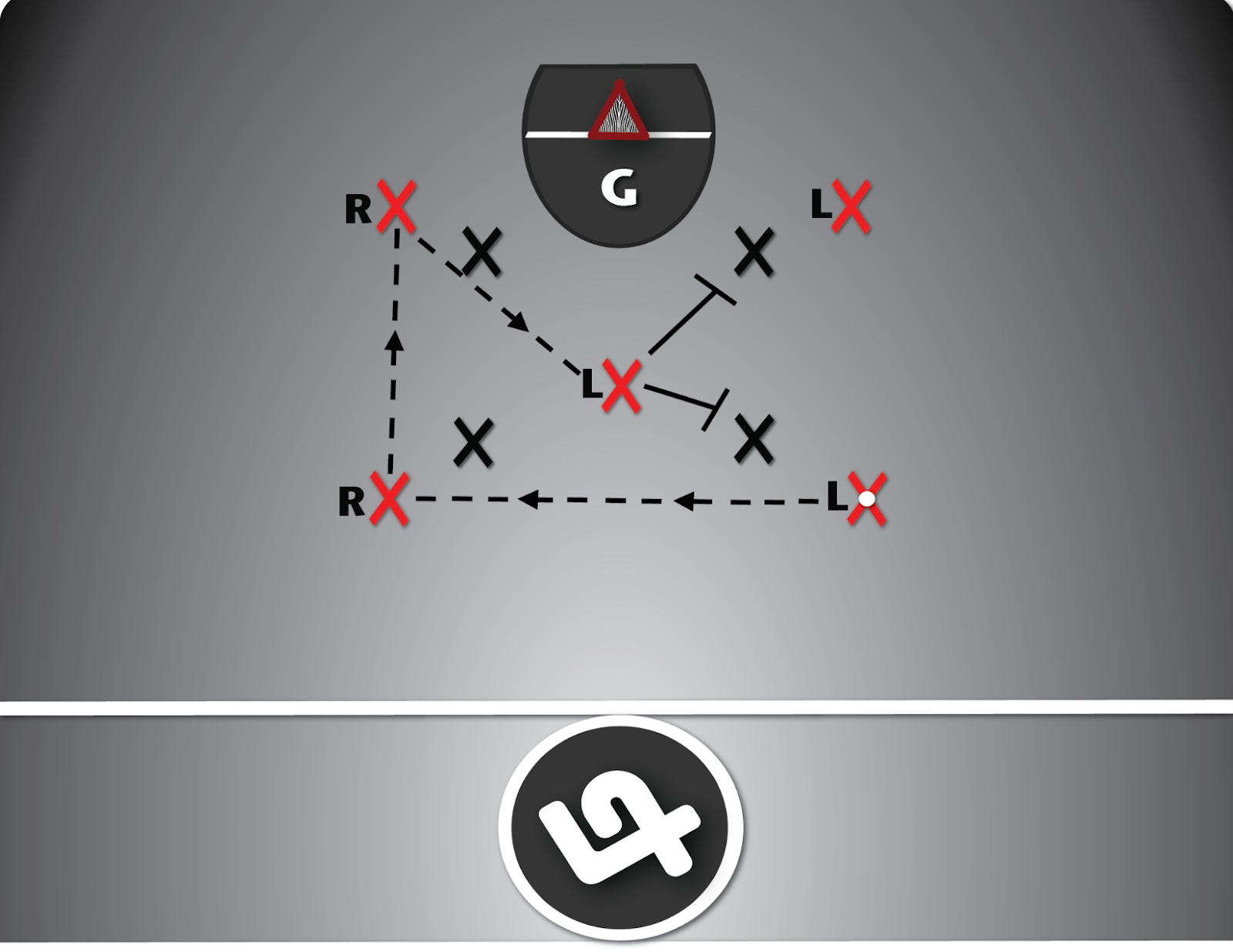
Short-Handed: - Click Here For Video
Being “short-handed” or on the “penalty kill” is a numerical disadvantage created by one or more players taking a penalty. Teams will usually set-up in a "box" or "diamond" zone defense while short-handed with 4 defenders, or a "triangle" with 3 defenders; with different "rotations" available for each, if desired.

The box is structured to defend both crease offenders and both shooters, with the two high defenders' also splitting the point player (or the player in the middle if the powerplay is in a 2-1-2). Should the point player attempt to shoot, both defenders should “pinch” tight together, trying to block the shot.

When one of the shooters cuts through the middle, it is also the off-ball “high” defenders’ responsibility to follow the "cutter," eventually “passing them off” to the on-ball low defender. The “low” defenders’ major responsibility is to lock-off the creases, with all defenders keeping their sticks and bodies in the shooting and passing lanes.
Generally, the “high” defenders’ sticks are towards the middle, and the low defenders’ sticks are towards the boards, in order to best defend these lanes. Although, if either "shooter" on the power-play is a significant playmaker, it may warrant the high defenders' stick being on the outside (board-side).
The diamond is structured to directly cover the point and both shooter positions, with one defender splitting both crease players down low, playing “cat & mouse.”

This defense is designed to invite shots from the crease players and take away the shots of the offenders up high. Defenders must be careful not to get over-extended, leaving too much space in the middle.
The goalie usually plays back closer to the goal-line (“deep” in the net) to eliminate the angles for quick stick opportunities at the crease. The two defenders at the side of the diamond should also have their sticks toward the middle, in order to better defend the passing lanes to the crease players.
The triangle is used to kill a 4-on-3 powerplay. It can be played with two defenders high and one defender low (2 up, 1 back), vice-versa, or a mixture of both (Inverted Triangle). Playing two defenders up high invites the crease players to shoot and vice-versa (1 up, 2 back) invites the shooters to shoot.
In the latter case, the “low” defenders need to lock off the “crease players,” allowing the goalies to come out and challenge the shooters. With two defenders high, the low defender must be able to deter quick sticks from one crease player to the other (“crease-to-crease”), while also playing “cat & mouse” and communicating with the goalie.

Short-Handed Execution:
It is important that all players know the situation and which zone defense is to be played, prior to getting on the floor; also any “assignments,” if required. If the other team is consistently successful against a certain zone (i.e. box vs. diamond), it is also important that coaches are ready to make adjustments. Teams may further switch up the zone being played simply to disrupt the other team’s offensive flow.
Players should always have their sticks up with their bodies in the shooting lanes, also aware of what is happening off-ball (head on a swivel). Defensive players need to recognize picks/seals, drags, cutters, fillers and players behind the net; communicating amongst one another. As a general team rule, players should not move more than “three shuffle steps” at a time, depending on the zone being played and the ball movement of the opposing team. If one player slides out of desperation, every player should slide in that same direction ("go"), effectively changing which part of the zone they are defending.
The Goaltender is essentially the biggest difference maker while short-handed, as they are the cornerstone of any defense. Loose balls are amply important, with the goaltender playing the most significant role via rebound control. Defenders also have a huge responsibility in this aspect as well, being sure to box-out after all shots (especially the low defenders). Instead of battling for rebounds in front of the net, it is usually better to just take a minor interference call, rather than allow the opposing team to pick-up a loose ball and potentially score.
Defenders need to make split-second decisions as to whether or not to pursue loose balls, some of which could potentially leave them out of position if they don’t get there first (50-50 balls). If a teammate does happen to obtain possession of the ball, defenders should run the ball up the floor “in two’s,” with all others running hard to the bench for a line change (a full change would be ideal; thus sparing the energy of the premiere penalty killers).
Concluding Thoughts:
Games are very often won and lost on special teams. It is one of the 4 major aspects of lacrosse which all teams strive to win in terms of differentials, when compared to the opponent. The other 3 aspects are transition goal differential, 5-on-5 goals for and against, and lastly loose ball totals.
Staying out of the penalty box is the easiest way to win the special teams battle. It takes special attention every practice to make sure your triggers, timing and positioning are flawless within your special teams. If they are, your team will never be out of a lacrosse game.
In the end, back-ups are just as important as the starters, as you never know who will be injured, tired, in the penalty box, alongside a host of other variables and scenarios that your special teams may be faced with.
Beginner Lacrosse Drills: Goaltending
Introduction:
Goaltending is a crucial element to any lacrosse team and is by far and away the most unique position in lacrosse. Goaltenders are the last line of defence and depending on the outcome of the game, can be hailed as heroes or scapegoats. As such, It is important for a coach to understand, teach and reinforce the fundamentals of goaltending and incorporate them into drills in practice, at all times. Solid goaltending incorporates a certain mixture of fearlessness, sound technique and athleticism, to help prevent opposing teams from scoring. The goaltender does not necessarily have to be the fastest athlete, but what they lack in speed they must make up for in terms of body control and game awareness.
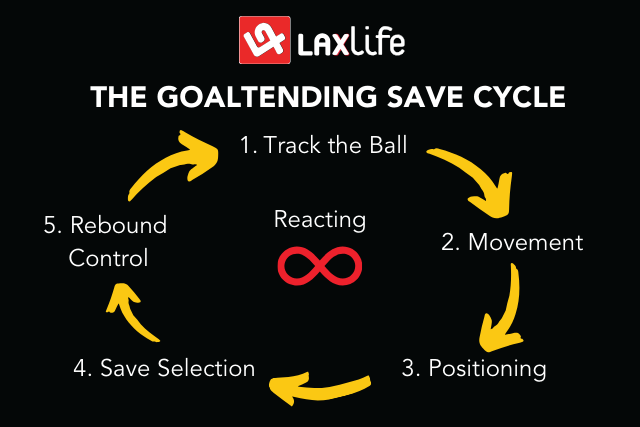
With this in mind we will introduce some key fundamental concepts related to developing a goaltender, while also reviewing the Goaltending Save Cycle – the process a goaltender goes through when protecting the net. This cycle includes tracking the ball, getting into position, maintaining a proper stance & good angles, selecting the appropriate save technique and controlling the rebound. In this blog we will give you 3 complimentary drills for each of the fundamentals, which we feel offer a quick and efficient means to improving your goaltending skills.
Tracking the Ball:

The number one priority of a goaltender is to always track the ball when it enters the defensive zone. As with “finishing a check” for a player, finishing the play if you’re a goalie means to track the ball until it is in your pads, otherwise “tracking rebounds” and always repositioning to the proper angle (all of which are the most important habits related to the position of a goaltender). As a player gets "in tight" with the ball, the goalie should be staring at the player’s stick, magnifying their focus and reading the body language of the shooter. The odd time teams will attempt to challenge a goalie’s mental focus in this regard when they perform a “hidden ball trick.”
Movement:

In order for goalies to be sure that they have the proper “angle” of the ball carrier covered they must know exactly where to stand, constantly repositioning, getting “ready” and “square” depending on where the ball is located. It can take upwards of 20 seconds for an opposing teams’ offense to generate a quality shot, and with only 30-40 shots per game on average this means goalies spend the majority of the time “repositioning” without actually making a save.
The Goalie Triangle
With offensive ball movement, goalies need to effectively move through their “goalie triangle” as the ball moves through the standard offensive positions, also adjusting to the corresponding release point of a potential threat. Occasionally, acrobatic saves are necessary to defend against quick ball movement, so goalies need to be able to recover quickly to the ready position, while still keeping their eye (tracking) on the ball and playing the angle. With rebounds and quick passing, goalies need to be able to reposition quickly and efficiently, in order to be successful.
Positioning:
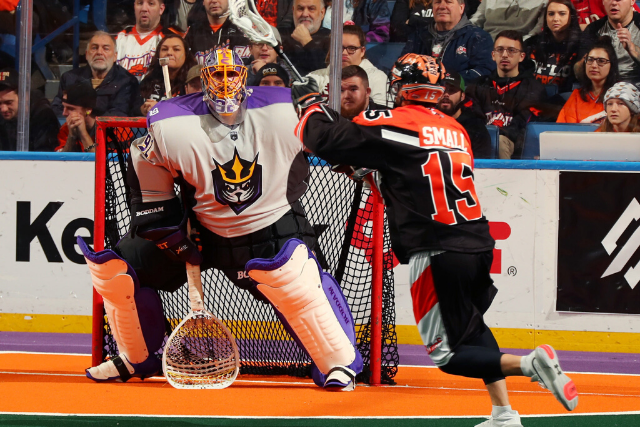
A goalie’s ready stance is very individualized to the goaltender and will evolve as a goalie develops with regards to stick position, off-hand location and other intricacies of the position. In general, a goalie should be standing in the “athletic position” with feet hip width apart (on the balls of their feet, with feet pointed slightly outward), the goalie’s upper body should be upright with a slight forward bend and lower body should have knees slightly bent; the large majority of the time. Goalies should strive to stay on their feet (for maximum net coverage) while keeping their eyes on the ball and repositioning to square up (align) with potential threats, as best as possible.
The goalie should hold their stick in their dominant hand, holding the shaft firm, halfway down the goalie’s thigh, tight to their body and they should be leaning on the stick slightly (positioned 3 to 6 inches in front of one’s feet); "dragging the stick" whenever moving. The “shaft” of the stick should pass between one’s elbow and body, with the arm-pit becoming a lever in aiding with the movement of the stick; the rest of the shaft comes out behind the goalie’s shoulder. The glove hand should then be placed beside the hip with one’s elbow slightly bent creating an "arm triangle" that covers up the “six-hole,” otherwise used to reach to save low perimeter shots.
Save Selection:

It is important for goaltenders to work on and use proper save selection. Proper save selection is important for goaltenders to work on and understand. The location of the shot determines the appropriate save technique a goalie should use. Many times, goaltenders tend to rely on one save technique for all shots (i.e. going down in a butterfly position on low shots). Using incorrect save selection will limit net coverage, rebound control and second-chance save ability. Using an inappropriate save technique based on the shot situation will limit net coverage and affect rebound control, as well as the goalie’s ability to make second-chance saves. Lastly, it’s important for goalies to exercise patience and track the ball with their eyes to increase their chances of making the correct save selection.
Fundamental Save Techniques:
Kick (Leg) Saves: When a goalie is standing big in the ready position and thinks a shooter is going to shoot to the low corners of the net, he/she can kick their foot out as a basic manoeuvre, making sure to also keep their stick “between their legs” (low to the ground). While making this manoeuvre the goalie’s foot should not be raised off of the ground and it should be kicked out and towards the ball. The other option on a low shot would be to drop into a butterfly/half-butterfly, although a stand-up style is generally preferred.
Glove (Arm) Saves: The “glove hand” is the hand of the goalie that is not holding the goalie stick, used to orient goalies in the net (see feeling for posts) and to help stop the ball from going in the net. The back of the goalie’s hand should always face the ball; goalies should never attempt to catch the ball with their bare hand, which could result in significant injury. Glove hand location is a personal preference, depending on the situation, something that beginner goalies will become more aware of as they develop. Goalies must learn to be active with this hand, keeping it loose and “ready” to react in anticipation of perimeter shots towards the “low corner” on the “glove-side.” The other option is to position this arm against their waist, forming an “arm triangle” (upper arm -> elbow -> lower arm).
Stick Saves/Stick Swipe: The stick hand is the hand that holds the goalie stick. Goalies must learn to be active with this hand, keeping it loose and “ready” to react in anticipation to shots coming from both inside and out, left and right. The majority of “stick saves,” however, come from goalie’s not moving their stick at all, keeping it low to the ground and in between one’s legs (five-hole) at all times (habits). Whether stepping (moving laterally) to the “stick-side” or “glove-side,” depending on the direction of the shot, the stick/leg/body should move together (as a unit). Another stick manoeuvre when the goalie feels a rebound bouncing at their feet is the behind-the-back sweep, or "swipe," whereby the goalie takes a step forward and swipes their stick behind their back with one hand, sweeping any stray balls away from the goal-line.
Shoulder Blocks (Left & Right)/Fake Shoulder Blocks: When a goalie thinks that they have the angle covered, perhaps tipped off by their teammates defensive positioning (i.e. defensive player forces the player to their wrong side), they can use a variety of explosive lateral (east-west) movements, such as “shoulder blocks,” to ensure that there is no net for the opponent to shoot at. Done quickly and decisively when players “telegraph” their shots, goalies should step laterally, keeping their stick between their legs and in one smooth motion exploding their lead shoulder out to the side (relaxed shoulders -> scapular set), covering the “top corners” of the net (see goalie “ready” position). Goalies can also entice players to shoot far-side or short side by “faking a shoulder block” to one side of the net and then exploding in the opposite direction at the last second, depending on the reaction of the shooter (give & take). Whatever way they might be "leaning" toward, goalies should be sure to move their entire body and commit to their final movement. Be wary of beginner goalies being tempted to jump on high shots, which should be discouraged by the coach.
Butterfly/Half Butterfly: A “butterfly” save is when a goalie drops to both knees in anticipation of a shot to the lower half of the net (often on underhand shots), keeping their “shoulders-set” (upright posture) and flaring their legs out to the side. A “half-butterfly” is a large side “lunge” step, either towards the “short-side” or “far-side” of the net, where the goalie will slide onto their lead leg while keeping their shoulders up to cover the top of the net. Goalies should beware that the half-butterfly may open up the five-hole for a brief moment, so it should be used sparingly. Goalies need to be able to recover quickly if they commit to a half-butterfly, which can be risky if the offense is able to quick stick the ball from side-to-side.
Rebound Control:
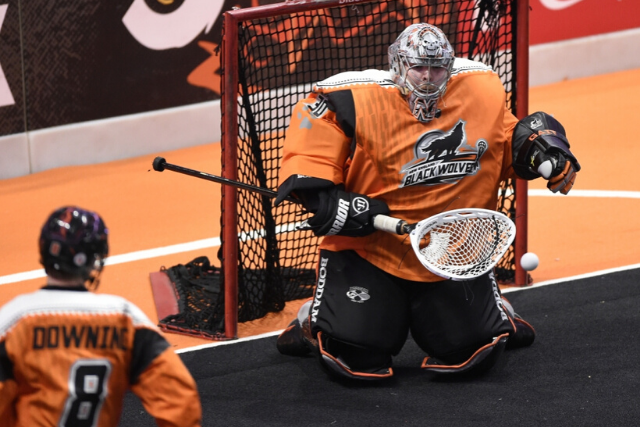
Rebounds and “rebound control” are a big part of a goalie’s job. Goalies should “battle” just as hard as anyone else around the crease and be aggressive (especially while short-handed) in order to obtain any sort of loose ball. Any loose balls around the crease should be scooped with 2 hands or picked up with the goalies’ hand. For loose balls outside of the crease, the goalie must be sure to have at least one foot in the crease while scooping, in order to avoid a "back in" call against.
Quality goaltender equipment and a goalie’s ability to cushion (corral) the ball after it hits their body or stick (similar to a player having “soft hands”), goes a long way in terms of rebound control. With a shot that hits the goalie’s stick, the goalie should twist the stick slightly in the opposite direction of where it hits the stick in order to avoid the stick “spinning," also in an attempt to corral the rebound. The action of “cupping” is the preferred method of controlling a high shot that is undoubtedly about to hit one’s “chest protector,” whereby a goalie drops their arms forward and absorbs the ball as it hits the chest protector, creating a sort of concave that effectively keeps the ball close by (instead of ricocheting into the corner or out of bounds).
When a rebound cannot be controlled, the next course of action is for the goalie to immediately "track the ball" and reposition. “Communication” with defenders is also a big part of this responsibility, and to the goaltender position as a whole.
Reacting To The Ball:
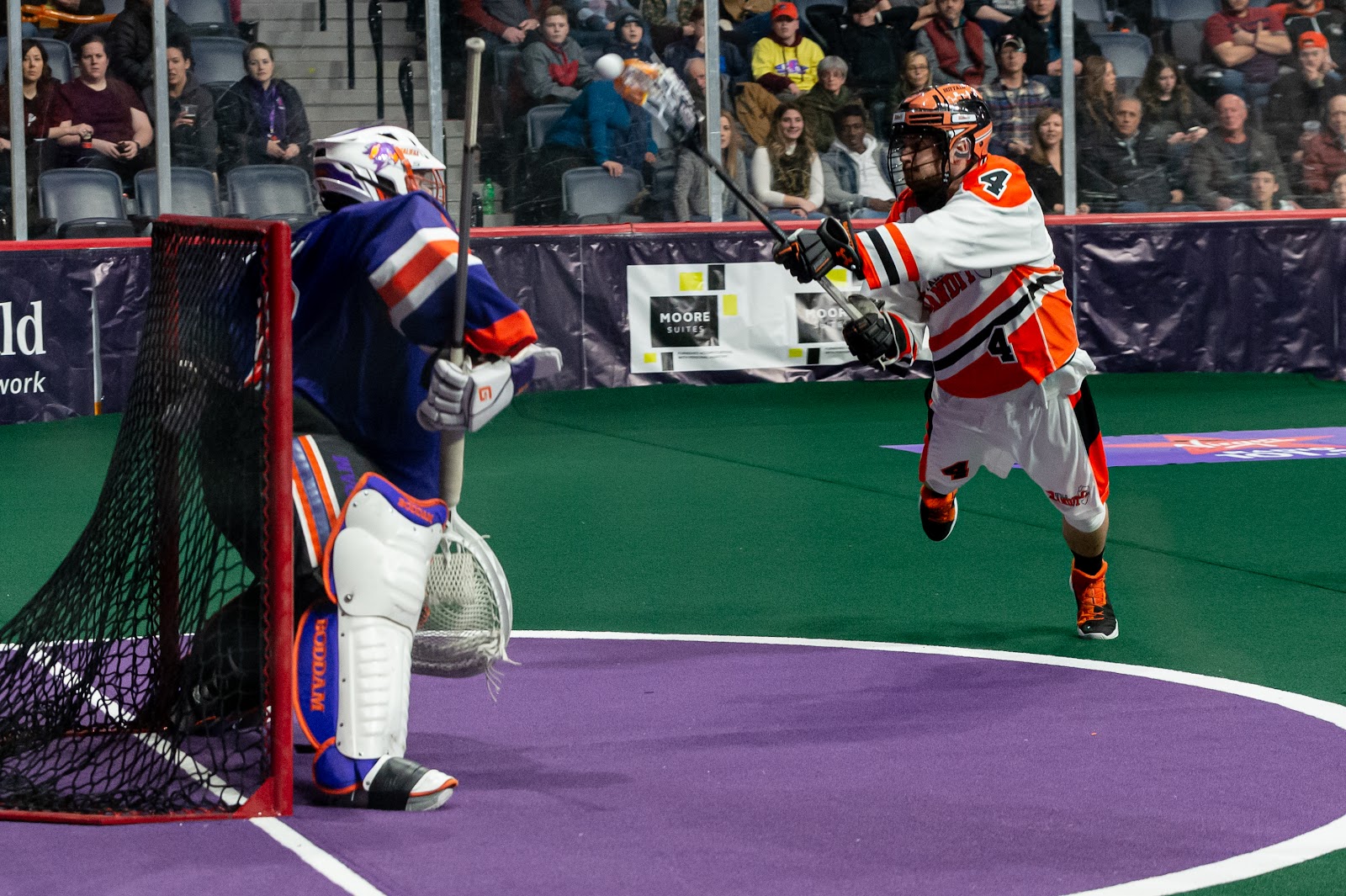
Lastly, it is important to mention that as the last line of defence, goalies should be “ready” to react at all times, especially when the ball enters the defensive zone. Shots from the opposing team can come from anyone at any time, thus a goaltender should always be prepared in a ready stance to react quickly to the action in front of them. In order to consider all of these different factors in a matter of seconds, a goalie’s mental focus must be one of their best qualities (“always alert”), alongside having a thorough understanding of how lacrosse is played and the personnel being defended against.
Drill #1: Warmup Shooting

Warm up shooting drills are a great way to help a goaltender develop their tracking skills, while also working on their positioning and save selection. These drills should be done during the beginning of practice, which allows the goalie to prepare mentally while also training their eyes to track the ball; especially for new goaltenders, getting comfortable with having a hard lacrosse ball thrown at them. The goalies focus should be on watching the ball as it leaves the players stick and training their eyes to follow the ball all the way up until it hits and see where the rebound goes after making a save.
Have the coach start off shooting to specific corners of the net indicating to the goaltender which corner they will be shooting at (5-10 shots per corner) prior to starting the drill and when switching between chosen corners. This takes the guessing out of where the shot will go and allows the goaltender to choose the appropriate save based off the location of the shot; tracking the shot out of the coaches stick.
As the goaltender becomes more comfortable the coach can then begin to shoot from different angles around the perimeter, switching to inside shots after shooting a few shots from each of the 5 different angles.
You can also increase the difficulty of the drill by instructing the goalie to trap and scoop any rebounds close by the front of the crease. This forces the goaltender to not only track the ball as a shot is coming towards them but also to follow the ball after making a save and either corralling the rebound or repositioning themselves for another shot. Missing the net on purpose every now and then, hitting the ball off the glass, or rolling the ball somewhere near the crease, are also effective teaching techniques. Have the goalie reach for loose balls outside of the crease (in front of and/or behind the net), being sure to keep at least one foot in the crease while trying to obtain the ball.
To further increase the difficulty, add a second shooter to the drill and pass the ball east-west prior to shooting on the goalie. In this variation coaches can switch up their release points to allow the goalie to track the ball leaving the players stick from different angles, while first having to reposition off of swing pass from the other coach.
Drill #2: Goalie Numbers Drill

Goalies can be faced with movement between several of these positions in a variety of sequences, during any given situation. Central ball position is the most threatening, with inside shots being relatively more threatening overall as compared to perimeter shots. A great way to work on footwork and movement around the crease is have the goaltender move through the 5 standard angles. Have between 1 and 5 players or coaches (often just 1-2 coaches) standing at one or more of the standard offensive positions.
If less than 5 players/coaches are in the drill, a coach or player may call out the number (see drill diagram) of the position where the player is missing, and the goalie must re-position ("square up") to that number as if there was an imaginary player there.
Instruct the goalie to move through the 5 standard angles, repositioning back to the goal line and feeling for their posts in between each angle. The coach calls out a variety of numbers and the goalie repositions to those numbers, or otherwise follows the ball (if multiple players/coaches), ultimately finishing with an adjacent shot (1-2 & 5-4) or finishing at the crease (2-1 & 4-5). Start off slowly and advance the drill to move as quickly as possible as the goaltender becomes more comfortable. Have the goalie move from left to right, right to left, or alternate from side to side.
Drill #3: Quick Reaction Rebounds

Begin with a line of left-handed and a line of right-handed players on their proper floor sides, at the shooter positions.
The goalie starts facing the coach (or player), who will be sending in the first pass to either the same-side or opposite side shooter (pre-determined), whose turn it is. The goalie must reposition to challenge the shooter, who takes an outside shot.
After the shot, the shooter continues toward the net as if attacking the rebound on the same-side. This player then receives a pass (or loose ball) from the other coach (or player), who is standing at the crease position or behind the net, feeding them on the door-step. Players can also become passers after they shoot, before rejoining their original line (depending on the calibre of players).
This drill alternates from side-to-side in orientation, with the next player not taking their turn until the player in front of them is out of the drill.
You can also start with balls in one shooter line or the other (switching halfway through the drill). The players run toward the net and can make as many passes as they want, with one player eventually shooting.
Whoever doesn't shoot, the coach (or player) on the same-side or opposite to them (pre-determined) feeds them a pass for another shot on the door-step. Coaches should mix it up sometimes, and throw a second pass to the original shooter, in order to keep the goalies honest.
Concluding Thoughts:
Goaltending is a special and unique position that requires specific attention and focus by coaches to help hone and develop a goaltenders’ skills and abilities. Don’t just fire balls at a goaltender at practice and hope that their skills will improve over time. Instead set aside specific time to work with your goaltender(s) during practice and incorporate goaltending skill development into regular drills using the Goaltending Save Cycle as a guide to building the foundations of solid goaltending.
This blog was written in partnership with former New Brunswick Mavericks Head Coach & General Manager, Evan Richtsfeld. For further information and more goaltending related drills subscribe to laxlife.ca and take a look at the goaltending section of the website; otherwise keep an eye on this blog for more goaltending information in the future...
Beginner Lacrosse Drills: Motion Offense
Upon transitioning the ball from defense to offense teams will get into the phase of the game known as their set-offense, otherwise known as their offensive system. For beginners (8-16 year olds), this is a very simple set of goals/objectives on offense (different for each age group), usually taught within the framework of the “motion offense,” which is the most basic offensive system and ultimately the focus of this blog.
A team’s set-offense should not start until all 5 players are generally in their set positions, which for our purposes are the 5 standard offensive positions. This is a big problem at the grassroots level where often two players have not even entered the offensive zone and individual players are going one-on-one against 5 defenders, trying to set up “their shot.” The concept of “team offense” refers to working together as a group, in unison.

The first look in any offensive system is fundamentally the give-and-go. The ball gets passed to a certain area of the floor and then you move (“cut”), and if in that process you are “wide open,” the ball should in theory be passed back to you. Heck, if somebody is wide open at any point you should be giving them the ball, which is an offensive fundamental that has to do with players having their head up and seeing the floor whenever they are in the offensive zone.
The “motion offense” is a system that relies on getting the ball low (to the “crease position”) and then sending a series of cutters in a particular order (timing), with the ball carrier carrying the ball high and shooting, if no options present themselves.
The principles of the motion offense in box lacrosse & how to teach it most effectively has been a difficult task that has taken years to organize, amidst much of the scattered misinformation that surrounds it, never seeming to be fully or adequately explained.
Here is my best attempt…
Drill #1 - Motion Offense (Walk Through)
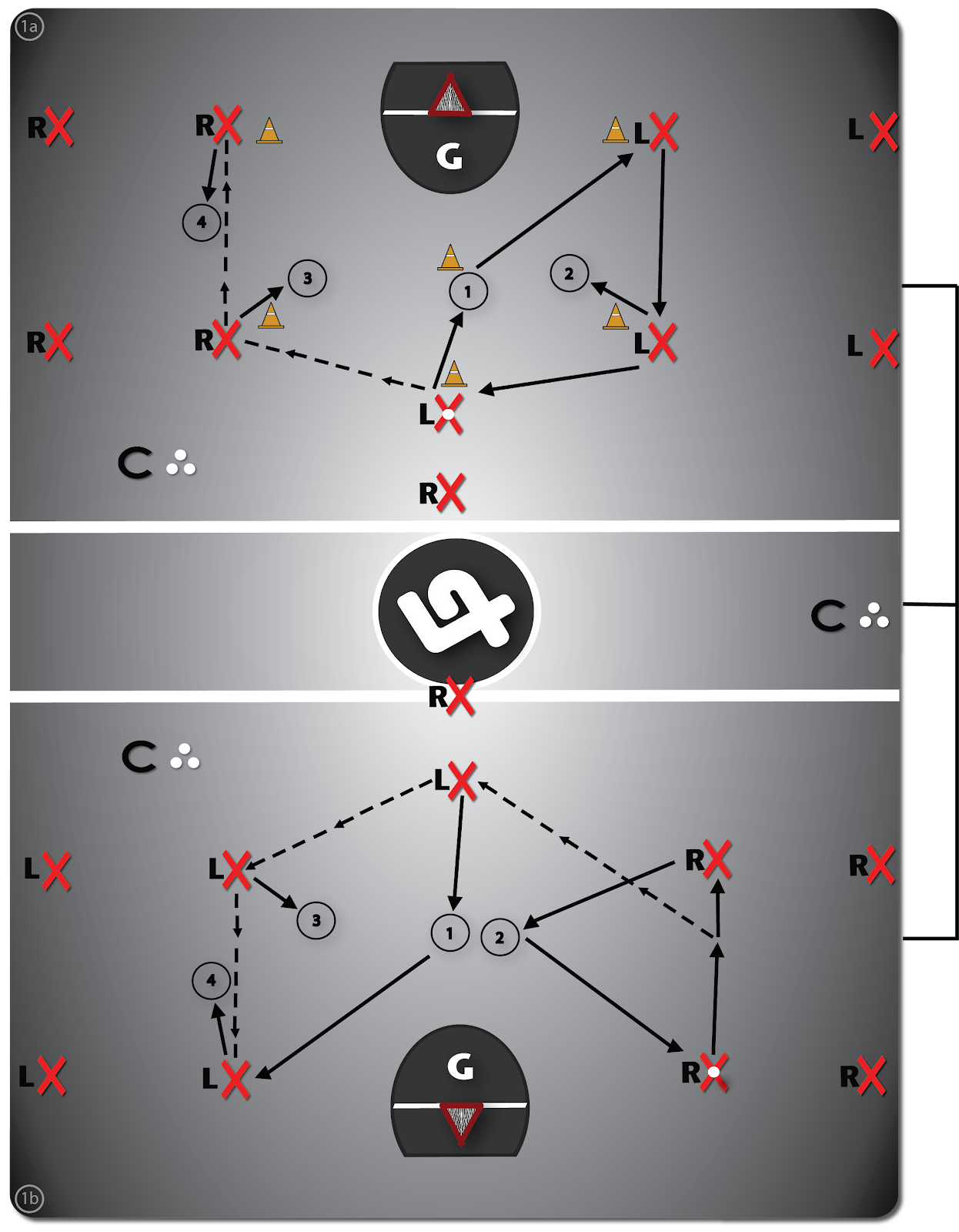
The most basic motion (Look #1) happens after the point player (strong-side) passes to either shooter and then cuts the middle, eventually filling into the strong-side crease position (perhaps running around the net first). If this player is wide open they could in theory receive a “give-and-go,” but that is rarely the case.
Next, the crease player should pop-out and the ball should then be passed low (deep), triggering Motion/Look #2 which is an off-ball "cut" from the far-side shooter position; this is the first read/look for the new ball carrier. After the off-ball shooter cuts they will either receive a pass, or if not fill into the crease position on the far-side, with the crease player filling up into the shooter position on that side of the floor.
If no pass is made, Motion/Look #3 is the next decision for the ball carrier to read, which is a cutter from the player at ball-side (same-side) shooter position, who looks for a give-and-go return pass; otherwise to seal the shooter position, or down-pick the crease position (these are the “age dependant” variables).
If none of those "looks" are open for the ball carrier they should fill/cycle up into the shooter position and take a shot (if it's there) or swing the ball to the far-side shooter/point (Motion/Look #4), repeating the process (if advanced); otherwise being free to go one-on-one. Throughout this process it is the ball carrier’s responsibility to have their head up, always being a threat.
Drill #2 - Point To Shooter (Give & Go)

I like to do my first walk through, and teach the principles of the motion offense, by “triggering” it with a pass from the point player to the weak-side shooter. A pass to the strong-side is a harder give-and-go return pass to catch (cross body), yet both are practiced in this first drill, with players encouraged to switch who they pass to each time through the line at point. Both of these passes (weak-side & strong-side) are also important in subsequent drills, and this is great practice for beginners in popping out to receive the pass, while also working on soft hands and disguising their passes.
Drill #3 - Off-Ball Cutter
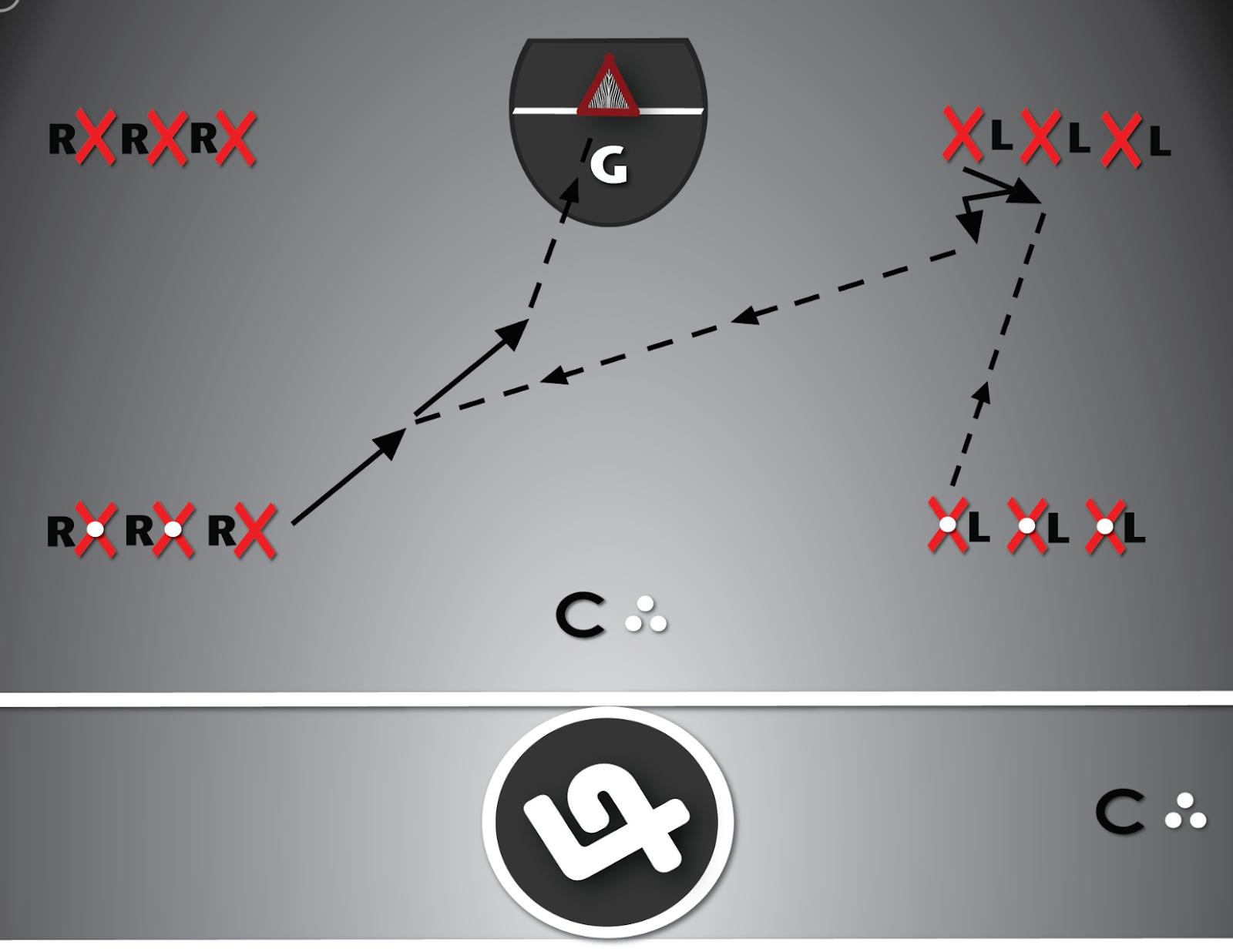
The first legitimate threat in the motion offense happens after the ball gets passed (or run) low, to the crease position; at which point the off-ball shooter needs to cut through the middle. It’s important to reiterate that the ball doesn’t necessarily have to be passed low in a game/practice, as once the defense catches on they may start locking off this pass. It is also important to note that the off-ball cutter usually takes some sort of physical beating while cutting, and a good defender won’t just let you do whatever you want. In this drill and the one to follow, the “next step” is to add a coach or volunteer defender that you must cut past, either overtop or underneath.
Drill #3 - On-Ball Cutter (Give & Go)
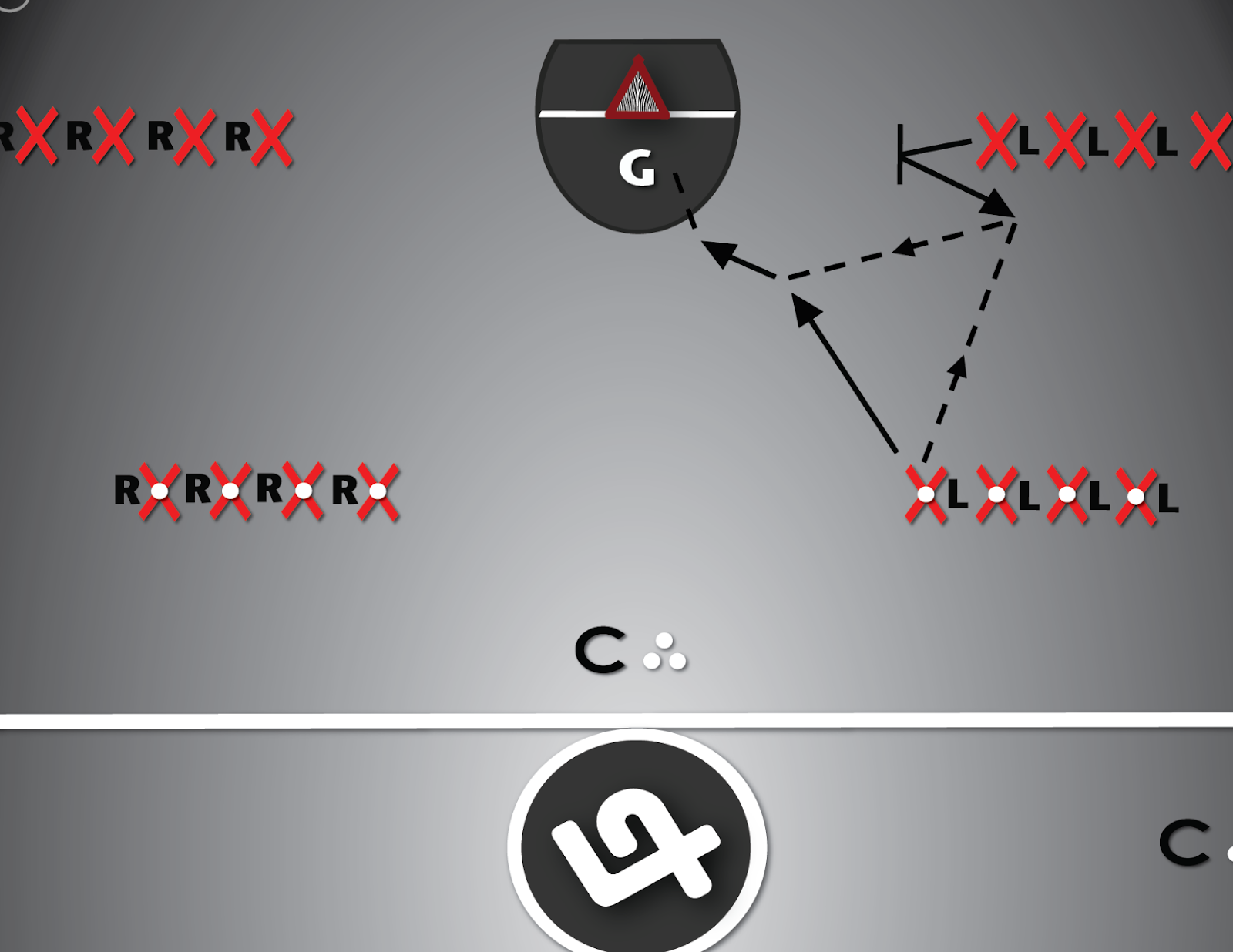
After the ball gets passed low, the on-ball cutter must learn to “delay” for a half second, which allows for the off-ball cutter to get through the middle, in theory. This speaks to the timing of the motion offense, the off-ball cutter needs to leave as soon as the ball is low, and the on-ball cutter should leave as soon as the off-ball cutter is beginning to exit the middle. The on-ball cutter then attempts to cut overtop, or underneath their check (imaginary or voluntary), and if they were open they should in theory receive the ball.
On-ball is where the magic happens! Again, it’s always going to be a fight to the middle when you are cutting. If I pass it low and then need to get around Graeme Hossack for a give-go-pass, which is the premise of the drill above, that’s likely not going to happen. That said, there are two other options “on-ball” within the motion offense: set a down pick at the crease position (most common), or set a screen at the shooter position (least common). For advanced players, they would read the situation and choose the best option. For first-timers, the extent of your set offense is usually a simple down pick on the weak-side, but not until that off-ball cutter is through, which takes a lot of practice...
Drill #4 - On-Ball Down-Pick (Crease)
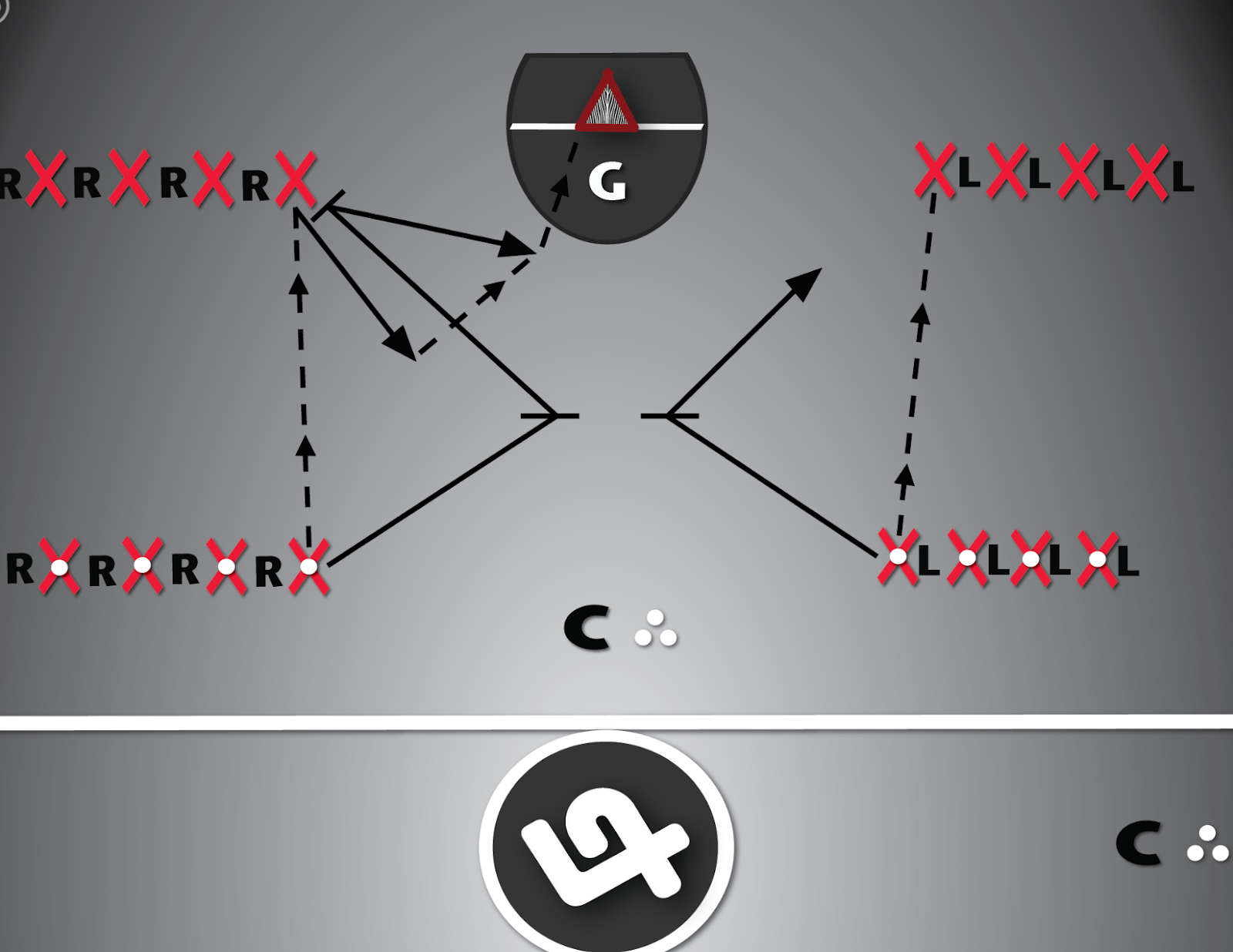
I’m not about to walk you through how to properly execute the pick & roll, which will be the focus of a future blog. I will tell you however, that I’ve done a lot of exploring on best practice for team offense in minor lacrosse.
Two summers ago I was at my former teammate’s wedding, he also happens to be my business partner’s brother, Nathan Sanderson. I got chatting with uncle Shane when I was there; Shane is one of the 4 infamous Sanderson brothers from Orangeville in the 70’s/80’s. He is also a long-standing coach in Orangeville minor lacrosse, including the head coach of their 12U rep team that has only lost one game in the last three seasons at the top level in Ontario. So I took the opportunity to ask him about how he went about running his offense? He got telling me a story about “The Peterborough Pick” and how they were always pushing the ball for fast breaks in transition, and that if no opportunity presented itself that they would run the ball deep to the far-side and immediately send a down-pick As that was happening the off-ball players would be cutting and cycling (perhaps coming from the bench on a line change). That was the whole offense! Down picks, with off ball cutters...Sound familiar?
Drill #5 - On-Ball Seal/Screen (Shooter)
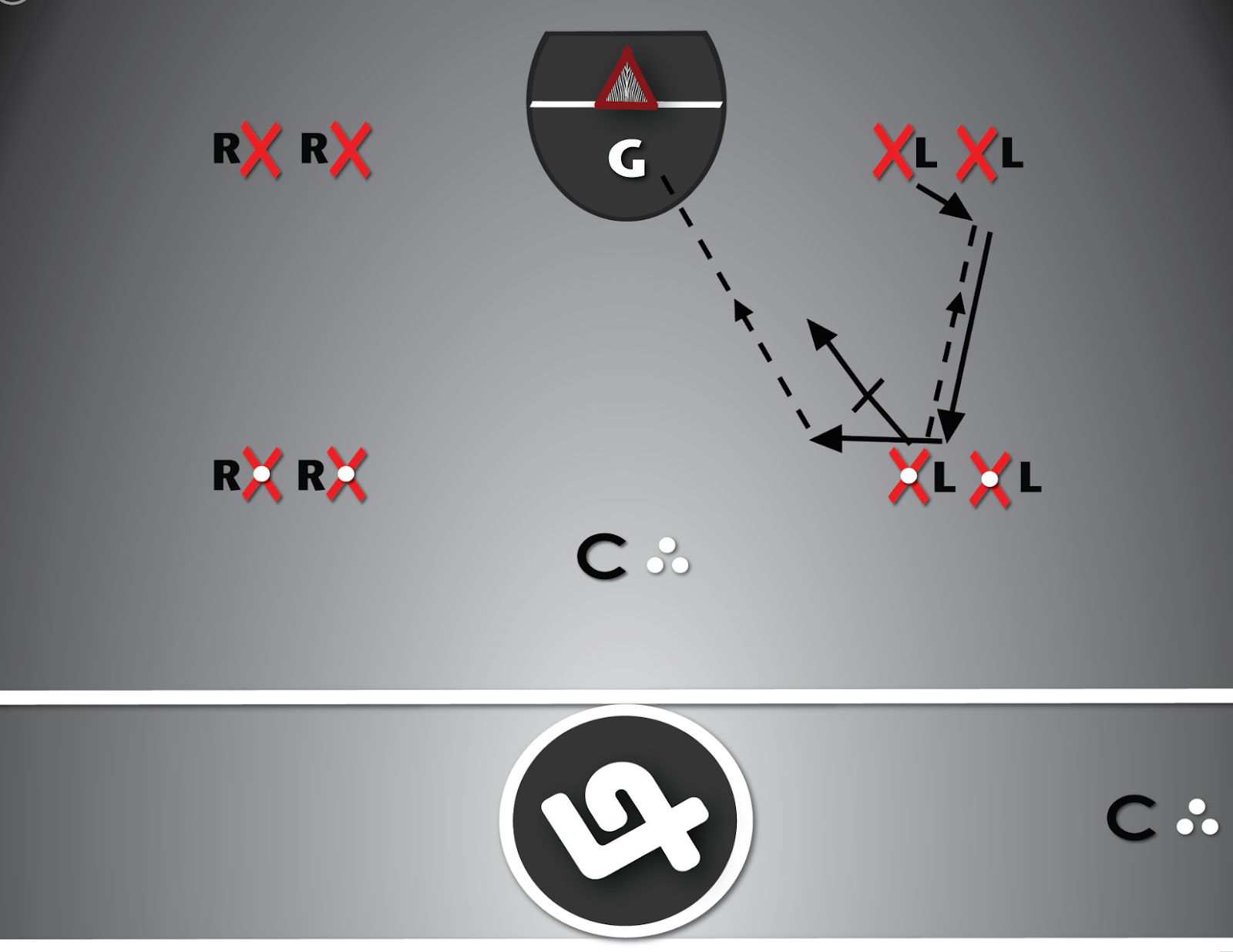
People can generally only remember 2-3 things in their working memory at at any given time, so “sealing at the shooter position” is something I wouldn’t normally discuss until players have demonstrated some sort of mastery with give & go’s and down-picks; otherwise if these actions are no longer working against regular opponents.
Again, I am not going to discuss proper sealing technique, only to say that as players get more familiar with the skills and concepts within the motion offense, eventually this on-ball cutter situation becomes a “read” by the ball carrier at the crease position, as opposed coaching players to seal the shooter every single time they pass it low on offense, which is the object of the drill above. Start with an imaginary defender and then advance to a volunteer defender, which give player a better “feel” for the situation.
Drill #6 - Six Nations Shuffle
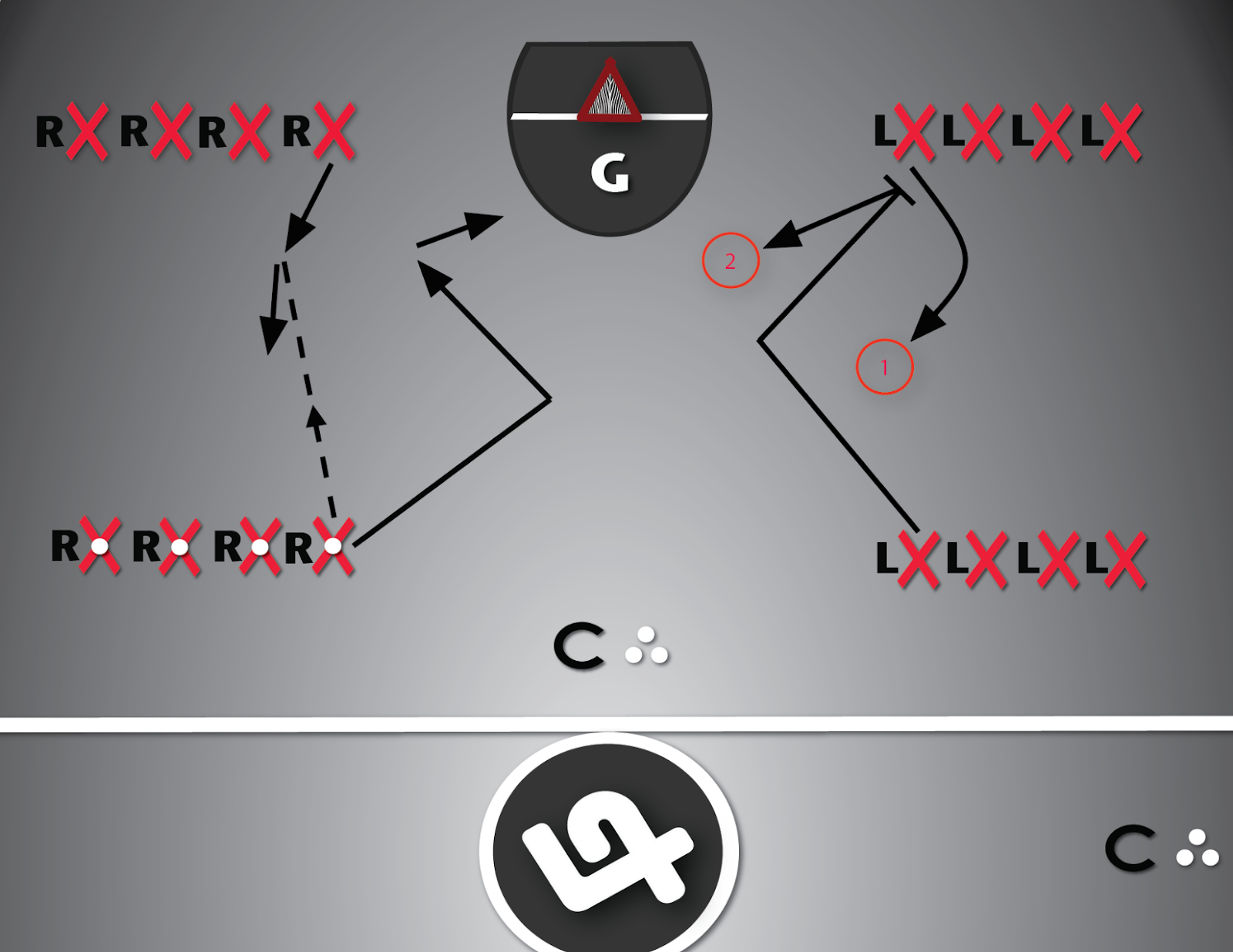
If none of the above options were open the ball carrier would carry high and shoot (which is another drill in our Shooting Series), otherwise swing it to the far side or perhaps pass to somebody who got open off of an off-ball pick after their cut (another advanced concept). At this point, players on both sides (on-ball/off-ball) would have done a full cycle/exchange of relative positions.
This “Six Nations Shuffle” is a great drill in that it allows you, as the coach, to ask for different patterns of the above mentioned drills; both on ball and off-ball working together in unison (getting a feel for the timing). There are so many variations you could do off of this drill set-up and it involves everyone in the offense (except the hypothetical point player who is the first to cut through the middle).
You could ask for the same pattern every time, or, if they are really good, you can change it up every time. Players both on ball and off-ball could either cycle (cut) through, seal or pick; the ball carrier has the option to pass to whoever they want, or to a specified person for beginners. Advanced players can get creative with how they finish after several passes.
Shout out to Scott Martin, a Mohawk man from Six Nations, who used this drill as a way to teach the concepts of team offense to one of our groups when he was out here in Nova Scotia helping coach, back in 2015.
Conclusion:
There’s no point in trying to teach this stuff if people can’t pass and catch, which is why all of the blogs in this series have been on the fundamentals of lacrosse up until now. This is really the first time players are asked to “think and play” while on offense, instead of just playing “jungle ball.”
The motion offense should be used as a framework to teach the basic skills and concepts of offense, which always apply regardless of which system is being played. With the motion offense in particular, the rules should be slowly relinquished throughout the course of the players development, with the end goal of being able to play within a Freelance Offense by the time you finish your minor lacrosse experience. It is a give & take relationship between the coach and the players, and sometimes if players continually go too far off-script, they will need to be held accountable.
Although to freelance literally means “to work for yourself, with no allegiance to anyone,” a successful freelance offensive system actually still has set team rules to provide structure and balance on the floor (developed based on team personnel + individual skill-sets).
Freelance is the style of offense that is used most often in Junior & Senior “box” lacrosse, promoting swinging the ball, plenty of motion, pick-and-roll game; and limited in its use of set-plays (except where trying to utilize the best attributes of the teams most skilled players). In other words “pass, pick, pop/roll, replace, cut, shoot” as Casey Powell describes it. Spread the defense by staying wide, while also adjusting your position to help create open passing lanes and seizing opportunities to be a threat; both on ball and off-ball. Avoid the temptation to creep towards the ball, and do not allow the off-ball defenders to sag and stand in help positions; keep them engaged with hard work and tenacity.
From there, offensive players should be watching the positioning of their offensive teammates in order to help with the timing of the “cycle” or set-play, being mindful of proper spacing. They should also be watching the positioning/personnel of the defensive players, exploiting weaknesses and watching for opportunities to get open for a high percentage shot on goal (i.e. following slides, back-cutting defenders, etc.). All players on the floor need to be involved/engaged in order for there to be any sort of continuity or "flow" to high level team offense. If you are not moving your feet you are not involved. Furthermore, an offense that doesn't get open in the middle, will not be successful in the long run.
For further interest in offensive systems which still apply the same rules and concepts of the motion offense, please also see the Dingo’s Mid-Board Cycle & Linds’ Drive Down Cycle.
Beginner Lacrosse Drills: Shooting
There are 2 styles of shot in lacrosse: shooting-on-the-run (which is the most frequent) & set-shooting (which is the focus of this article). Using a basketball analogy, for a set-shot think Steph Curry with his feet set, perfect balance, dropping a bomb from long range with perfect form. For a shot-on-the-run, picture Michael Jordan or Kobe Bryant slashing to the net and pulling up for an off-balance jump shot.
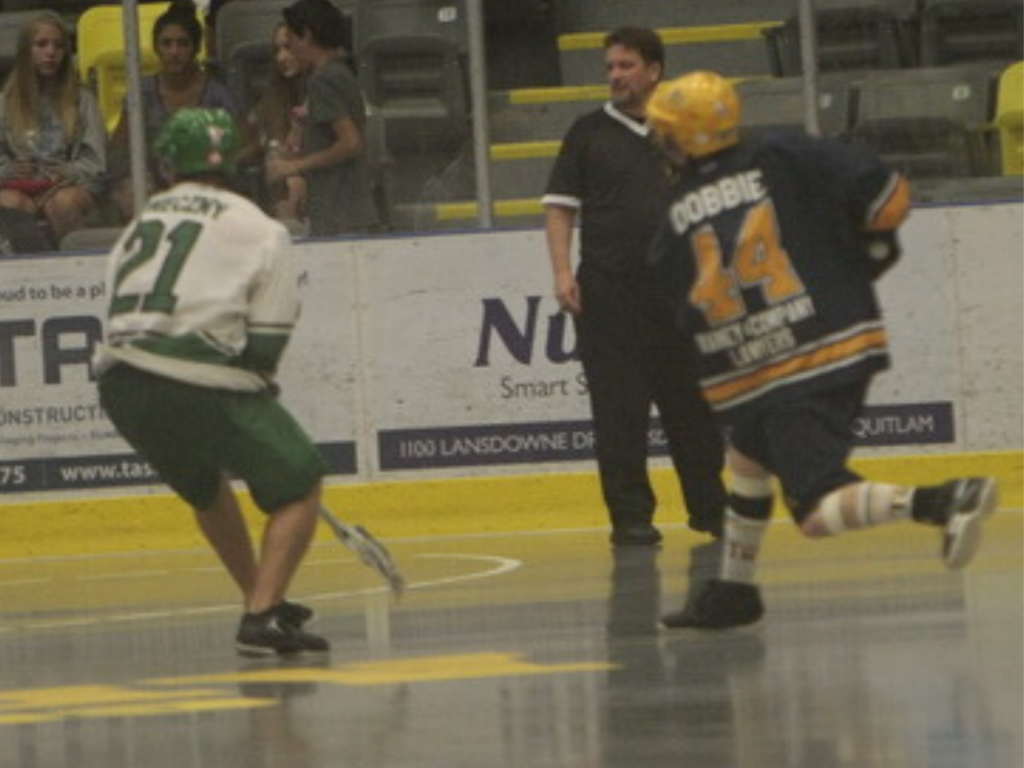
Set-Shooting sees the shooter start perpendicular to the net, taking a “crow hop” for extra power if “time & space is available
In lacrosse, when offenders get “time & space” in the prime scoring area, usually their first option is to take a “set-shot.” A good set-shot starts with a player standing perpendicular to the net, taking a baseball-like “crow-hop” if they have time, and then transferring their weight from their back foot forward onto their front foot; rotating their hips/shoulders (torso) and following through (shooting around the pipes). When set-shooting, remember the BEEF principles: Balanced (stance), Eyes (on target), Elbows (reaching back, tight to the body) and Follow Through (towards the target).
The following is a list of drill progressions we use at Laxlife.ca to teach set-shooting, all of which could also be used to teach shooting-on-the-run...
Drill #1: SEMI-CIRCLE (HORSESHOE) DRILL
SEE YOUTUBE VIDEO - Click Here
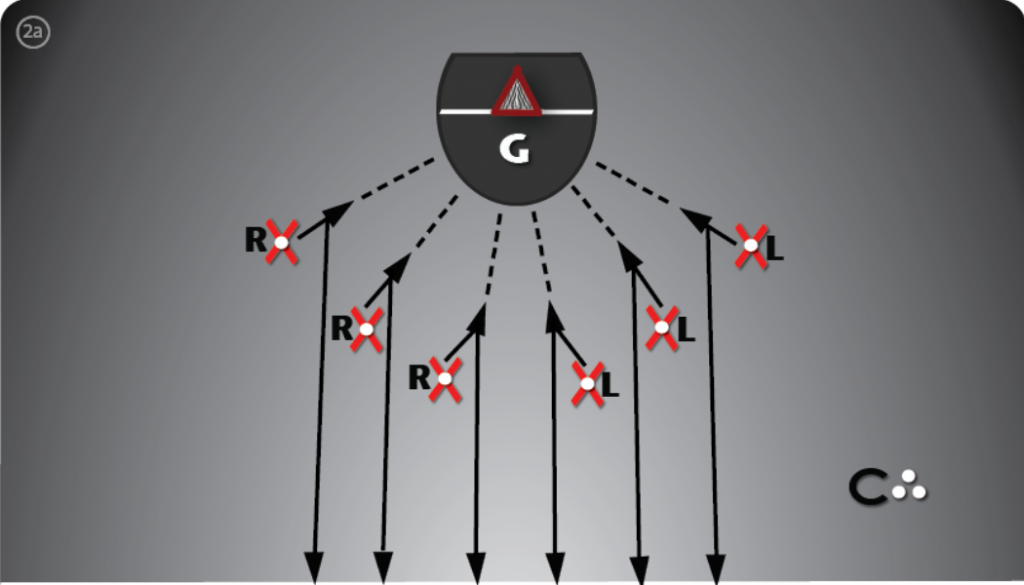
The horseshoe drill is a great starting point for teaching set-shooting to a large group. Although, if boards or a wall are available, doing a demo and then having players practice (warm-up) there for a couple of minutes before shooting on the net is usually best for beginners.
Using the net as a reference point helps teach players where they should be shooting from. In box lacrosse, players should always practice shots from inside of the "prime scoring area," on their "proper floor side."
The prime scoring area is defined as two imaginary diagonal lines going from each goal post outward on a 45° angle towards the side-boards. Just outside of the shooter position another imaginary semicircle (8-10 metres out from the top of the crease) connects to just outside of the other shooter position on the opposite side of the floor, forming an arc that ultimately connects to the diagonals (45°). Shots from this area are considered to be “high percentage,” as a higher percentage of goals are proven to go in from this area than anywhere else (consider duct taping this formation onto the floor during practice).
Prime Scoring Area
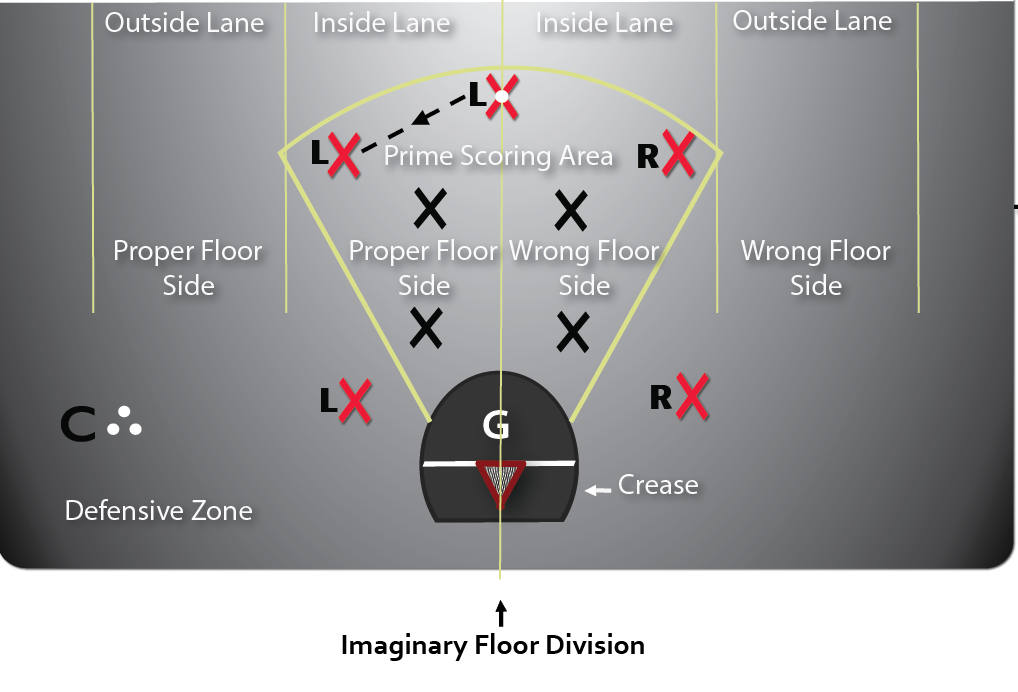
Players should also be sure to take shots from their proper floor side, defined as a lengthwise “imaginary division” of the floor, stretching from the middle of one net to the other; players’ sticks should be facing this imaginary midline for the large majority of the time while on the floor. Likewise, players’ bodies should rarely, if ever, cross this imaginary midline while shooting. Any shot on the “wrong floor-side” of this imaginary line is considered a bad shot, a win for the defense and a shot that the goalie should save.
If there's no goalie in the "horseshoe drill," coaches can ask that players shoot "all at once," which gives beginners a chance to get lots of repetitions. Some common errors we tend to see in beginning players are: not reaching their arms back and loading their weight onto their back foot in their preliminary movements, not releasing the ball properly (too far in front or behind their body), taking their eyes off of the target, not shooting overhand, and/or not following through to the target (stopping short; abrupt follow through).
If there is a goalie, players can take turns shooting, working their way from one side to the other (left to right or right to left), with one second in-between shots. Another more advanced variation is to incorporate side-to-side shooting, switching from a left-handed to a right-handed shooter on each shot, which forces the goalies to have to reset on each shot and ultimately opens up more holes for shooters to try and expose.
Once players have developed sound shot mechanics, coaches can ask that players “react back” after shooting, sprinting the length of the floor (collecting a loose ball along the way if possible), and then lining up in the same formation in the opposite end of the floor; or just sprinting to the rag-line (lining up again in the same end).
Drill #2: STEP & SHOOT
SEE YOUTUBE VIDEO - Click Here
As players begin to stabilize their shot, footwork patterns should then be added before the set-shot takes place. The first footwork pattern, and generally the most common is the "L-Shot." The player takes a hitch-step ("jab-step") toward the board-side, planting off of their outside leg and cutting toward the middle (2-3 steps max), "setting" their feet ("perpendicular" to the net) for an outside shot. For beginners, it helps to put pylons on the floor to give a visual representation of the pattern. See the top half of the diagram below…

If per se, the L-shot didn't open up a lane for a shot, the next option in a game would be to either pass to someone, or drag (back-pedal) back towards their proper floor side. In the "drag shot" variation (see the bottom half of the diagram above), the player takes a jab-step toward the top-side (opposite of the L-shot), planting off of their inside leg and pivoting into a back-pedal ("drag") toward the "board-side." At this point the player should re-establish their momentum towards the net (north-south) and take a shot while still in the prime scoring area.
Drill #3: CAROUSEL & SHOOT
SEE YOUTUBE VIDEO - Click Here
To simply pass the ball across the top of the defense is generally an ineffective strategy for creating a quality shot in a set-offense. Most offensive systems in box lacrosse see the ball get passed low first, and then carried high. During this process the ball carrier should "be a threat" to shoot. To replicate this, the next drill variation sees the first player on one side of the floor carry the ball from low to high, from the crease position up to the shooter position, and then step into a set-shot.
For beginners, pylons may be used as a visual landmark for players to curl around, progressing to having their "head up" looking at the middle while "carrying high" (as opposed to looking at the pylon they are running towards). This forces players to have to work on changing their body momentum from one direction to the other, in a north-south orientation. In a game, players would be reading the defense and taking whatever ground they could get towards the middle of the prime scoring area.

Drill #4: CATCH & SHOOT (STATIONARY)
SEE YOUTUBE VIDEO - Click Here
The next progression after learning how to shoot with the ball already in your stick is effectively catching and shooting the ball as seamlessly as possible. The ideal catch and shoot scenario sees the ball in the air with the player about to receive it already "crow-hopping" towards the net, receiving the ball with arms fully extended behind their body, catching and shooting seemingly all in one motion (not quite a quick stick).
For first timers, coaches can underhand flip the ball to the player (with their hands), encouraging the player attempting to catch and shoot the ball without cradling (or twirling) their stick. If players are competent enough, they can pass lefties to righties & vice versa (as seen in the two diagrams below), working on the same mechanics as described above.

Drill #5: CATCH & SHOOT (DYNAMIC)
SEE YOUTUBE VIDEO - Click Here
The most advanced variation of shooting is for players to catch a lead pass in stride (gradually building up their running speed), shifting their momentum downhill (north-south) and taking a set-shot as quickly as possible upon receiving the pass (ideally all in one motion if it’s a good pass). This is the most game-specific shot and the model for what players should try to be able to execute consistently. See the diagram below…

CONCLUDING THOUGHTS
The final piece of the puzzle is knowing when to, and when not to shoot; otherwise known as shot selection. Shot selection is a mental process of either taking a shot or passing a shot up (not taking a shot). Being ready to shoot and in the “triple threat position,” is half of the equation. The other half depends on game-specific context variables, most notably: whether there is an open “shooting lane” toward the net and whether or not the shooter has "time & space." Too often, beginning lacrosse players will take the first shot available and not necessarily the best available shot (shot clock dependent).
Players must use good judgment before taking low percentage shots outside, or on the cusp of, the prime scoring area. It is usually better to “curl” out and look for a teammate who is in a better position, rather than take a low-percentage shot.
Shot accuracy and knowing where to shoot on a goalie is the final x-factor, and is usually the responsibility of coaches and “scouts,” although input from players and goaltenders are equally as important.
Beginner Lacrosse Drills: Dodging (Ball Protection)
Once basic ball protection has been covered off in both static and dynamic fashion (as seen in our Basic Practice Plans), the next step is to “make moves” to get around defenders, learning how to change directions and change speeds while manipulating the lacrosse stick.

The way to protect the ball in lacrosse, as in most other sports, is to keep your body between the ball and the checker.
A dodge is a quick movement (or fake movement), usually toward the opponents net, with or without the ball, using quick foot and sometimes arm/hand/head movements. There are many different styles of dodges, described primarily by the action taken toward the net, usually beginning just beyond a sticks length away from a defender.
Whether it’s box (indoor) lacrosse or field (outdoor) lacrosse, the following dodges will allow players to get more quality scoring opportunities, which for most new players translates to "fun" while playing the game of lacrosse.
Skill # 1: THE JUKE
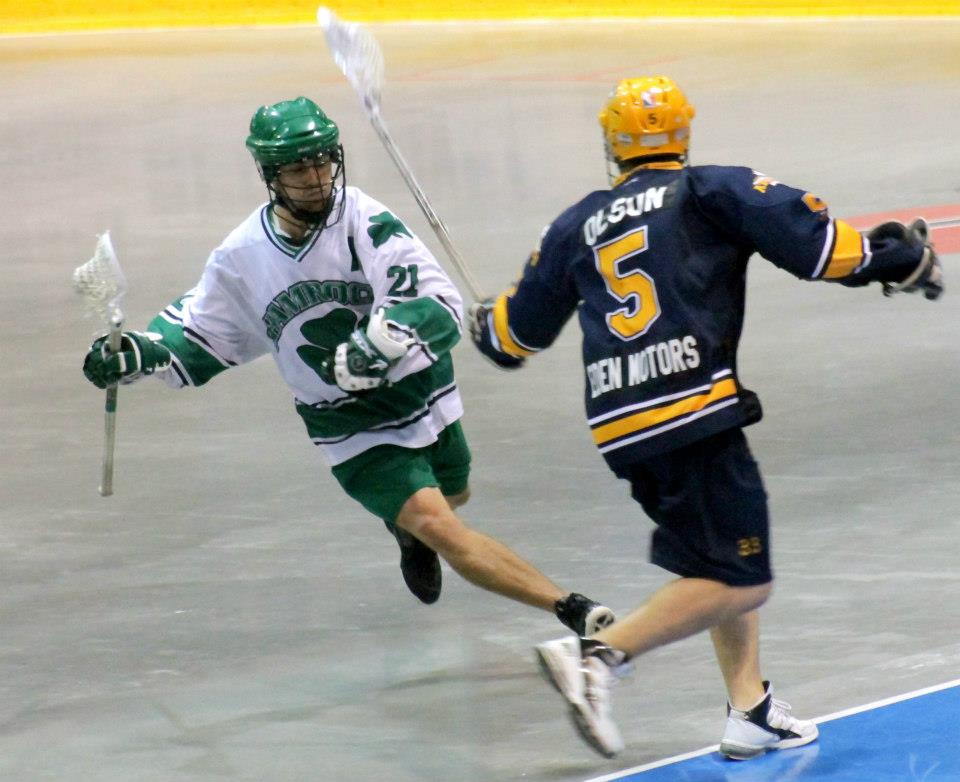
If this juke were in the offensive zone it would be important to keep two hands on the stick (“triple threat position”) while executing the movement. A juke is the most basic dodge in lacrosse.
A "juke" is a fake cut one way (“jab-step”), then planting hard off of a stiff outside leg while the inside leg is bent and parallel, eventually extending explosively in the opposite direction. Off-ball, a quick “side step” in one direction and then moving in the opposite direction is often enough to engage one’s check and keep them off balance. It is also very common for offensive ball carriers to “jab-step" then try to beat their check overtop for a sweep shot.
Otherwise known as a “counter-step” or “hitch step,” these “steps” can be utilized to deceptively mask a ball-carrier’s true intention, and later be combined with other dodges, like the face dodge or roll dodge.
Drill #1: “Dodging Around Pylons”
SEE YOUTUBE VIDEO - Click Here
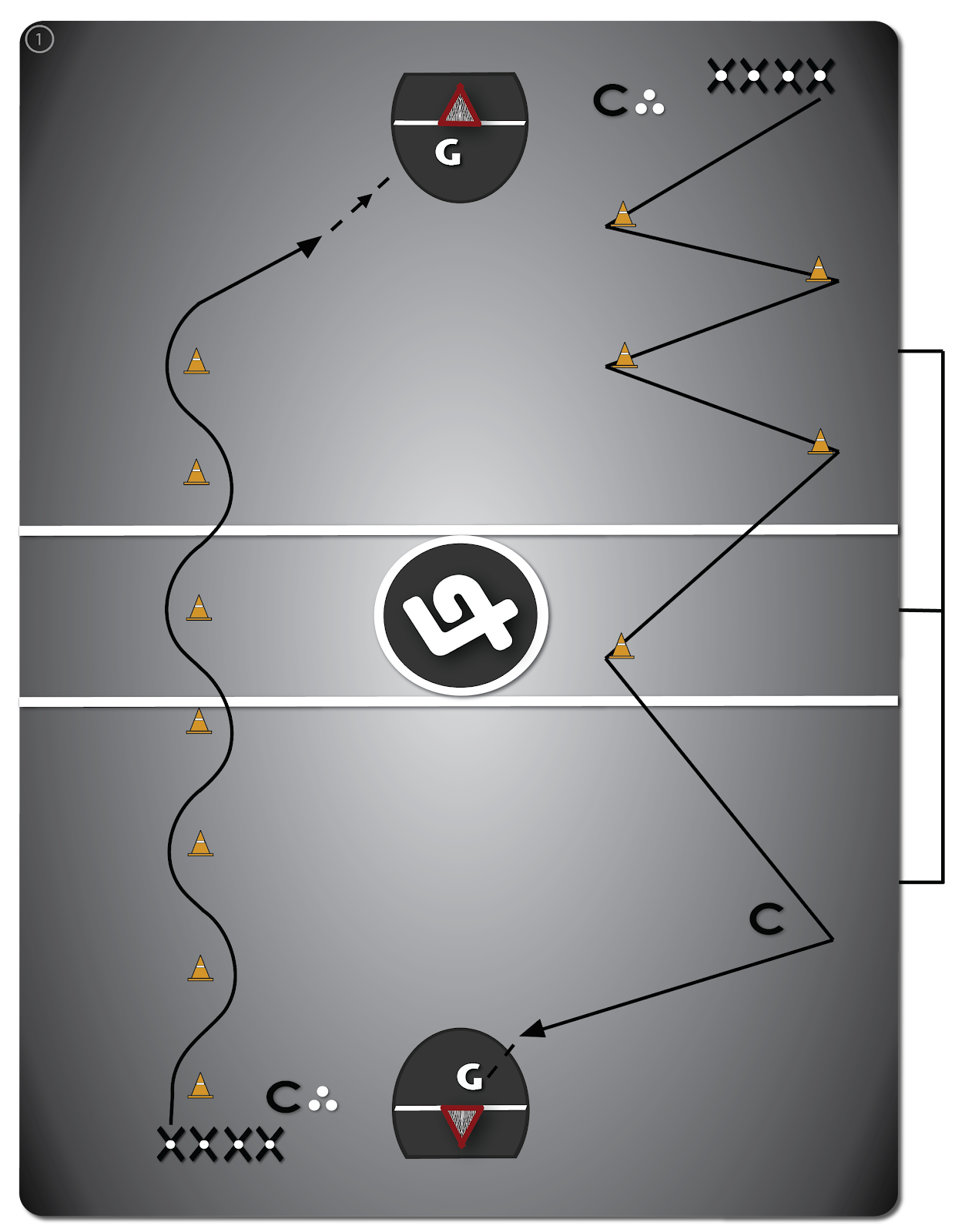
Skill #2: THE ROLL DODGE
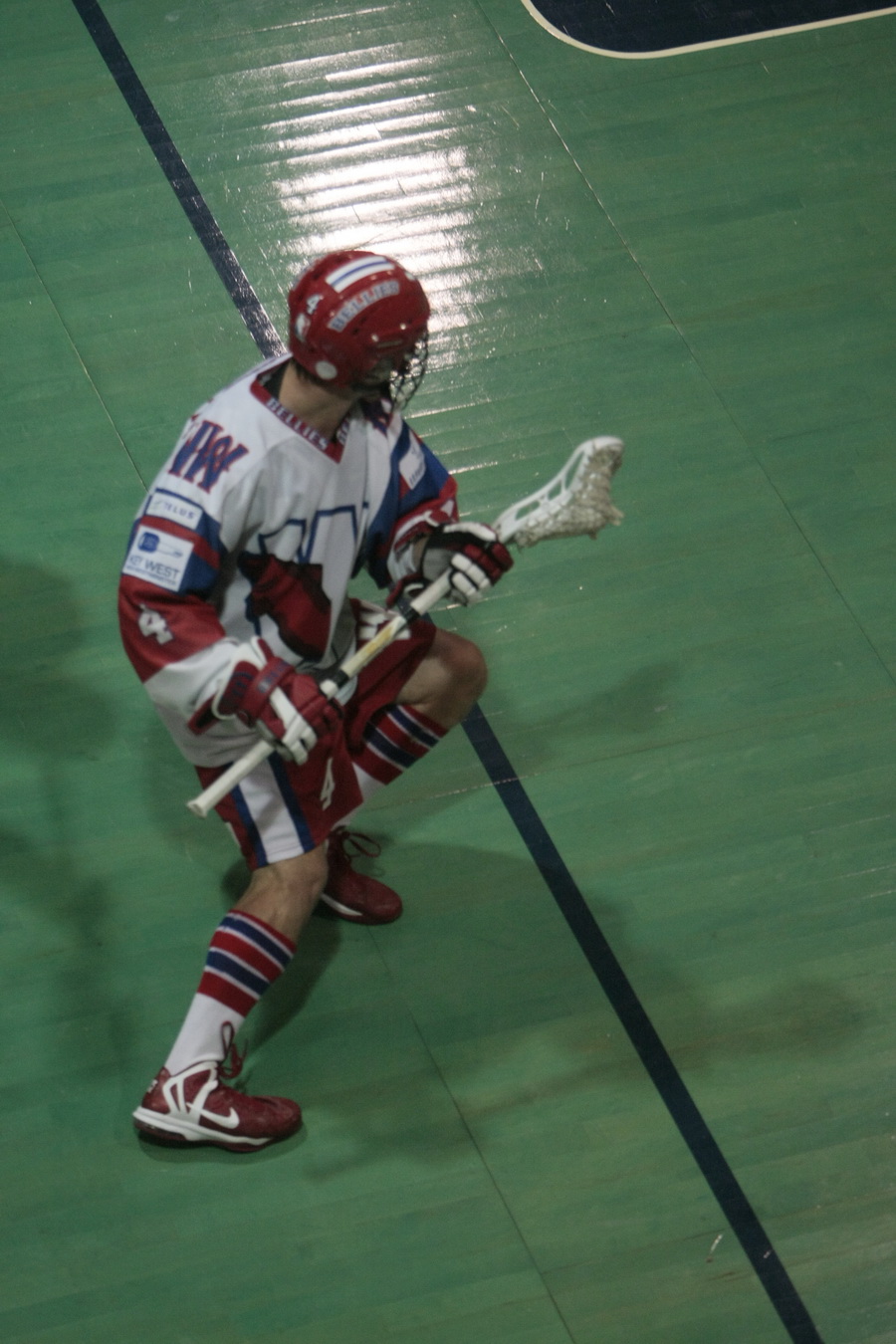
A roll dodge can be either clockwise or counter clockwise, exploding in the opposite direction while pushing off of the outside leg (careful not to leave your - butt-end hanging out!!!)
A “roll dodge” is a 180° or full 360° rotation of the body while engaging a defender, which can also help protect the ball as a player carries it toward the net. The roll dodge is usually accompanied by some sort of change in direction (usually east-west in orientation) and is sometimes used by players to free their hands for a shot on goal. It could be a drop-step "underneath" or spin "overtop" of the defender.
Where the opportunity presents itself, offensive players should roll dodge toward the butt-end of the defender’s stick ("away from their stick"), initiate contact with their lead shoulder from approximately a sticks length from the defender, and accelerate out of the dodge.
Drill #2: “Open Floor Dodging & Checking”
SEE YOUTUBE VIDEO - Click Here
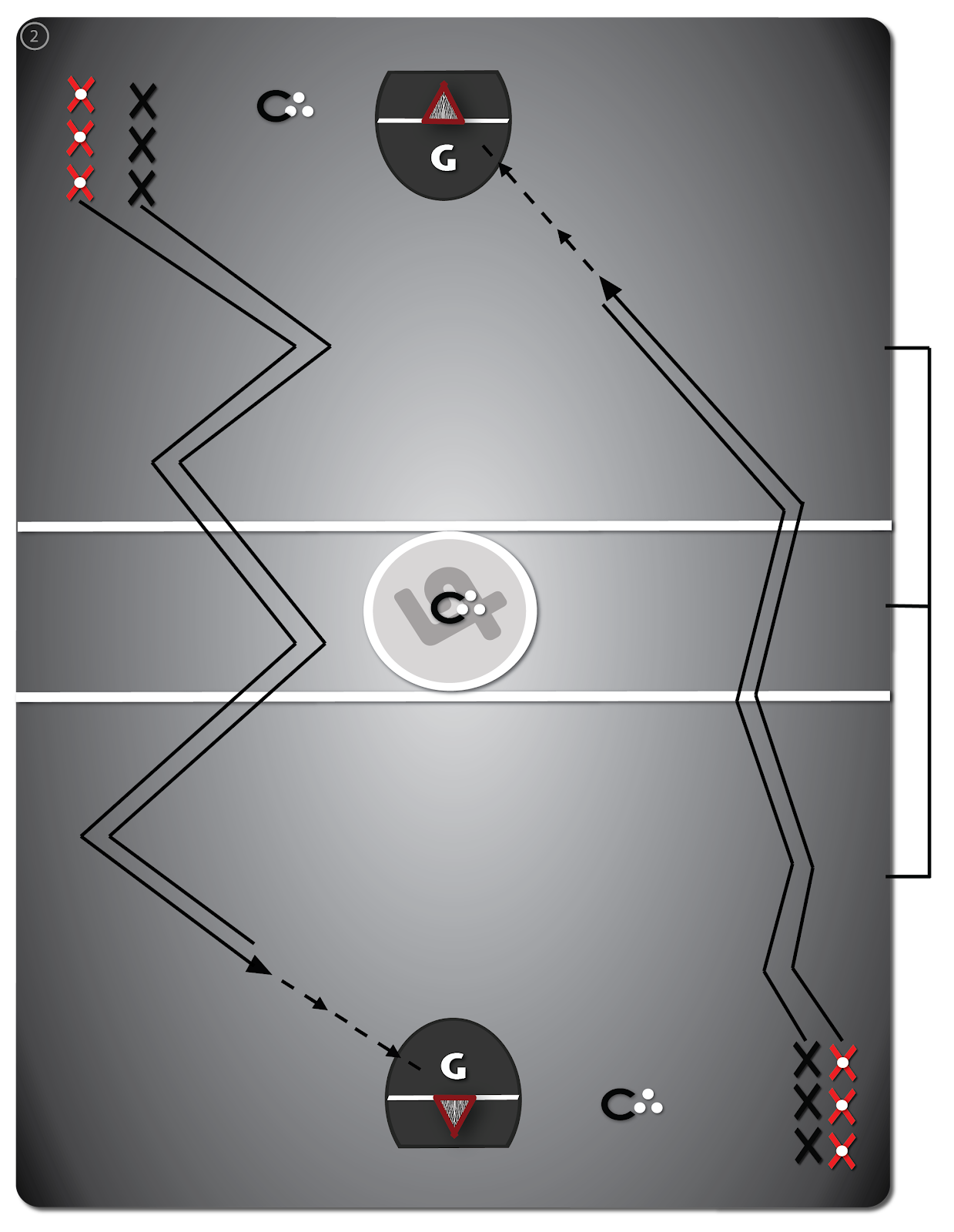
Skill #3: THE FACE DODGE
The "face dodge" is one of the most common dodges you will see in lacrosse whereby a ball carrier brings the ball across their body (their "face"), rotating their hips and accelerating out of the dodge, all while keeping the ball “tucked in” and tight to their body; it is a classic move when set-up with a fake shot (“crow hop”). This move and others are utilized to get around aggressive defenders, or to free up time & space for a quality shot. Where the opportunity presents itself, offensive players should attack the butt-end of the defender’s stick ("away from their stick") at roughly a stick's length away.
Drill #3: “Dodging In Traffic” Shuttle
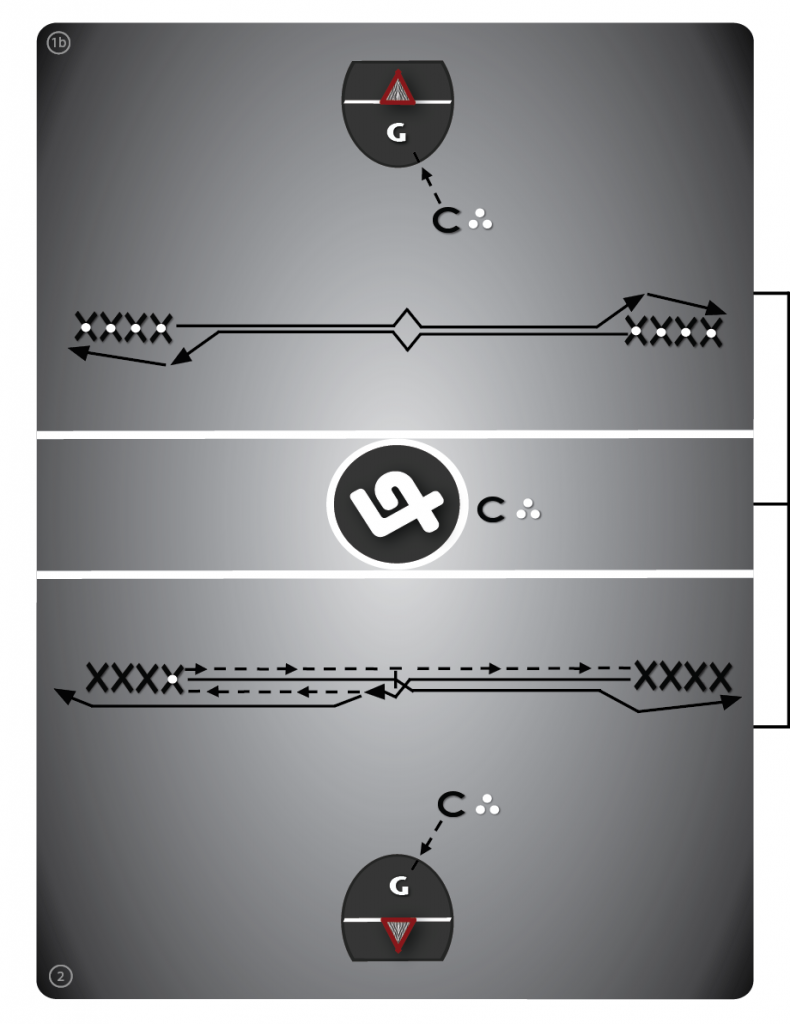
CONCLUDING THOUGHTS:
The ideal scenario where all three of these dodges can be incorporated into one series of dodges would see the defender catching a pass, attacking their defender with a quick juke, face dodging underneath, and then when the defender is trying to catch up with them, roll dodging back overtop for a screen shot; or in a perfect world, leaving them naked in front of the net with the goalie. The timing of the dodge cannot be understated, and the art of dodging lies in knowing exactly when and where to dodge. If the beginning lacrosse player incorporates these dodges into their game, they are going to have much more success (fun).
Beginner Lacrosse Drills: Loose Balls
Assuming the basics of scooping through the ball, trapping & scooping, “scoop-tuck & turn,” and “scoop to triple-threat” have been covered off in both static and dynamic fashion (as seen in our “Basic Practice Plans,” the next step is to start preparing players to get loose balls in traffic (against an opponent). Little nuances such as boxing out, “keeping it alive” for a teammate to come in and scoop it, other times poking at, kicking or batting the ball to gain an advantage, all come into play; all of which are worthy of drills in and of themselves!

Being “two hand tough” on loose balls means keeping two hands on the stick even when you know you are about to take a slash across the forearms
Drill #1: “Stationary/Dynamic Loose Balls”
SEE YOUTUBE VIDEO - Click Here
As a Warm-Up prior to all out competing with an opponent, players can practice several variations of stationary (Variation #1 - Top Diagram Below) and dynamic loose balls, depending on their skill level. To recreate the feel for “scooping through” a loose ball in traffic, players can eventually pair up, with one partner putting their stick flush behind the ball as the other partner comes in and scoops through the ball/stick (Variation #2 - Bottom Diagram Below). After picking it up they can practice tucking it in and running to open space, afterwards setting up the same situation for their partner to practice. Players could also practice knocking the stick out of the way and boxing-out, then trap & scooping the ball and getting their hands up into the triple threat position. There are many combinations of loose ball skills and situations you could practice. Another more advanced variation is having one player ready to scoop a loose ball while the other tries to poke at their bottom hand, in an effort to interrupt their rhythm.
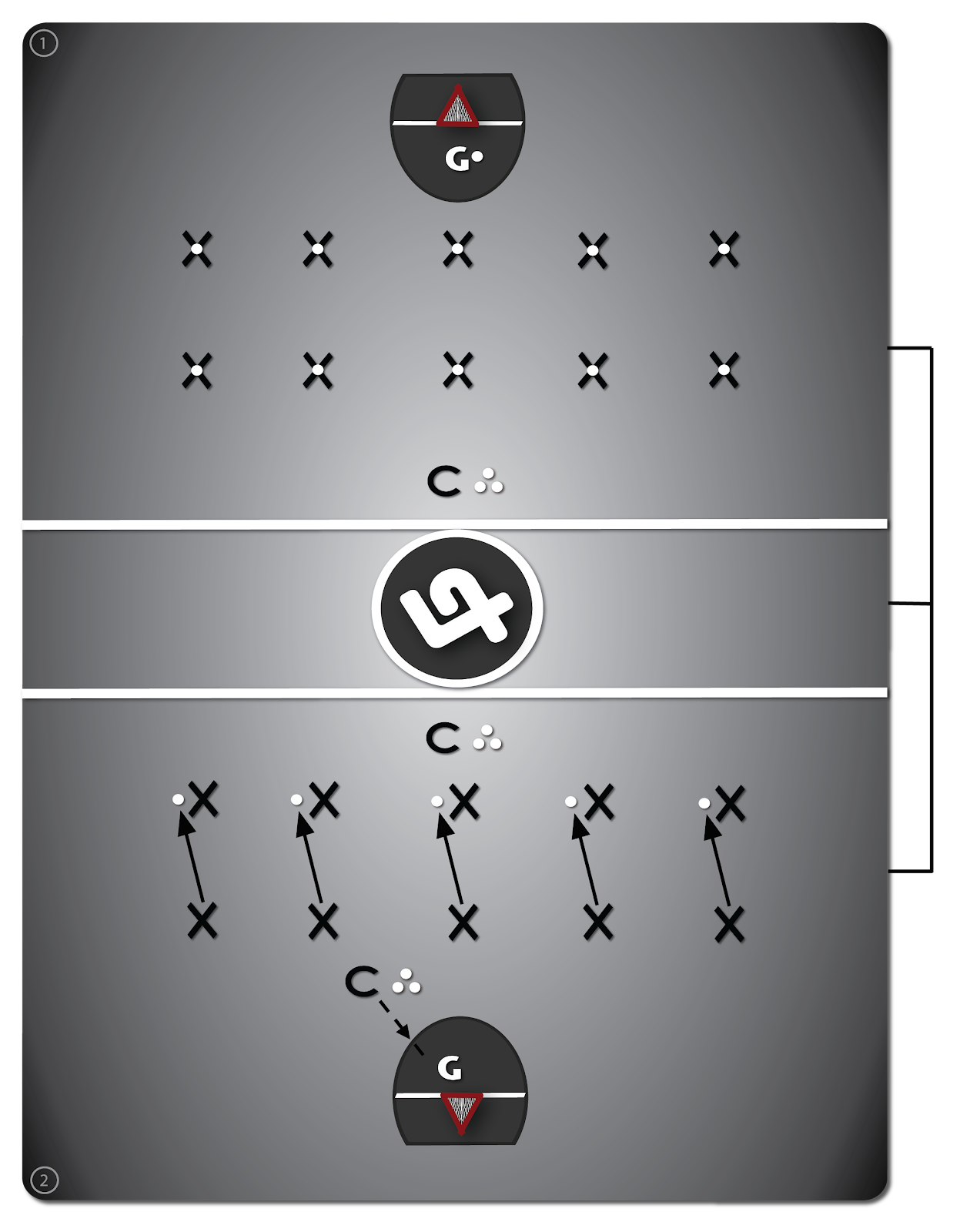
Drill #2: “Loose Balls - Sans Pressure”
SEE YOUTUBE VIDEO - Click Here
We have thus far started our drill series on a continuum building up from stationary, to pursuing loose balls with no pressure, eventually getting to the speed and pressure of a real live 50/50 loose ball battle. The drill below could be skipped for more skilled players, but for beginners it is perfect for practicing Attacking Loose Balls with speed as they are coming off of the boards, and protecting it once you’ve got it. After the player corrals the loose ball they should run it back towards the middle of the floor and put it into the pile in front of the coach, which represents what you would do after collecting a loose ball in the defensive end of the floor (Variation #1 - Top Diagram). The goal of the drill is to get lots of reps of full intensity loose balls, reacting to them upon first sight (coach is standing behind players).
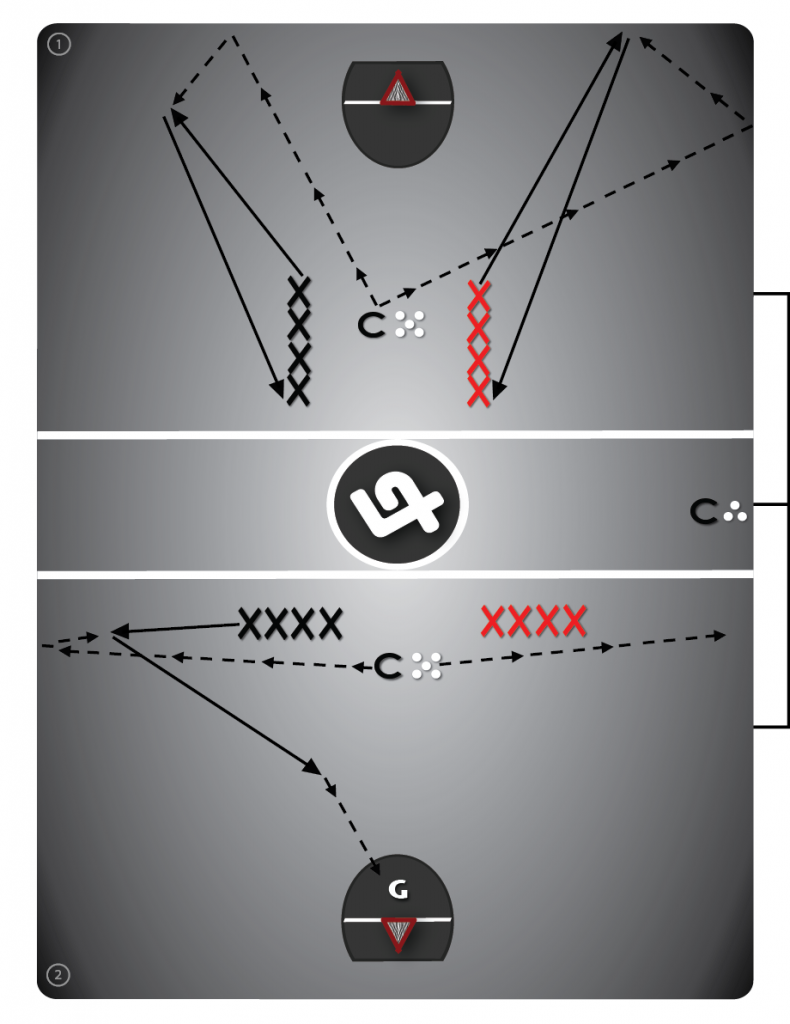
Variation #2 (Bottom Diagram) is similar in orientation but represents a loose ball near the offensive end of the floor. Players get the loose ball off of the side-boards instead of the corner, collecting the loose ball and running quickly to the net for a shot (representing a broken play in the neutral zone). It also adds a bit of a fatigue element to the subsequent loose balls (and shots), which will be harder to execute successfully as the drill goes on.
Drill #3: “Loose Balls With Pressure”
SEE YOUTUBE VIDEO - Click Here
Next, consider adding a real live element of pressure (Variation #1), whereby two players go into the corner for the loose ball, with one player having a head start over the other. The player trailing the play should stay close enough where if the player ahead of them misses the ball they can attempt to get it, but otherwise applying pressure on the player as they attempt to clear it out of the “defensive zone.” Players should explore different match-ups so they get to go against players with the same and different measures of the size, speed and strength.
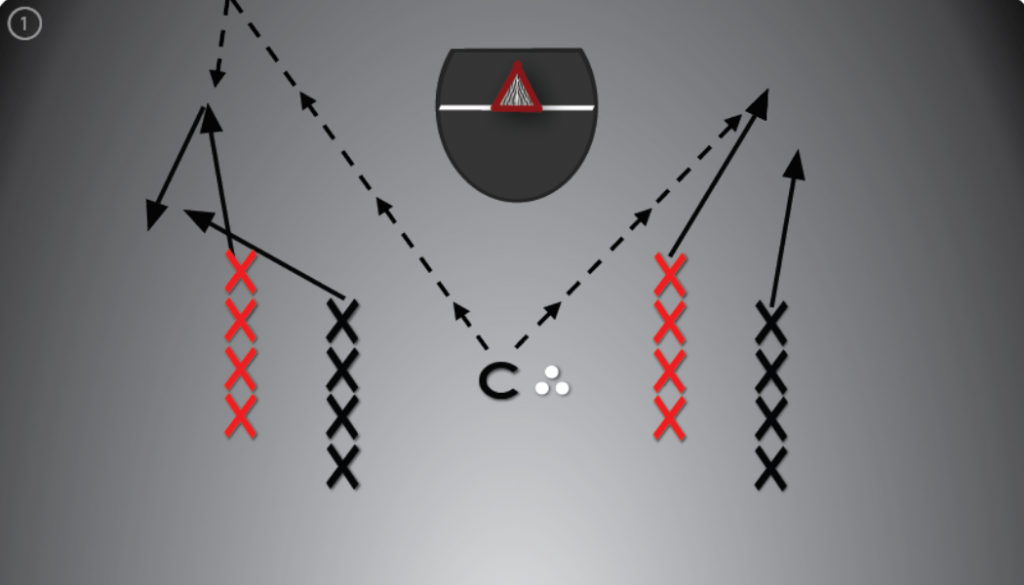
Variation #2 changes the location of the loose ball to an area of the floor that requires less spatial awareness (i.e. no crease), but also adds the element of having to pass the ball back to the next person in line behind you in line, mimicking a support pass while Breaking Out up the floor (scoop-to-triple threat). Players also begin side-by-side this time, with one of the players behind them rolling the loose ball in to start the play.
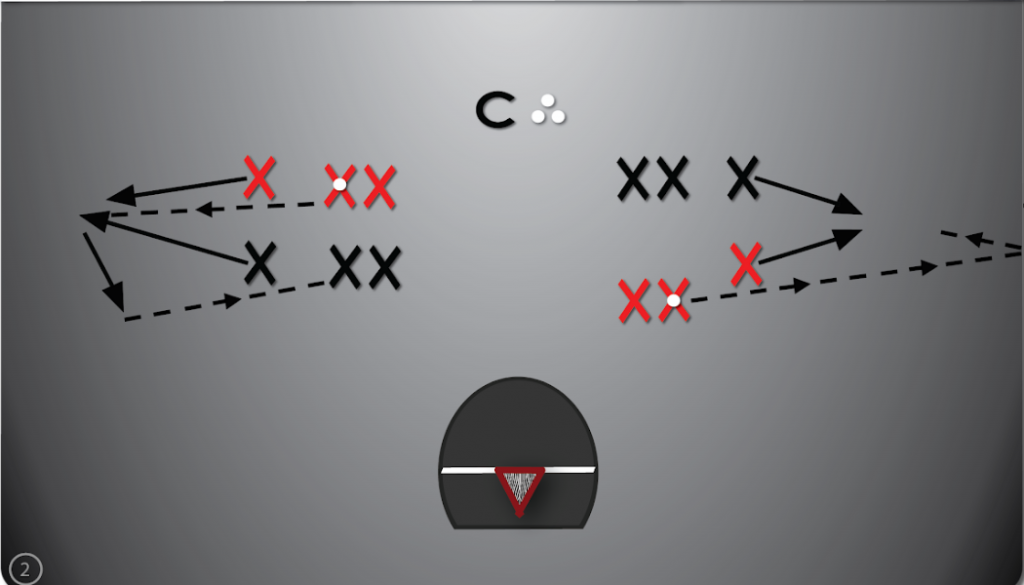
Drill #4: “Loose Ball Battle”
SEE YOUTUBE VIDEO - Click Here
Lastly have players compete for 50/50 balls, which means players are starting side-by-side on each side of the coach, with the coach behind the players who are facing the corners. Upon first sight of the ball, players run into the corner and “battle” for the ball. Whoever comes up with it can either run it out of the drill, otherwise they may be given a chance to explore playing some one-on-one for 5 seconds, before sending a ball into the opposite corner.
Advance to 2 vs. 2, which requires players to work in tandem, and utilizes a lot more finicky maneuvers, which should be the focus in drills moving forward. The Box-Out Drill for instance, is especially important for players in these types of tight quarters, helping differentiate from what may otherwise be called as minor interference if performed incorrectly. Loose ball battles should frequently be re-hashed upon throughout the course of a season, ensuring that effort and physicality on loose balls is always high in any drill performed moving forward.
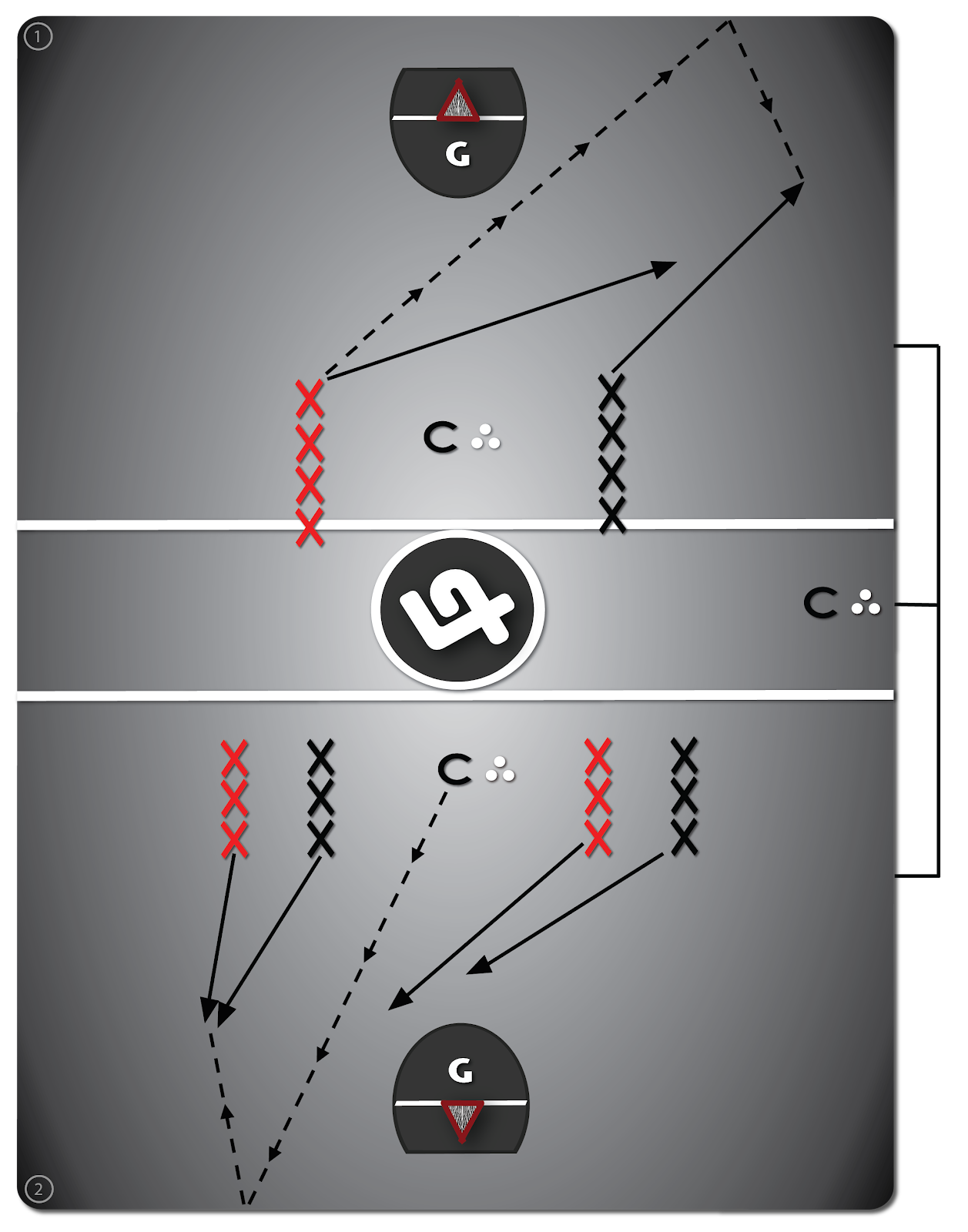
CONCLUDING THOUGHTS:

At the end of the day, the team that wins the most loose ball battles usually ends up winning the game. More loose balls (also known as “ground balls” in field lacrosse) translates into more possession, which usually effects other variables such as: momentum, multiple re-sets, shot totals and fatigue. The biggest determining factor in getting a loose ball is hard/effort, which generally comes from developing your anaerobic capacity off the floor; and having the will to compete. Battling to keep the ball alive for a teammate is sometimes just as important as picking the ball up for oneself. The best loose ball players have a 6th gear they can kick it into and somehow come out of a corner with the ball against two opponents. They simply want it more.
Beginner Lacrosse Drills: Basic Defense
Outside of the fundamental footwork described in our FREE "Fundamental Lacrosse Practices," landmarking the top-shoulder of your check (the person you are covering defensively) while in a "closed stance," is the proper defensive technique when checking a player on the ball-side of the defense.
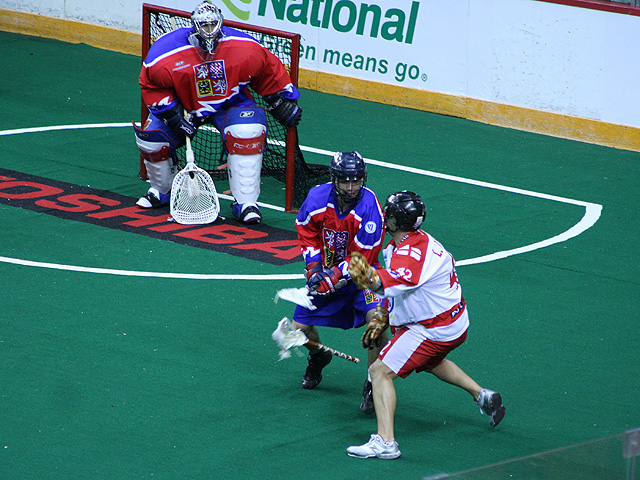
Denying underneath while playing “top-side” defense at the crease position during the 2007 World Indoor Lacrosse Championships in Halifax
Players need to learn how to play top-side defense while defending at all 5 positions of the "House" which is essentially the inverted coverage of the prime scoring area, in the shape of a stick-figured house (box + triangle). It covers both crease positions (low), both shooter positions (high corners) and the point position (top-centre), both on-ball and later off-ball. It is often useful to first show this basic defensive framework to the players before having them practice defending each of the different areas of the floor.
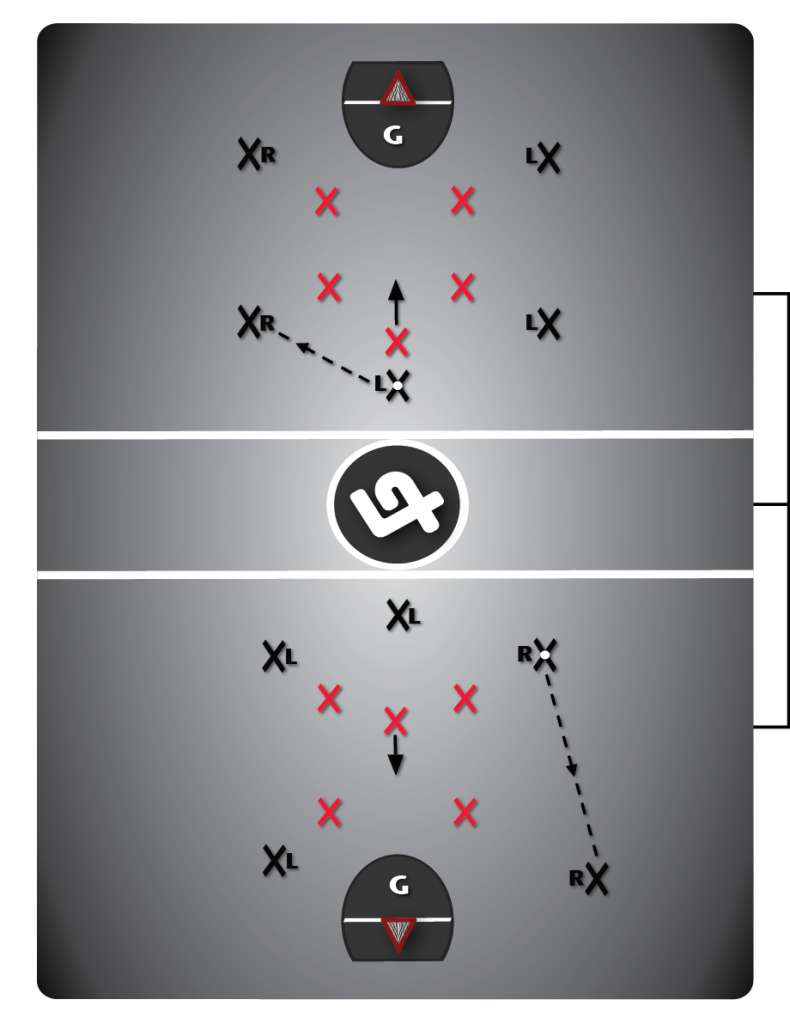
A "House" defense is a zone defense and the most basic system used to teach defensive principles to beginners
Drill #1: "On-Ball Shadowing”
SEE YOUTUBE VIDEO - Click Here
The drill below gives players a chance to "shadow" the movements of the offensive player while playing top-side defense. The offensive player must stay behind and between the two pylons (which are set up at the crease and shooter positions) for the first 5 seconds, before a second whistle signals that they may now take it to the net (1-on-1). The offensive player then gets another 5 seconds to get a quality shot, perhaps using some basic dodges learned in a previous practice. The defenders job then becomes not to get beat over-top, nor to get beat underneath, and otherwise to contest any shot taken from the offensive player’s proper-floor-side.
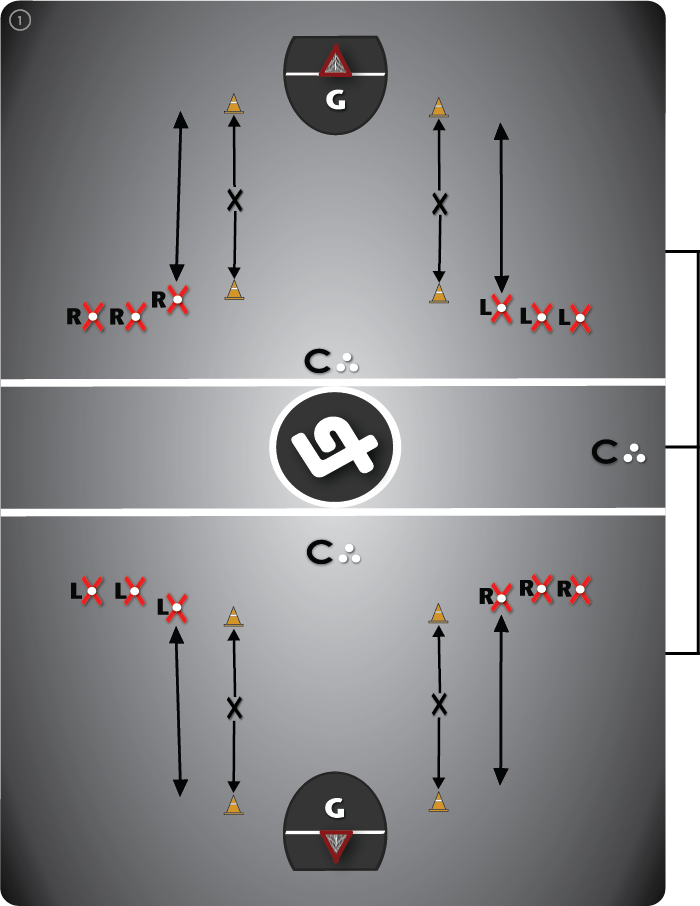
Defenders must stay square to the top shoulder of the ball carrier as they make "moves" between the pylons and the coach blows the whistle for a 1-on-1 after approximately 5 seconds
Drill #2: "Recover Top-Side”
SEE YOUTUBE VIDEO - Click Here
Inevitably defenders will find themself trailing the offender, having been beaten top-side. However, the play is never over and it is possible to reclaim the top-side by taking the right angle when recovering. The last resort is a trail check scenario, which is a more advanced concept. Beginners should just concentrate on realigning with the offensive player’s top shoulder and they will be successful.
This drill starts with the defender underneath the offensive player, hip-to-hip (shoulder-to-shoulder), at the crease and shooter positions on both sides of the floor. The defenders job is to reclaim the top side and avoid giving up a quality shot.
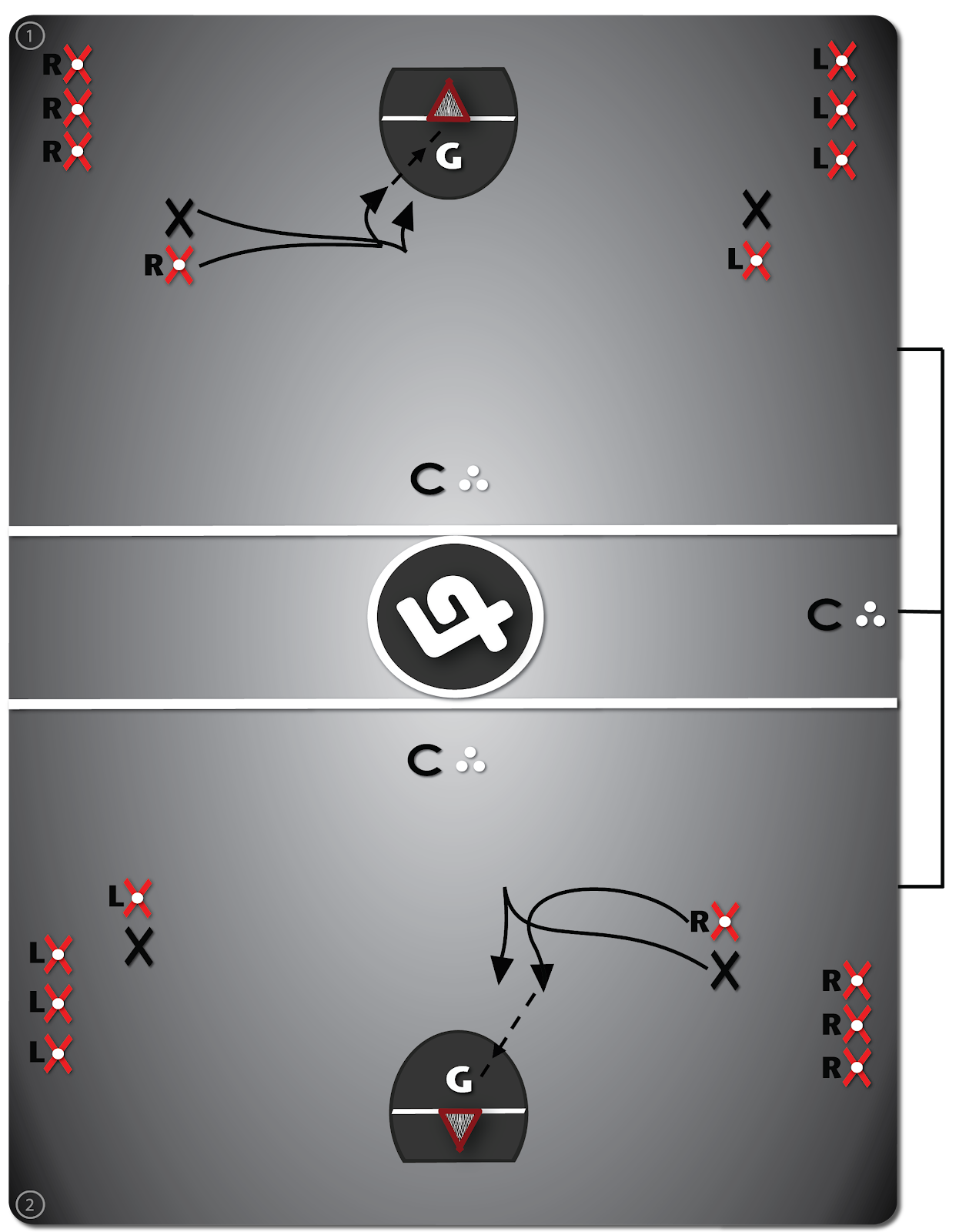
Inevitably a defender will get beaten top-side and needs to know how to “recover” while at the crease and shooter positions, which is the focus of our second staple drill
Drill #3: "4 Corner Checking"
SEE YOUTUBE VIDEO - Click Here
This drill incorporates all of the concepts of the previous drills in terms of playing "top-side," except it allows for more reps for more players, in a shorter amount of time.
Variation #1 sees the player play offense, then defense, at either the crease or shooter position on their proper-floor-side, switching lines after playing defense. Variation #2 is more consolitory in nature, meaning that after players have shown good "top-side" technique while relatively fresh, players are now forced to play defense against all 4 corners consecutively, which adds an element of fatigue to the equation.
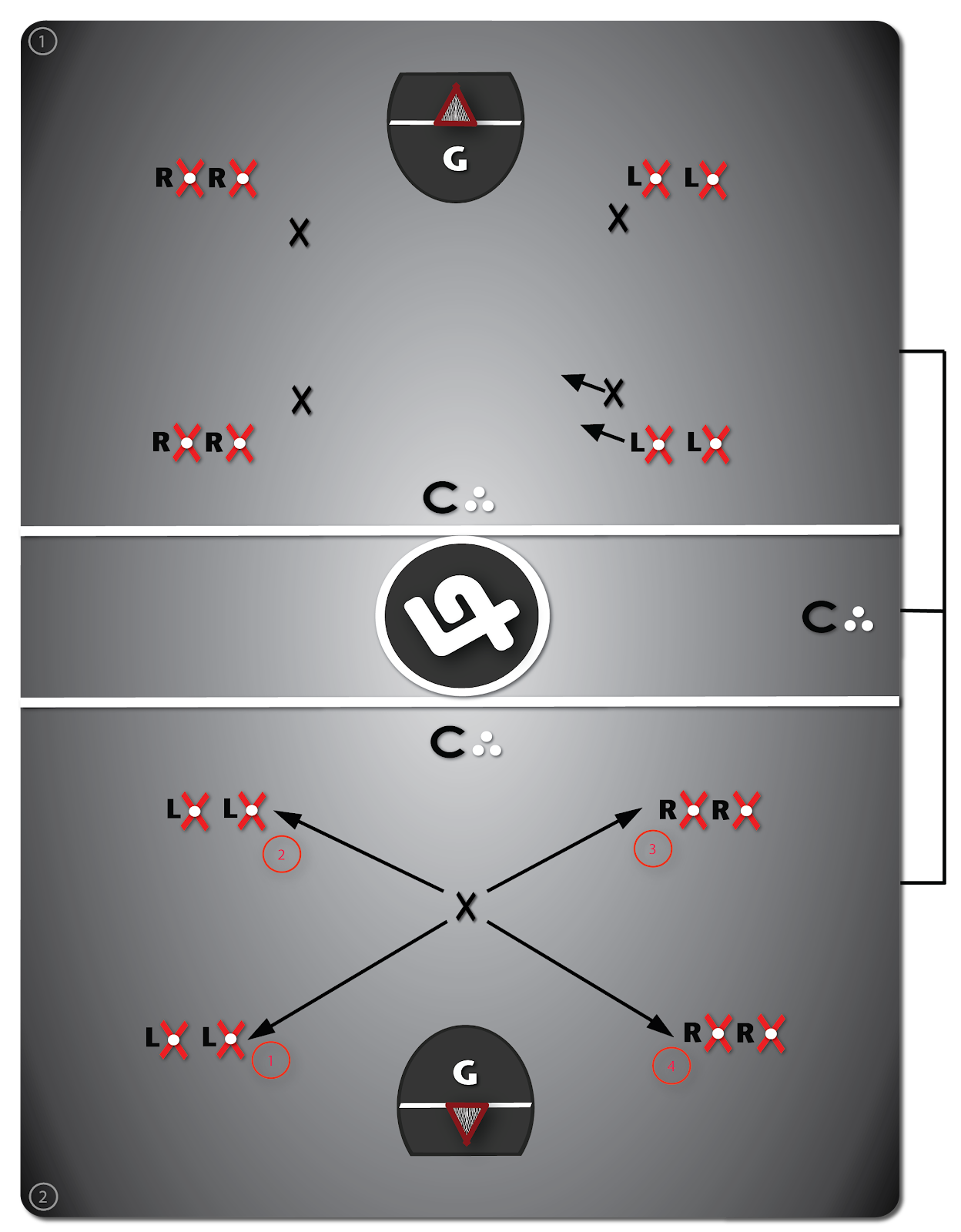
Final 1-on-1 skill/drill consolidation can happen by checking an individual corner at a time and then rotating, or for more advanced players, checking all 4 corners consecutively
CONCLUDING THOUGHTS:
This sequence of drills is a great foundation for better defense at the beginner level. It is limited in that it has no elements of off-ball defense and team defense as a whole. Likewise, for a group of beginners, this might be the extent of the defense that gets taught (perhaps over several practices instead of all in one) over the course of the season. The other fundamentals of loose balls, ball protection, basic transition, passing, catching, shooting, and basic offense, are equally as worthy.

The next step is playing good team defense and helping each other out where possible...
Beginner Lacrosse Drills: Don’t Start With Passing & Catching!
The fundamentals of lacrosse include: basic defense, scooping (loose balls), cradling/ball protection, basic transition, passing, catching, shooting & basic offense (appearing hypothetically in that order). You play good defense, knock the ball loose, pick it up, protect it and/or cradle it forward, pass the ball to any open players ahead of you, catch the pass and then shoot it if you are undefended and in the middle of the defense; otherwise creating a shot with basic offensive maneuvers. This is the order of operations in lacrosse, and this is the order we introduced the fundamentals in our first 3 (free) one-hour practices for beginners, requiring only helmets & gloves, nets & balls.
In this blog, we are actually going to start where, in our opinion, most coaches go wrong in teaching first-timers, and that’s starting with passing and catching! Usually, we would start with defense, loose balls, then cradling/ball protection, before getting to passing and catching, as this is the order that the skills appear in a hypothetical game. Below, you will find a great drill for warming up the catching skills of beginners, eventually getting into stationary passing & catching progressions and later dynamic passing-on-the-run.
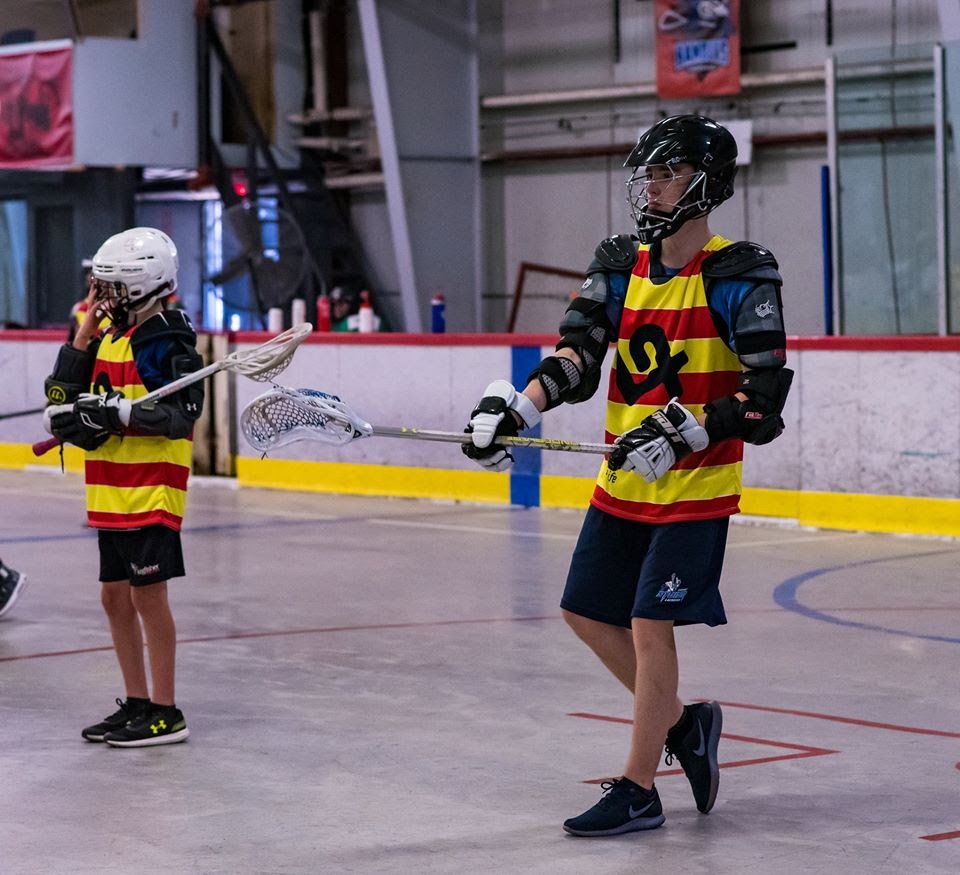
Drill #1: Catching On-The-Run
SEE YOUTUBE VIDEO - Click Here
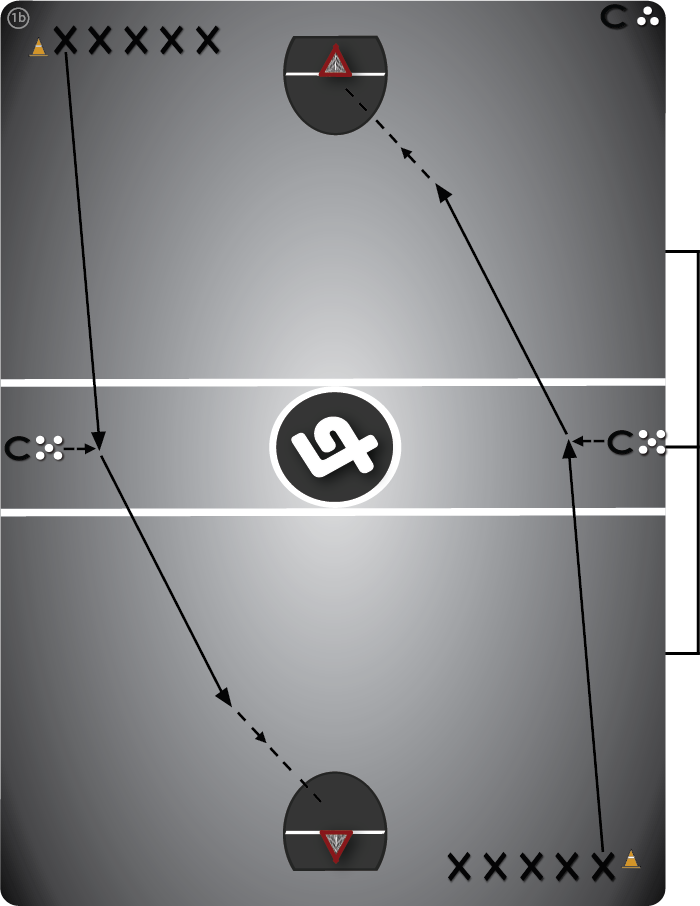
This first warm-up drill is a great starting point for continuing to build on the dynamic aspects of catching. In its most simplest form, our Laxlife Fundamentals Practice #1 broke Catching down to a coach or teammate underhand passing the ball with their hand into the player’s stick (above their shoulder in “the box”); where required. In this drill we are essentially doing the same thing except the player is now in motion, yet the ball remains relatively stable.
The coaches are at centre-floor (by the side-boards) with a pile of balls and as a player approaches, the coach throws the ball straight up into the air for the player to then run underneath and catch (ideally over their shoulder). Players then go in for a breakaway shot on the goalie or open net (from mid-range - perhaps put a pylon down for a marker), being sure to get to their proper side where necessary. In that respect, coaches should also switch which corner the line they are throwing to is coming from, in that way players will have the chance to catch the ball with their stick towards the boards, and also with their stick towards the middle.
This drill is also one of the drills we use to track the dynamic catching skills of players in our Fundamental Skills Tracking Sheet.
Drill #2: Partner Passing
SEE YOUTUBE VIDEO - Click Here
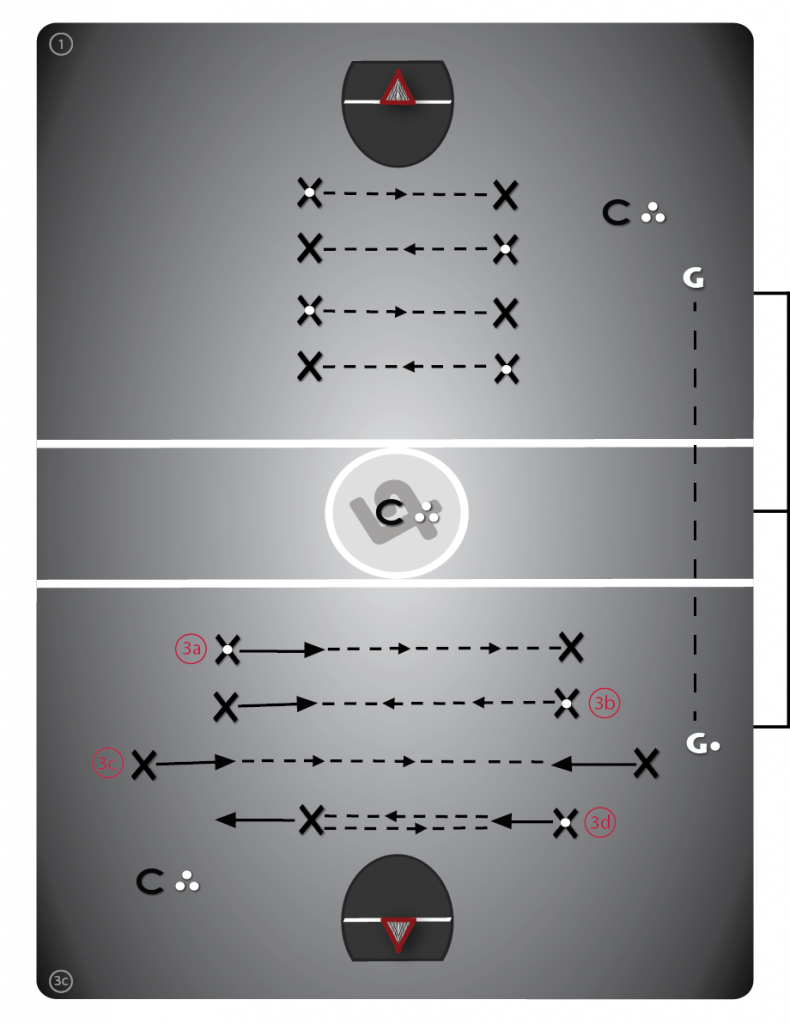
Here it is assumed that players have already gone through a series of drills for the fundamentals of passing and catching, and have likely already done the partner passing drills to follow. However, the difference is that this time coaches will be adamant that passers use basic footwork (performing changes of direction while running forward, back-pedaling and/or side-shuffling), before passing.
People can typically only remember 2-3 pieces of information maximum in any given scenario, so the first time through partner passing, as in our Laxlife Fundamentals Practice #2, we had players focus on basic footwork for instance, stepping with the opposite-side leg from the hand with which they throw. That was combined with remembering to reach their arms when they prepare to pass, and transferring their weight from their back foot to their front foot. We are now asking players to pass while slightly off balance, maintaining the triple threat position (“shopping") and focusing more on their follow through. This is a further example of the horizontal integration required to efficiently build up a stabilized fundamental skill.
The drill variations remain the same as in the basic fundamentals practices, beginning with stationary catching (regular and later “facing away”), except this time players progress to both a dynamic passer and a dynamic receiver running towards each other (Variation #3C).
Drill #3: "Staggered" Partner Passing On-The Run
SEE YOUTUBE VIDEO - Click Here
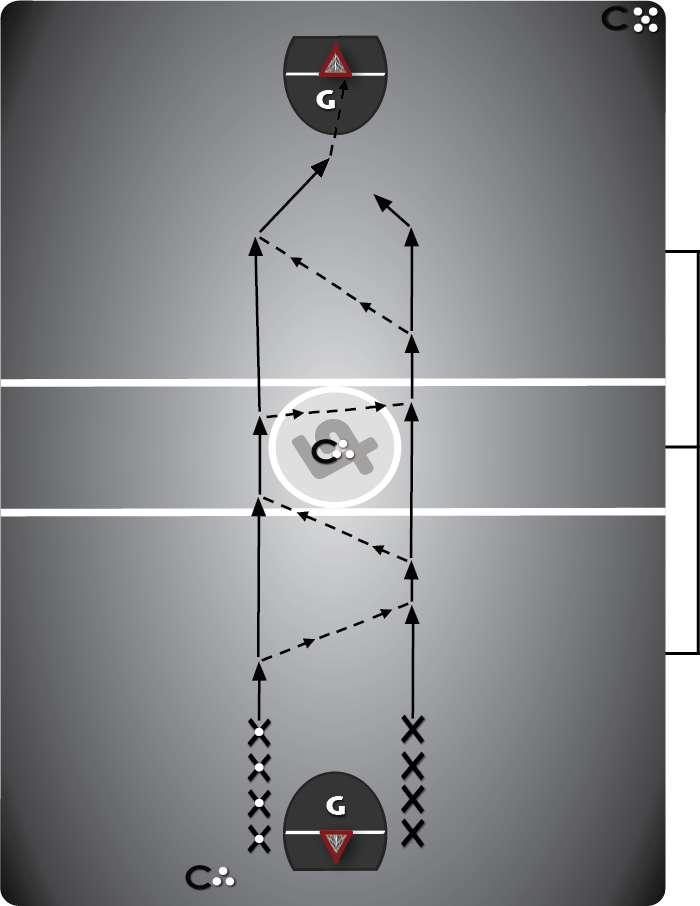
The previous drill increased the movement of the passer and the receiver, yet still within a confined space. In this drill players are now asked to pass and catch on-the-run, while running in the open floor, with players now getting the opportunity to explore the concept of “lead” passing; throwing the ball to where the player is headed, not where they currently are.
Starting with two parallel lines at the top of one of the creases, and players on their wrong floor-side (which may seem counterintuitive at first), just the receiver runs forward while the passer uses basic footwork to deliver the pass. The passer then runs forward and becomes the receiver, while the original receiver becomes the passer. Players must make lead passes to each other while running from one end to the other; finishing with a quality shot on net. They may also need to “soften up” their pass when they are this close together.
Start slow, around 50% of maximum speed and move players progressively further apart. After a few reps this way (which is generally easier), players now switch to starting on their proper floor side, which is a bit more challenging of a pass to gauge, as the receiver’s stick is now trailing behind their body as they run forward. The passer as well, needs to consciously reach their stick back, and open their hips to make a successful pass. No side-shuffling is allowed; players should always be running straight forward, side-by-side, separated by gradually increased distances.
Don’t Do It!
It may be hypocritical that we say not to start with passing and catching when teaching the fundamentals to first time lacrosse players, and then go and do our first fundamentals blog on passing and catching progressions. The truth is, there are always exceptions, and this case, practical considerations (Covid-19).
Originally we had intended to release our blog on “Individual Defensive Skill Progressions” first, but we had to stay flexible and adaptable given the situation, which is a big part of coaching (and life). Players as well, perhaps don’t always have all of the tools available to their peers; it’s important to be versatile! Use your imagination. Stay safe, and continue to spread the medicine game to those in need!
Beginner Lacrosse Drills: Warm-Up Drills & Shuttles
A Dynamic Warm-Up is a fundamental element of any physical activity, often beginning with a series of basic calisthenics (body weight activities) used to get the blood moving (break a sweat) and joints lubricated. In a training environment, this could entail a 20m: run forward/backpedal backward (twice), side shuffle with arm swings (both directions twice), tracking forward/backward (twice), carioca (both directions twice). For kids, it could be as simple as a modified multi-sport game. During practices and games, a general warm-up could also just be a basic drill done at 75% of max intensity.
In a sport specific context, any drill that keeps the players' feet and sticks moving continuously for 3-5 minutes, or until players “break a sweat,” is a great prelude to the dynamic stretches (or foam rolling) that should generally follow. Below are some of the common drills used not only as a tool for warming-up, but also for coaches who are new to a group and trying to assess the overall level of stick skills.
Drill #1: "Basic Line Shuttles”
SEE YOUTUBE VIDEO - Click Here
The next most tried, tested and true method for warming up the sticks of beginners, also providing lots of reps in a short amount of time, is doing “shuttles.”
The most basic shuttle is a loose ball line shuttle. With two lines starting across from each other (approximately 15 metres apart), the first player at the front of the line “attacks” a stationary loose ball in the middle. This player “traps & scoops” the ball, then puts it back on the ground for the first player in the opposite line from them and runs to the back of that opposite line. There is a certain element of cardio/fatigue with the extra running involved and that is where shuttles are useful as a general warm-up.
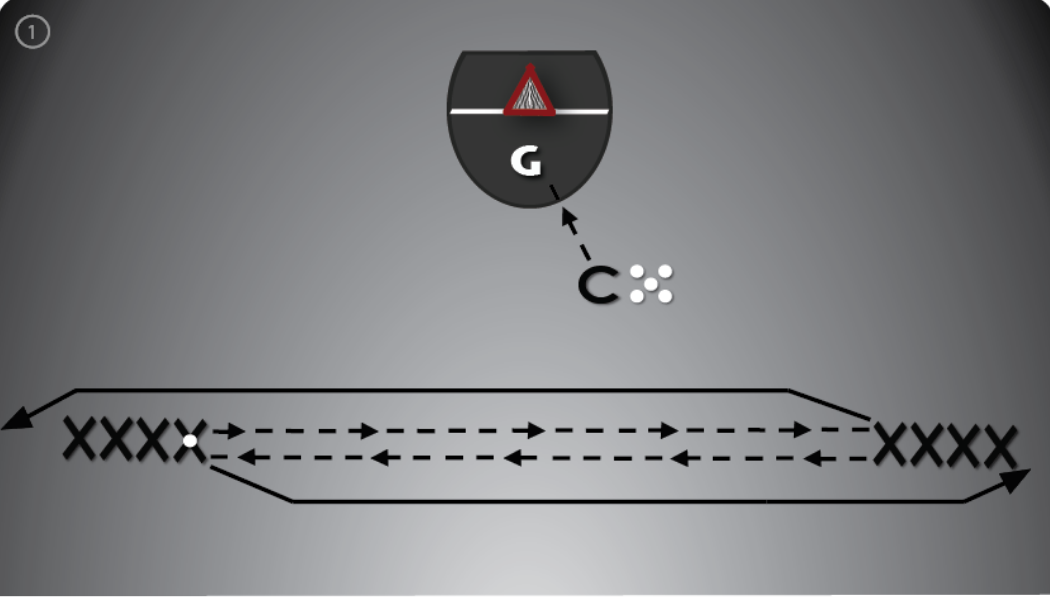
The next progression is very similar except this time the first player in one line rolls a ball to the first player in the opposite line and then runs to the back of that line. The player at the front of the opposite line “attacks” the loose ball, and continues the cycle (see diagram above). There are many variations of a line shuttle and it can be used for loose balls, passing, or both. If more than one shuttle grouping is being used because of lots of players, competition between the different shuttle groups in terms of how many successful catches they make in a row, for example, can be a great motivator and lots of fun!
Drill #2: Board Shuttles
SEE YOUTUBE VIDEO - Click Here
Board shuttles bring a trickier ball bounce to the equation, whereas the last drill had a stationary ball placement which progressed to rolling the ball along the ground. Now, players are asked to pass the ball against the boards, with the next player in line corralling the rebound and doing the same for the player behind them. Players will ultimately see a much more diverse array of loose balls, with the most basic teaching point being “get your body in front of it.” That way, at least if the player misses the ball it could hit their body, which often gives the player a second opportunity at it. Coaches should always have at least 3 balls on hand, that way if a player misses one, they can toss another ball in quickly, so as to not interrupt the flow of the drill.
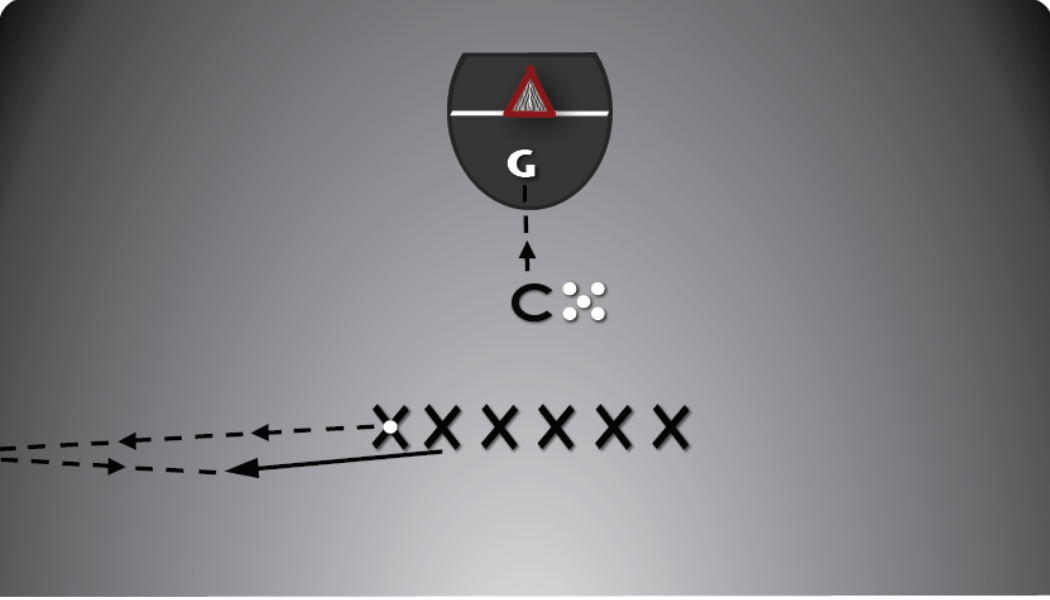
Drill #3: "3-Player Shuttles”
SEE YOUTUBE VIDEO - Click Here
In three player shuttles, players are arranged into groups of 3, in a straight line, with the outside players approximately 15-20 metres apart and a third player in the middle. The player in the middle switches every 30 seconds at the sound of the coaches whistle and each player gets two turns in the middle with each variation of the shuttle.
The most basic variation is the “reaction pass” (Variation #1) where both outside players have balls and the player in the middle is facing one of the two outside players. The player in the middle switches back and forth with who they are looking at, catching a pass and then passing it back to the same person, before eventually turning and receiving another pass.

In Variation #2, the player in the middle starts closer to one outside player than another, facing the player they are furthest away from. The player in the middle passes the ball to this person and continues running forward until they receive the pass back. As they receive the pass back they either turn into the ball (Variation #2A), or turn away from the ball (Variation #2B). As a reference point, "turning into the ball" would see the player turn in toward the midline of their body with their top-hand shoulder, whereas "turning away from the ball" would be turning away from the players' mid-line. The player in the middle continues back and forth, switching patterns each time through the drill.
Drill #4: "Traffic Shuttles”
SEE YOUTUBE VIDEO - Click Here
The “Traffic Shuttle” fundamentally requires more players than drills #1 to #3, which can be done with as little as 2 and 4 players, respectively. This drill would require at least 8 players. Spatial awareness is a big part of being able to successfully corral loose balls, pass and catch in a game situation, and this drill is a great progression for players as they now have to execute loose ball, passing and catching skills ("stickwork") in a more dynamic environment. The most important lesson here is for players to keep their “head on a swivel” as much as possible, before and after receiving the ball. This drill can also be made into a relay race, where coaches track successful passes or cycles through the shuttle without a dropped ball. The team with the most at the end is the winner.
CONCLUDING THOUGHTS:
The bottom line is that doing basic lacrosse drills that get the blood going is a lot more fun for kids than just running laps, cone drills, or whatever you may be doing as a general warm-up for your practice (likely for too long and/or with not enough continuous cardio). The less players in each shuttle, the more cardio effect to be had, and the higher likelihood of players dropping balls in the drill. If you are coaching young beginners, you may never even get past loose ball shuttles, but at least you can still progress with some of the different shuttle variations listed above, with further variations available to subscribers.
For more intermediate and advanced shuttle variations, visit the warm-up section of the laxlife.ca website.