Standard Breakout (“Clearing”)
INTERMEDIATE TRANSITION SET
- A “breakout” is a structured approach to safely and efficiently transition the ball out of the defensive zone, as a team.
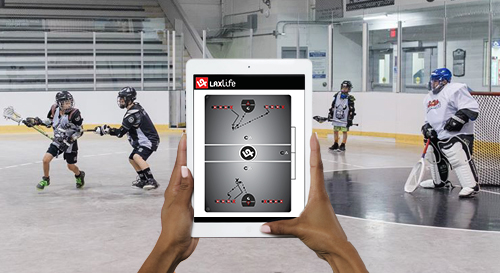
- Each player has set responsibilities as to exactly where to go and what to do if their goalie makes a save, or if there is any sort of turnover by the opposing team's offense. After a shot on net by the opponent, or the goalie/defender has corralled the rebound or loose ball, all other players should run (or backpedal) to the “standard breakout positions” (see diagram) based on their relative floor position (whoever is closest); keeping their eyes on the ball.
- The two players closest to the bench should “run hard to the bench” to try and help create a fast-break (bench assist), with the two players on the far-side (opposite the bench-side) being the most utilized outlets (Position B & C). Players should be aware not to leave the defensive zone too early, supporting the ball if one of their teammates needs an outlet to pass to.
- The key outlet is the player in the middle (Position D), in having to make a decision whether to run hard to the bench or do a button-hook as an "emergency outlet" if all other outlets are well covered. If this player is also covered, all other players should button hook back to the ball and whoever gets it should carry the ball to the middle of the floor in order to break the "Press."
If the goalie has the ball to start the breakout it is important that they spot the open player and quickly make a high percentage pass, without hesitation. If no outlet is available the goalie should step out of the crease either behind the net or on the bench-side (to avoid a 5 second call) and the team should take a slow break approach to transitioning the ball.
The first look for the goalie (if advanced) should be down the floor for a breakaway (Position A), but only if wide open. Intermediate goalies should look to initiate a fast break (Position B), if possible. For beginners, or if pressure is applied, players on the far-side should button hook down as far as the mid-boards and GLE (where required), for an easy outlet pass. Otherwise, a player may quickly come into the crease and get the ball from the goalie, running it out.
For the most part the ball should be moved up the side boards opposite the player's bench, unless there is a fast-break. The golden rule: "when in doubt, run it out." Transitioning defensive players should “run the ball deep” and “in two’s,” looking for "late" transition (trailers) and eventually passing the ball off to players coming on the floor from the bench (Position E); changing if there is more than 16 seconds left on the shot clock (in the "Offense-Defense" transition system).
If playing in a "Two-Way" transition system and having players start on defense, all players should run the length of the floor upon breaking out, getting to their proper floor side if possible (except the ball carrier who should generally carry the ball away from the bench). If playing offense first, players will later play defense and then two-players will have to stay and start the "breakout" back towards the offensive zone before eventually changing.

Would you like to share your thoughts?
Your email address will not be published. Required fields are marked *
Leave a Reply
You must be logged in to post a comment.
Would you like to share your thoughts?
Your email address will not be published. Required fields are marked *
Leave a Reply
You must be logged in to post a comment.
0 Comments