U9 - Systems & Sets
Level = Beginner
- Draw diagrams and do a "walk through" of each system/set as it is introduced in practice
- Goaltending Skills Analysis Link
- Loose Balls & Face-Offs Skills Analysis Link
- Defense Skills Analysis Link
- Transition Skills Analysis Link
- Offensive Skills Analysis Link
Systems
 PLAY #SYSTEMS
Principles/Guidelines/Team Rules/Discipline:
- Simple fundamental rules that are clear and concise with respect to defensive, transition and offensive strategies, all of which can be effectively drilled during practice. They also must be enforced in order to maintain accountability and to ultimately be effective as a unit (team).
- When players are playing as individuals, and not abiding to “principles” set-forth by the team, "trust" will be lacking and team success will be compromised. Should a player consistently break rules or guidelines (being “undisciplined”), they should be held accountable in terms of playing time and respect. Champions put teammates before self at all times and egos must be kept in check in subtle/creative and overt ways by coaches and teammates alike. There is no “I” in “Team.”
- Note: It won't always go exactly as drawn up, the goal is to ATTEMPT to accomplish the basic movements and passes.3 Back Face-Off Set
 PLAY #Transition Set
PLAY NAME = 3-BACK
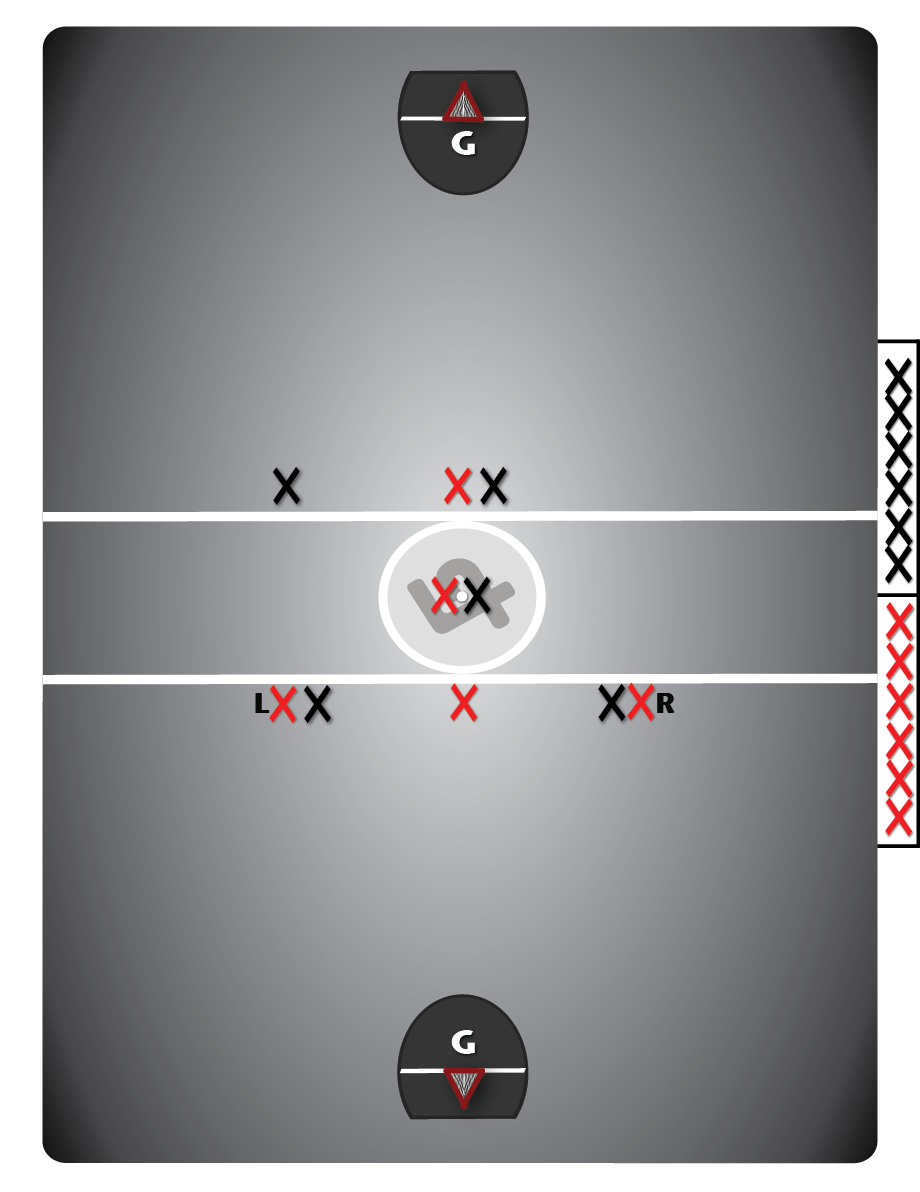
- This is a basic defensively oriented face-off set up, with 3 defenders in a flat-triangle formation near the defensive restraining line and one player on the offensive side of the restraining line; all players having a set responsibility.
- The lone player on the offensive side of the ball is usually the teams best loose ball player, while the other 3 players on the defensive side of the ball should also be high calibre loose ball specialists.
- The player in the middle at the back of the triangle is the safety, also the outlet and ball support for any player that retrieves a loose ball; usually the smartest and most reliable player on the floor.
- The other two players on the outside of the middle player also attack the loose ball and should have their sticks to the outside, in order to be able to help protect their stick in a loose ball situation (also helping box-out their opponent).
- See the Face-Off Skills Analysis for further information on face-off techniques.Two-Way System ("Lines")
 PLAY #Transition System
SYSTEM NAME = "LINES"
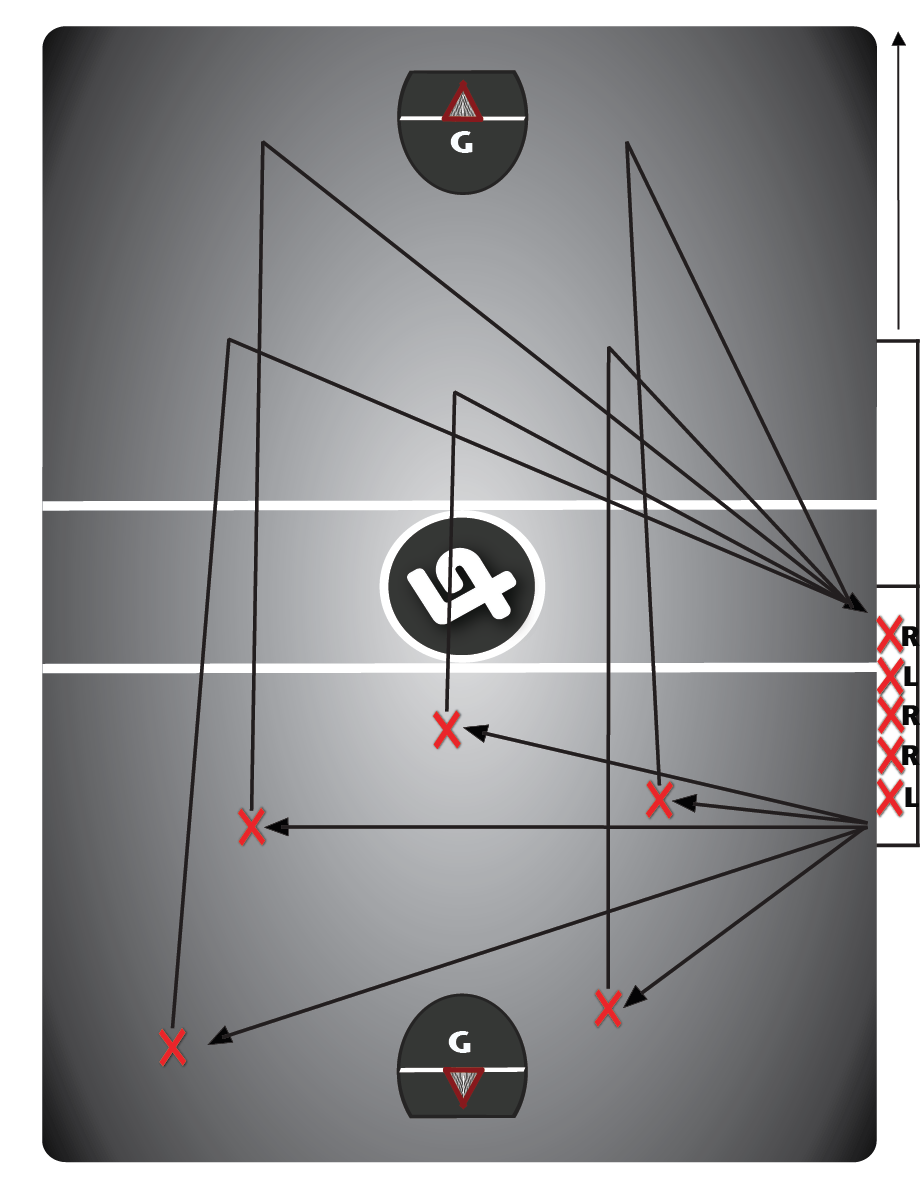
- A "two way" transition system is a player substitution method that sees players play both offense and defense, in 5 player “lines” (usually with extra subs), before eventually line-changing. This system has been used for many decades prior to the current trend in Senior/Professional lacrosse of using an Offense-Defense "platooning" style of play. All "Minor" lacrosse players should be fostered using the "lines" system, until beginning to specialize around ages 15-16.
- There are two methods of playing this system and both have to do with line changes, and whether a team has the long-change or short-change in a particular period/quarter.
- On the "short defensive change" (1st & 3rd period - as seen in diagram), coaches will usually first have players run out on defense and then run up and play offense, before “changing;" a Standard Breakout still being required by at least 2 players (not shown in diagram).
- On the "long defensive change" (2nd period - not seen in diagram), teams will usually have players play offense first and then play defense, before line changing; covering against reverse-transition still being required by at least one player. As the "short offensive change," it is an opportunity for breakaways and set-plays coming off of the bench.
- Coaches may also choose to line change outside of any set pattern (“go with the flow”). For example, if a team has multiple re-sets on offense, or a fast-break from their defense (or the opposing defense). If one player is caught on the floor while the rest of their line has changed, the coach can rectify the situation by having the "sub" play only "one-way" for that shift instead of "two-ways" (in order to keep the lines together).
- The obvious drawback with each method is that players are more fatigued while playing either offense or defense, depending on which they had to play first; a fact which should also be weighed for strategic purposes. Playing defense second, for example, not only increases the other team's chance of scoring, but also eliminates the potency of most fast-break opportunities.
- Coaches can also make small adjustments within this system throughout the game, depending on variables such as: the strengths of the players, the current situation, whether or not their team has a lead or is losing on the scoreboard, and how tired their players seem to be, as just a few examples. If players seem to be tired, an appropriately timed time-out is usually enough to get players back near full recovery.Fast Breaks (Lanes & Spacing)
 PLAY #Transition Set
PLAY NAME = "RUN"
Lanes:
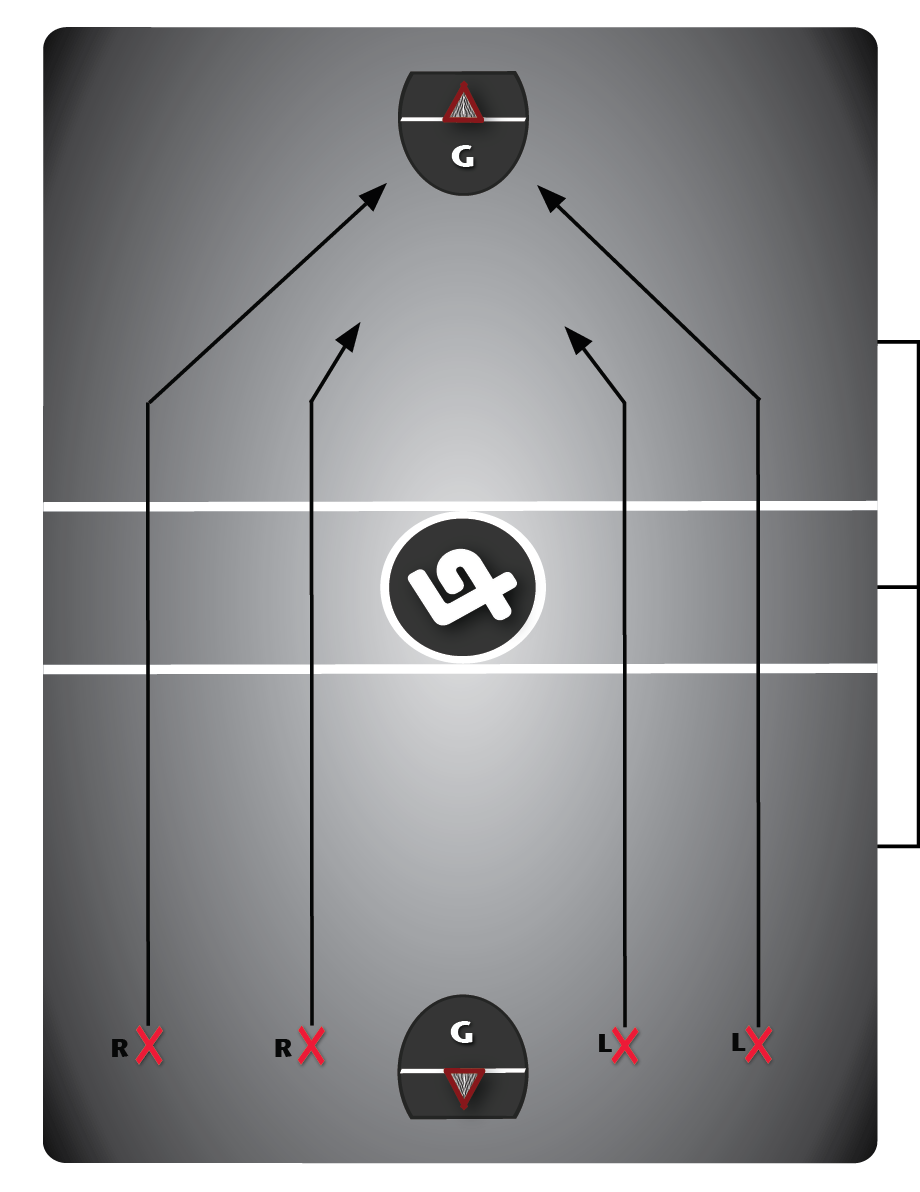
- There are four imaginary “lanes” referenced lengthwise (north-south) on the floor in lacrosse, two outside and two inside. These lanes are often referred to when speaking about transition and the pick & roll.
- The lanes stretch from either a few metres off of the side-boards to a few metres outside of the goal posts (“outside lanes”), or from a few metres outside of the goal posts to the middle of the net (“inside lanes”).
- Players running in the outside lanes during a fast-break should run as hard as they can to the same-side goal post on a 45° angle, as a general team rule. Inside players should be trailing the play, at least slightly (if possible), and will sometimes have to “slow up” in order to maintain proper "spacing."
Spacing:
- Essentially, transitioning players must maintain good “spacing” so as to not get too close to each other, whereby one defender could potentially defend two offensive players.
- The focal point of spacing is normally the position of the ball. The player carrying the ball should have an opportunity to beat their check at all times. The more space this player is provided in the prime scoring area (staying “spread”), the more likely they are to get a quality shot.
- Proper spacing during fast-breaks is also referred to as running in your “lanes.” The player with the ball in a 2-on-1 needs to remain a threat as they approach the prime scoring area and either shoot or pass, depending on whether the defender slides or "hitches."
- The same goes for a 3-on-2, with one player in the middle lane and two players in the outside lanes, ideally breaking the play down to a 2-on-1 and ultimately a 1-on-0.Basic “House” Defense
 PLAY #Defensive System
SYSTEM NAME = "HOUSE"
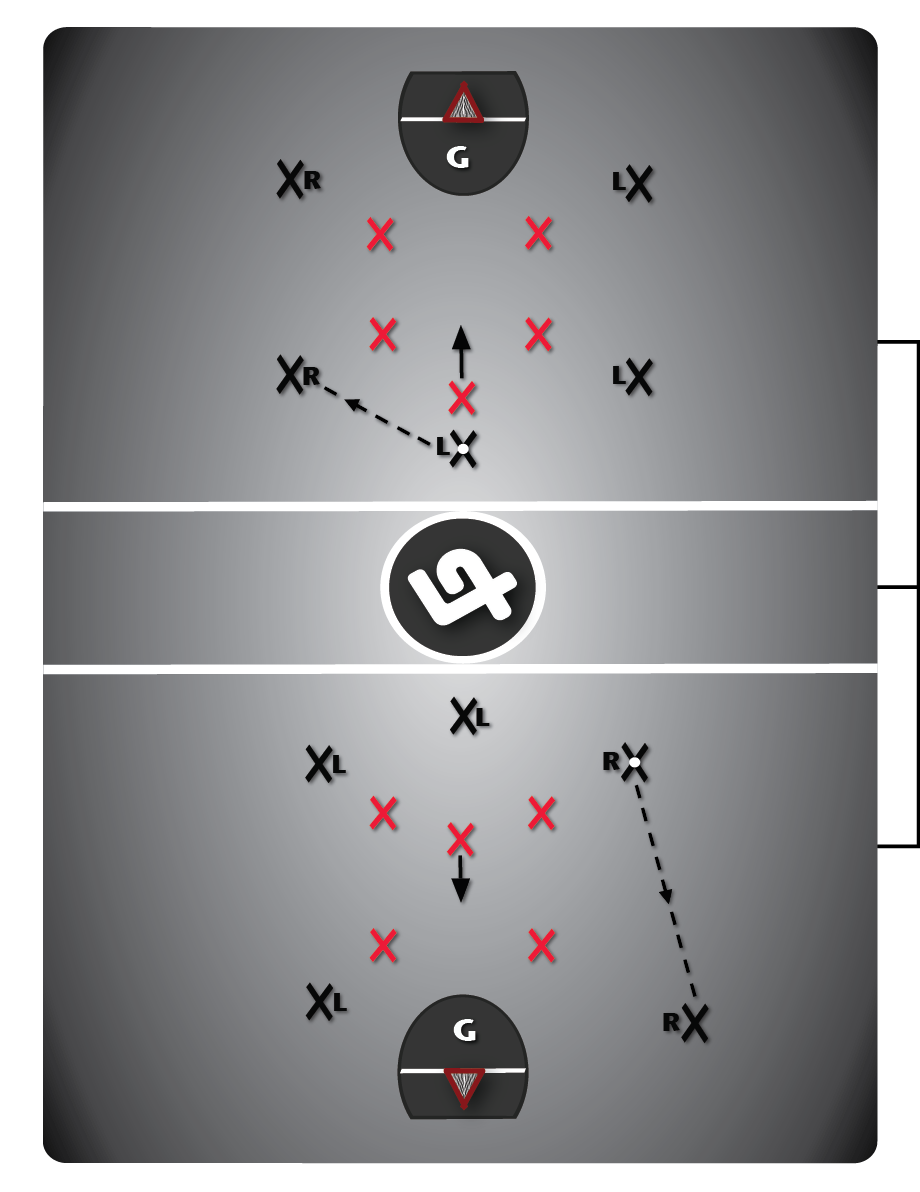
- Zone Defense: A style of defense characterized by defensive players covering a certain area of the floor.
- A basic "house" zone defense is essentially the inverted coverage of the prime scoring area, in the shape of a stick-figured house (box + triangle).
- Two defenders cover the crease positions, two cover the shooter positions and one covers the point position. The defensive zone can effectively be broken into 4 quadrants, with each of the low (crease) and high (shooter) defenders responsible for what happens in their quadrants.
- Generally, you want bigger defenders low; players who are willing to block shots, box-out in front of the net and ideally someone with good stick skills able to pick off passes going through to the crease. Up high, you want your quicker, smarter defenders, able to make split second decisions like closing the gap on shooters, getting on the gloves of passers and pursuing loose balls.
- The most important player in the defense is the point defender, who is usually the smartest player on the floor on any given shift; with their first responsibility being to make sure that all of their teammates are in their respective positions.
- The defender covering the point must “play on a string,” covering both the point player and the middle of the box when the point player doesn’t have the ball. While in the middle, this player must be prepared to help any teammate that gets beat; adjacent defenders should also "show help" as best as possible, without over-committing.
- Once all defenders have established their spot in the zone they should: keep their sticks up (in passing lanes), maintain "top-side" positioning (closed stance) and stand in shooting lanes on-ball. The high defenders are responsible for closing the gap on shooters and fighting overtop of seals, while the on-ball low defenders responsibility is mainly to block shots and not get beat underneath (where they have no help). It's also worth noting the the low defenders should be as low as the other teams lowest offensive player on their side, as a general rule.
- Beginner/intermediate lacrosse teams should have players start in this defensive formation, time permitting. If players are unable to run to their designated area by the time the ball has entered the defensive zone, sometimes it's best for the coach to call off this defense and switch to a "Man" defense for that particular shift.
- Note: This system is generally the default defense used to defend a 6-on-5 (“pull the goalie”) situation. It is also worth noting that the best way to beat a zone defense is to overload one area of the zone with 2 players, which is why all defenders need to be ready to fight overtop of any seals in their zone and give help to any teammates that they see getting overloaded.Motion Offense ("Timing Offense")
 PLAY #Offensive System
SYSTEM NAME = "MOVE"
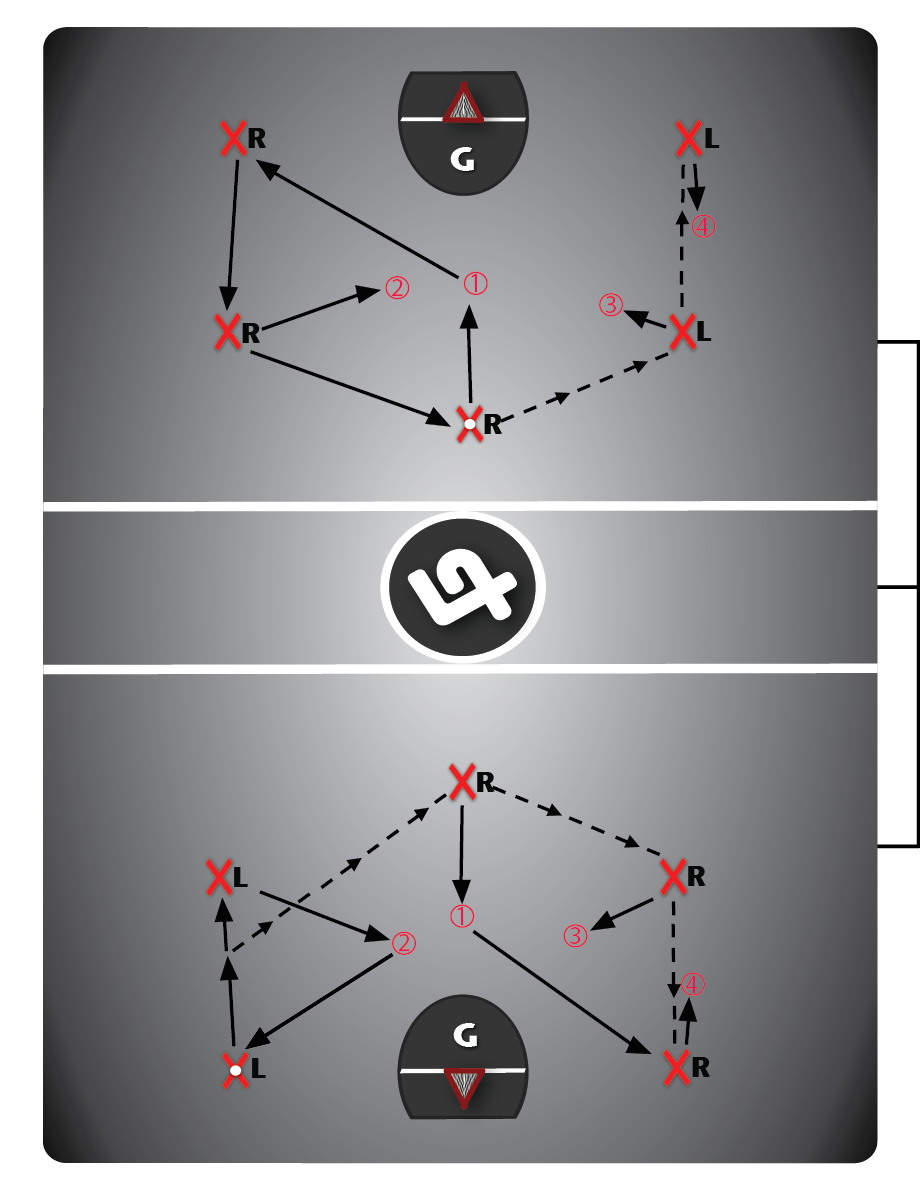
- The "motion offense" is the most basic offensive system, one which relies on getting the ball low and sending a series of cutters in a particular order (timing), otherwise carrying the ball high if no other options present themselves. It is the answer to any defense, as it is a system that responds to whoever is open.
- The most basic Motion/Look #1 happens after the point player (strong-side) passes to either shooter and then cuts the middle, eventually filling into the strong-side crease position (perhaps running around the net first). If this player is wide open they could in theory receive a give-and-go pass, but that is rarely the case.
- Next, the crease player should pop-out and the ball should then be passed low (deep), triggering Motion/Look #2 which is an off-ball "cut" from the far-side shooter position; this is the first read/look for the new ball carrier. If this pass is denied by the defense, the ultimate goal is to "get it low" so the original ball carrier can just carry it low and exchange positions with the crease player. After the off-ball shooter cuts they will either receive a pass, otherwise fill into the crease position on the far-side, with the crease player filling up into the shooter position on that side of the floor.
- If no pass is made, Motion/Look #3 is the next decision for the ball carrier to read, which is a cut from the player at the ball-side (same-side) shooter position, who looks for a give-and-go return pass (advanced); otherwise to seal the shooter position (beginner), or down-pick the crease position (intermediate).
- If none of those "looks" are open for the ball carrier they should fill/cycle up into the shooter position and take a shot (if it's there) or swing the ball to the far-side shooter/point (Motion/Look #4), repeating the process if there's time or going one-on-one to the net in an attempt to get a re-set.
- Throughout this process it is the ball carrier's responsibility to have their head up, always being a threat and passing to any players who are wide open.Systems
PLAY #SYSTEMS
Principles/Guidelines/Team Rules/Discipline:
- Simple fundamental rules that are clear and concise with respect to defensive, transition and offensive strategies, all of which can be effectively drilled during practice. They also must be enforced in order to maintain accountability and to ultimately be effective as a unit (team).
- When players are playing as individuals, and not abiding to “principles” set-forth by the team, "trust" will be lacking and team success will be compromised. Should a player consistently break rules or guidelines (being “undisciplined”), they should be held accountable in terms of playing time and respect. Champions put teammates before self at all times and egos must be kept in check in subtle/creative and overt ways by coaches and teammates alike. There is no “I” in “Team.”
- Note: It won't always go exactly as drawn up, the goal is to ATTEMPT to accomplish the basic movements and passes.3 Back Face-Off Set
PLAY #Transition Set
PLAY NAME = 3-BACK
- This is a basic defensively oriented face-off set up, with 3 defenders in a flat-triangle formation near the defensive restraining line and one player on the offensive side of the restraining line; all players having a set responsibility.
- The lone player on the offensive side of the ball is usually the teams best loose ball player, while the other 3 players on the defensive side of the ball should also be high calibre loose ball specialists.
- The player in the middle at the back of the triangle is the safety, also the outlet and ball support for any player that retrieves a loose ball; usually the smartest and most reliable player on the floor.
- The other two players on the outside of the middle player also attack the loose ball and should have their sticks to the outside, in order to be able to help protect their stick in a loose ball situation (also helping box-out their opponent).
- See the Face-Off Skills Analysis for further information on face-off techniques.Two-Way System ("Lines")
PLAY #Transition System
SYSTEM NAME = "LINES"
- A "two way" transition system is a player substitution method that sees players play both offense and defense, in 5 player “lines” (usually with extra subs), before eventually line-changing. This system has been used for many decades prior to the current trend in Senior/Professional lacrosse of using an Offense-Defense "platooning" style of play. All "Minor" lacrosse players should be fostered using the "lines" system, until beginning to specialize around ages 15-16.
- There are two methods of playing this system and both have to do with line changes, and whether a team has the long-change or short-change in a particular period/quarter.
- On the "short defensive change" (1st & 3rd period - as seen in diagram), coaches will usually first have players run out on defense and then run up and play offense, before “changing;" a Standard Breakout still being required by at least 2 players (not shown in diagram).
- On the "long defensive change" (2nd period - not seen in diagram), teams will usually have players play offense first and then play defense, before line changing; covering against reverse-transition still being required by at least one player. As the "short offensive change," it is an opportunity for breakaways and set-plays coming off of the bench.
- Coaches may also choose to line change outside of any set pattern (“go with the flow”). For example, if a team has multiple re-sets on offense, or a fast-break from their defense (or the opposing defense). If one player is caught on the floor while the rest of their line has changed, the coach can rectify the situation by having the "sub" play only "one-way" for that shift instead of "two-ways" (in order to keep the lines together).
- The obvious drawback with each method is that players are more fatigued while playing either offense or defense, depending on which they had to play first; a fact which should also be weighed for strategic purposes. Playing defense second, for example, not only increases the other team's chance of scoring, but also eliminates the potency of most fast-break opportunities.
- Coaches can also make small adjustments within this system throughout the game, depending on variables such as: the strengths of the players, the current situation, whether or not their team has a lead or is losing on the scoreboard, and how tired their players seem to be, as just a few examples. If players seem to be tired, an appropriately timed time-out is usually enough to get players back near full recovery.Fast Breaks (Lanes & Spacing)
PLAY #Transition Set
PLAY NAME = "RUN"
Lanes:
- There are four imaginary “lanes” referenced lengthwise (north-south) on the floor in lacrosse, two outside and two inside. These lanes are often referred to when speaking about transition and the pick & roll.
- The lanes stretch from either a few metres off of the side-boards to a few metres outside of the goal posts (“outside lanes”), or from a few metres outside of the goal posts to the middle of the net (“inside lanes”).
- Players running in the outside lanes during a fast-break should run as hard as they can to the same-side goal post on a 45° angle, as a general team rule. Inside players should be trailing the play, at least slightly (if possible), and will sometimes have to “slow up” in order to maintain proper "spacing."
Spacing:
- Essentially, transitioning players must maintain good “spacing” so as to not get too close to each other, whereby one defender could potentially defend two offensive players.
- The focal point of spacing is normally the position of the ball. The player carrying the ball should have an opportunity to beat their check at all times. The more space this player is provided in the prime scoring area (staying “spread”), the more likely they are to get a quality shot.
- Proper spacing during fast-breaks is also referred to as running in your “lanes.” The player with the ball in a 2-on-1 needs to remain a threat as they approach the prime scoring area and either shoot or pass, depending on whether the defender slides or "hitches."
- The same goes for a 3-on-2, with one player in the middle lane and two players in the outside lanes, ideally breaking the play down to a 2-on-1 and ultimately a 1-on-0.Basic “House” Defense
PLAY #Defensive System
SYSTEM NAME = "HOUSE"
- Zone Defense: A style of defense characterized by defensive players covering a certain area of the floor.
- A basic "house" zone defense is essentially the inverted coverage of the prime scoring area, in the shape of a stick-figured house (box + triangle).
- Two defenders cover the crease positions, two cover the shooter positions and one covers the point position. The defensive zone can effectively be broken into 4 quadrants, with each of the low (crease) and high (shooter) defenders responsible for what happens in their quadrants.
- Generally, you want bigger defenders low; players who are willing to block shots, box-out in front of the net and ideally someone with good stick skills able to pick off passes going through to the crease. Up high, you want your quicker, smarter defenders, able to make split second decisions like closing the gap on shooters, getting on the gloves of passers and pursuing loose balls.
- The most important player in the defense is the point defender, who is usually the smartest player on the floor on any given shift; with their first responsibility being to make sure that all of their teammates are in their respective positions.
- The defender covering the point must “play on a string,” covering both the point player and the middle of the box when the point player doesn’t have the ball. While in the middle, this player must be prepared to help any teammate that gets beat; adjacent defenders should also "show help" as best as possible, without over-committing.
- Once all defenders have established their spot in the zone they should: keep their sticks up (in passing lanes), maintain "top-side" positioning (closed stance) and stand in shooting lanes on-ball. The high defenders are responsible for closing the gap on shooters and fighting overtop of seals, while the on-ball low defenders responsibility is mainly to block shots and not get beat underneath (where they have no help). It's also worth noting the the low defenders should be as low as the other teams lowest offensive player on their side, as a general rule.
- Beginner/intermediate lacrosse teams should have players start in this defensive formation, time permitting. If players are unable to run to their designated area by the time the ball has entered the defensive zone, sometimes it's best for the coach to call off this defense and switch to a "Man" defense for that particular shift.
- Note: This system is generally the default defense used to defend a 6-on-5 (“pull the goalie”) situation. It is also worth noting that the best way to beat a zone defense is to overload one area of the zone with 2 players, which is why all defenders need to be ready to fight overtop of any seals in their zone and give help to any teammates that they see getting overloaded.Motion Offense ("Timing Offense")
PLAY #Offensive System
SYSTEM NAME = "MOVE"
- The "motion offense" is the most basic offensive system, one which relies on getting the ball low and sending a series of cutters in a particular order (timing), otherwise carrying the ball high if no other options present themselves. It is the answer to any defense, as it is a system that responds to whoever is open.
- The most basic Motion/Look #1 happens after the point player (strong-side) passes to either shooter and then cuts the middle, eventually filling into the strong-side crease position (perhaps running around the net first). If this player is wide open they could in theory receive a give-and-go pass, but that is rarely the case.
- Next, the crease player should pop-out and the ball should then be passed low (deep), triggering Motion/Look #2 which is an off-ball "cut" from the far-side shooter position; this is the first read/look for the new ball carrier. If this pass is denied by the defense, the ultimate goal is to "get it low" so the original ball carrier can just carry it low and exchange positions with the crease player. After the off-ball shooter cuts they will either receive a pass, otherwise fill into the crease position on the far-side, with the crease player filling up into the shooter position on that side of the floor.
- If no pass is made, Motion/Look #3 is the next decision for the ball carrier to read, which is a cut from the player at the ball-side (same-side) shooter position, who looks for a give-and-go return pass (advanced); otherwise to seal the shooter position (beginner), or down-pick the crease position (intermediate).
- If none of those "looks" are open for the ball carrier they should fill/cycle up into the shooter position and take a shot (if it's there) or swing the ball to the far-side shooter/point (Motion/Look #4), repeating the process if there's time or going one-on-one to the net in an attempt to get a re-set.
- Throughout this process it is the ball carrier's responsibility to have their head up, always being a threat and passing to any players who are wide open.
FREE
No Sign Up Beginner Content



Level #1
Content Access