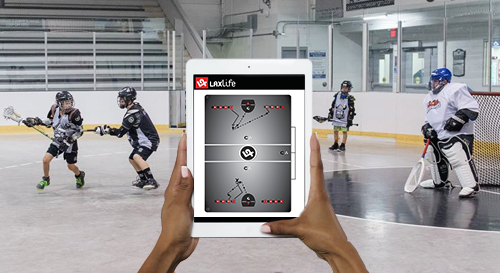
U9 - Special Teams (Strong Right)
Level = Beginner
5-On-4 (5 Plays):
Play #0 - Draw & Dump - "Shot"
Play #1A - Point Drag - "D1" (Option #1 = Point, Option #2 = Left Crease )
Play #1B - Point Drag - Fake - "D2" (Option #1 = Left Shooter, Option #2 = Right Crease)
Play #2A - Point - Seal The Shooter - "Push" (Option #1 = Right Shooter, Option #2 = Left Shooter)
Play #2B - Point - Pick The Shooter - "Pop" (Option #1 = Right Shooter, Option #2 = Point)
6-On-5:
- Use Play #0 - "Draw & Dump" - with a 6th player in the middle
4-On-3:
- Use Box Play #0 - "Draw & Dump"
Short-Handed:
- Box
- 2-Up Triangle
Power Plays
 PLAY #POWERPLAY
- Teams should either "draw & dump" up top (see 5-On-4 Play #0) or execute a set-play within each power-play possession (re-set), with the goal of getting an open shot in the prime scoring area.
- Most set-plays on the power-play involve some sort of overload, via a pick or multiple picks, combined with some sort of ball/player movement; all at specific times (established during practice).
- Teams should do their best to apply pressure once general coverage has been established, in order to create a 10 second call or a turnover. If they are tired or unsuccessful, the back-up (Power Play #2) unit usually then gets the next opportunity on offense (mix up the units every game to allow all players to have an opportunity).5-On-4 Box Play #0 (“Draw & Dump”)
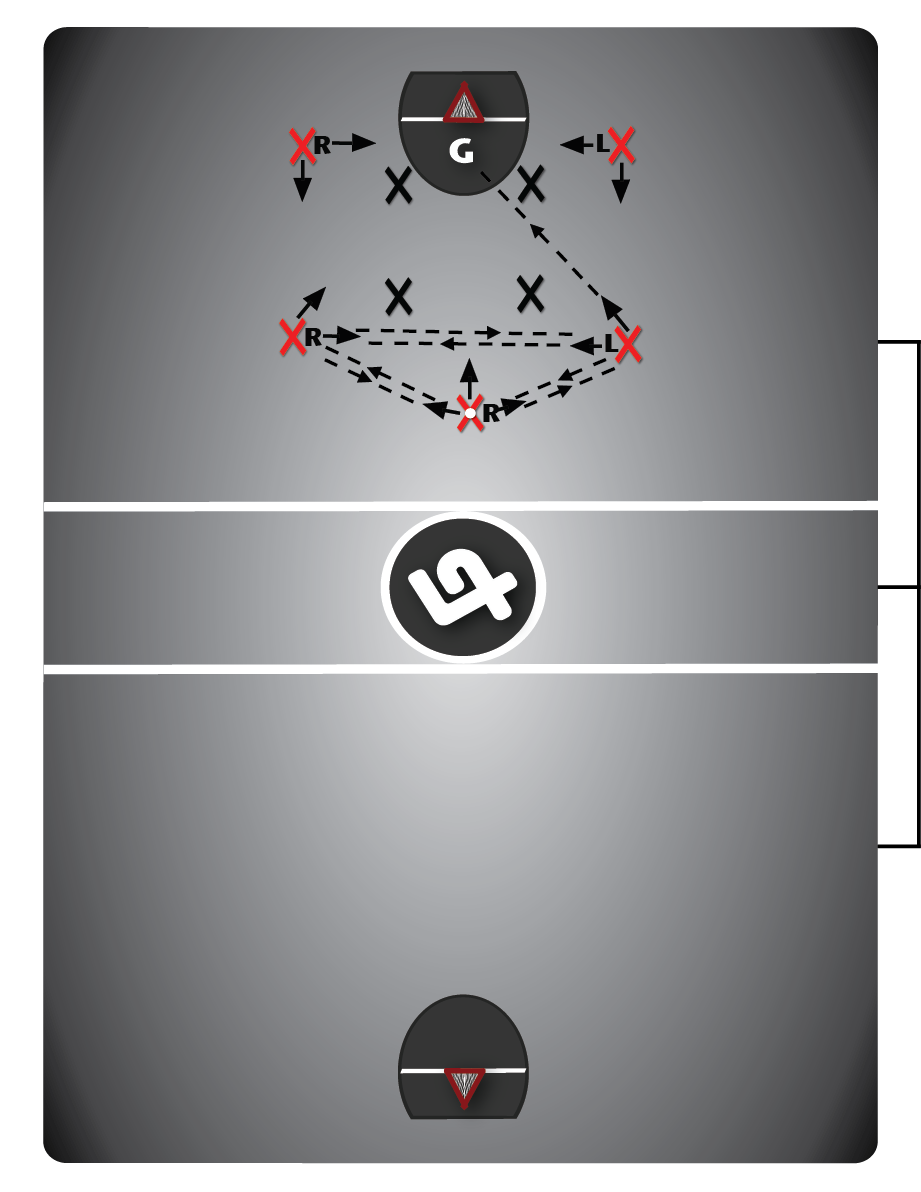 PLAY #0. "Draw & Dump"
PLAY NAME = "SHOT"
- "Draw & Dump" or "Drag & Dump" is the primary aspect of a "FREELANCE" powerplay, which is essentially a 3-on-2 up high, with the point player and both shooters against the two high defenders in a box defense.
- The concept of "dragging" is often utilized whereby a player "draws" their check (who is splitting) out of position (by being a threat); eventually "dumping" the ball to an open teammate for an "uncontested" shot.5-On-4 Box Play #1A ("Point Drag") & Play #1B ("Point Drag - Fake")
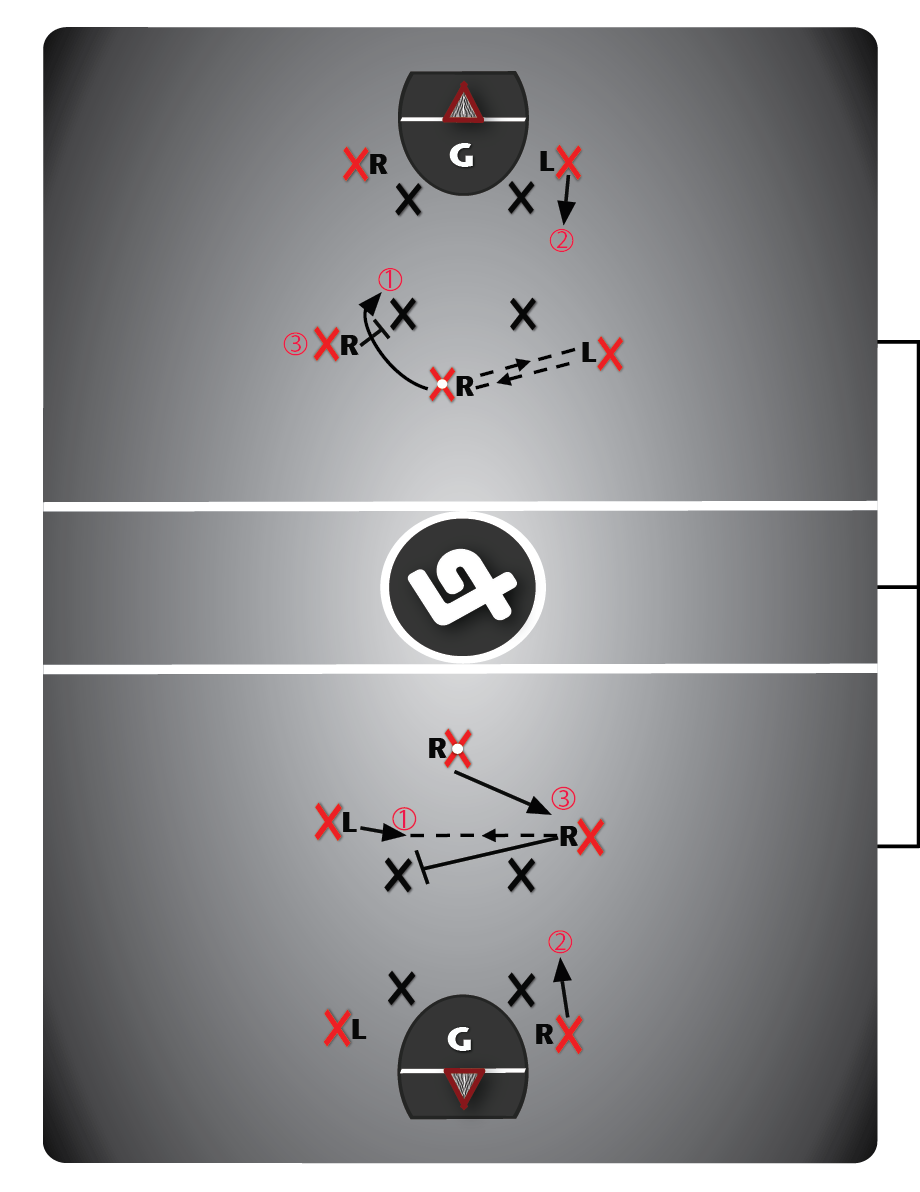 PLAY #1A. Point - "Drag"
PLAY NAME = "D1"
*top diagram*
- The point player passes "around the horn," receives a pass back, then carries ("drags") the ball toward the strong-side shooter position.
- Just before the point player arrives at the shooter position, the shooter that is already there should seal their check down and in toward the middle.
- The point player continues dragging behind the seal for a seam shot (Option #1), or at any time skip passes to the far-side crease player who moves up to the soft spot (Option #2).
1B. Point - "Fake Drag"
PLAY NAME = "D2"
*bottom diagram*
- The point player passes around the horn, receives a pass back, then slowly backpedals ("drags") the ball toward the same-handed shooter position.
- As the point player starts "dragging" the same-handed shooter fakes to set an on-ball seal and instead sets a cross-pick for the opposite-side shooter (another variation is to "slip" to the middle). As a slight variation, this cross-pick could also be set for the opposite side crease player.
- The point player passes to the weak-side shooter a split-second before they come around the seal (or to the slip option in the middle).
- After receiving the pass, ideally the ball carrier can step overtop of the seal and into the middle for a high quality shot (Option #1), otherwise skip passes the ball to the far-side crease player (Option #2).5-On-4 Box Play #2A (“Seal The Shooter”) & Play #2B (“Pick The Shooter”)
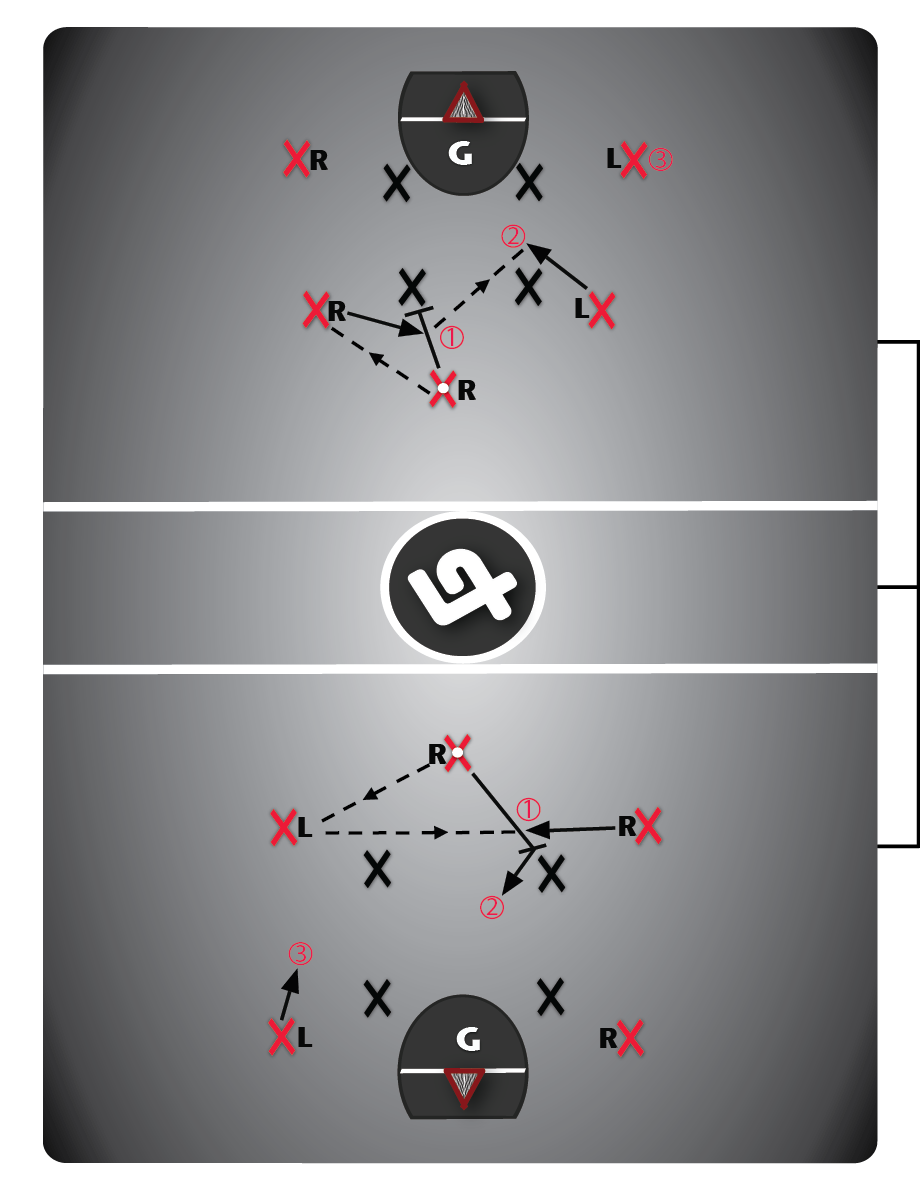 PLAY #2A. Point - "Seal The Shooter" (On-Ball)
PLAY NAME = "PUSH"
*top diagram*
- The point player passes to the same-handed shooter, which triggers the play.
- The point player then seals for the same-handed shooter, who comes overtop and either shoots (Option #1) or passes to the off-ball shooter who cuts the middle (or otherwise stands ready to quickly catch & shoot from the outside) if the off-ball high defender tries to help ("pinch") at the point position (Option #2).
2B. Point - "Pick The Shooter" (Off-Ball)
PLAY NAME = "POP"
*bottom diagram*
- The point player passes to the opposite-handed shooter (who also has the option to pass to the same-side crease player), which triggers the play.
- The point player then picks for the same-handed shooter who either comes overtop for a shot (Option #1), or passes to the picker who rolls to the middle after setting the pick (Option #2).Penalty Kill/Short-Handed
 PLAY #PENALTY KILL/SHORT-HANDED
- It is important that all players know the situation and any other special “assignments" (i.e. who the likely shooter will be).
- Players should always have their sticks up with their bodies in the shooting lanes, also aware of what is happening off-ball (head on a swivel). Defensive players need to recognize picks/seals, drags, cutters, fillers and players behind the net; communicating amongst one another.
- As a general team rule, players should not move more than “three shuffle steps” at a time, depending on the zone being played and the ball movement of the opposing team. If one player slides out of desperation, every player should slide in that same direction ("go"), effectively changing which part of the zone they are defending.
-The Goaltender is essentially the biggest difference maker while short-handed, as they are the cornerstone of any defense. Loose balls are amply important, with the goaltender playing the most significant role via rebound control. Defenders also have a huge responsibility in this aspect as well, being sure to box-out after all shots (especially the low defenders).
- Defenders need to make split-second decisions as to whether or not to pursue loose balls, some of which could potentially leave them out of position if they don’t get there first (50-50 balls). If a teammate does happen to obtain possession of the ball, defenders should run the ball up the floor “in two’s,” with all others running hard to the bench for a line change (a full change would be ideal; thus sparing the energy of the premiere penalty killers).Box
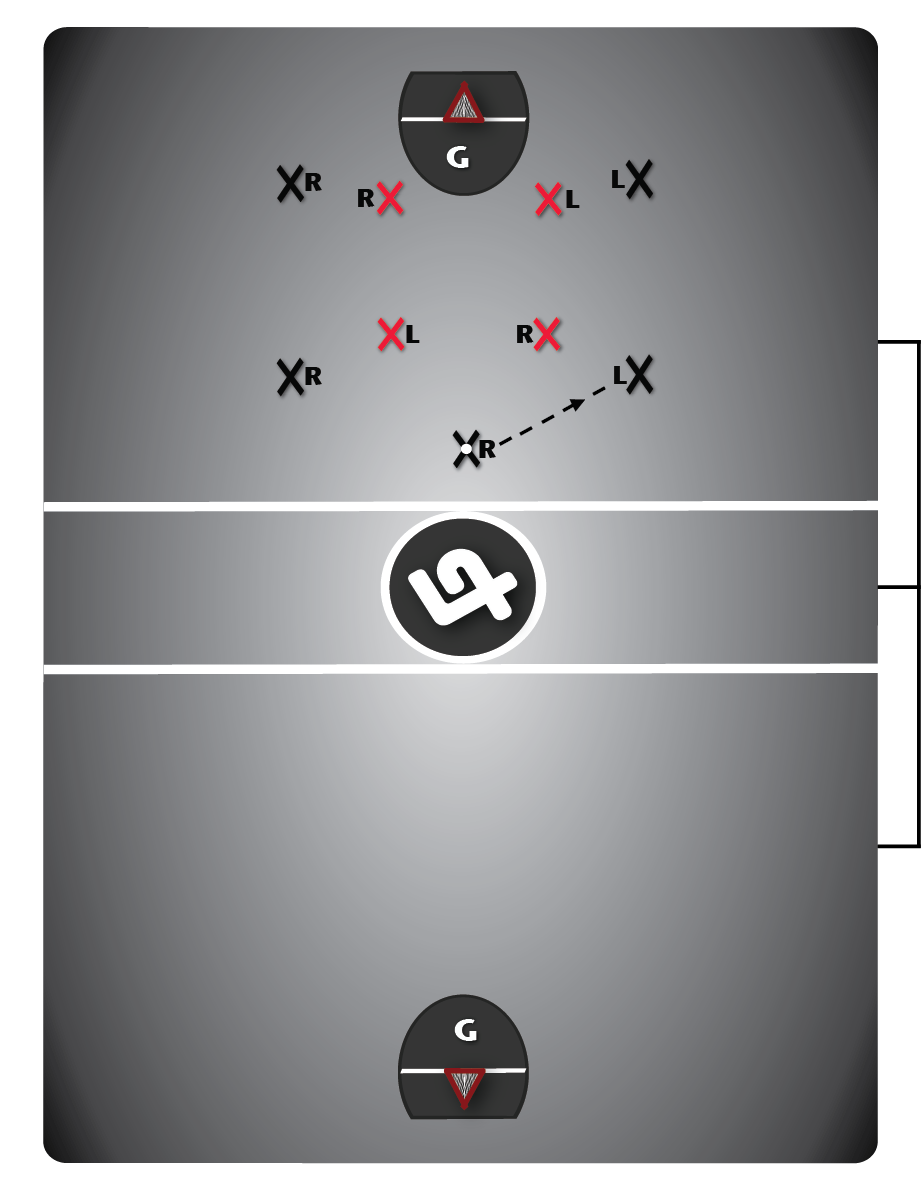 PLAY #Short-Handed (4 vs. 5)
PLAY NAME = "BOX"
- The box is structured to defend both crease players and both shooters, with the two high defenders also splitting the point player (or the player in the middle if the powerplay is in a 2-1-2). Should the point player attempt to shoot, both defenders should “pinch” tight together, trying to block the shot.
- When one of the shooters cuts through the middle, it is also the off-ball “high” defenders responsibility to follow the "cutter," eventually “passing them off” to the on-ball low defender.
- The “low” defenders’ major responsibility is to lock-off the creases, with all defenders keeping their sticks and bodies in the shooting and passing lanes.
- Generally, the “high” defenders’ sticks are towards the middle, and the low defenders’ sticks are towards the boards, in order to best defend these lanes. Although, if either "shooter" on the power-play is a significant play maker, it may warrant the high defenders' stick being on the outside (board-side).
Triangle
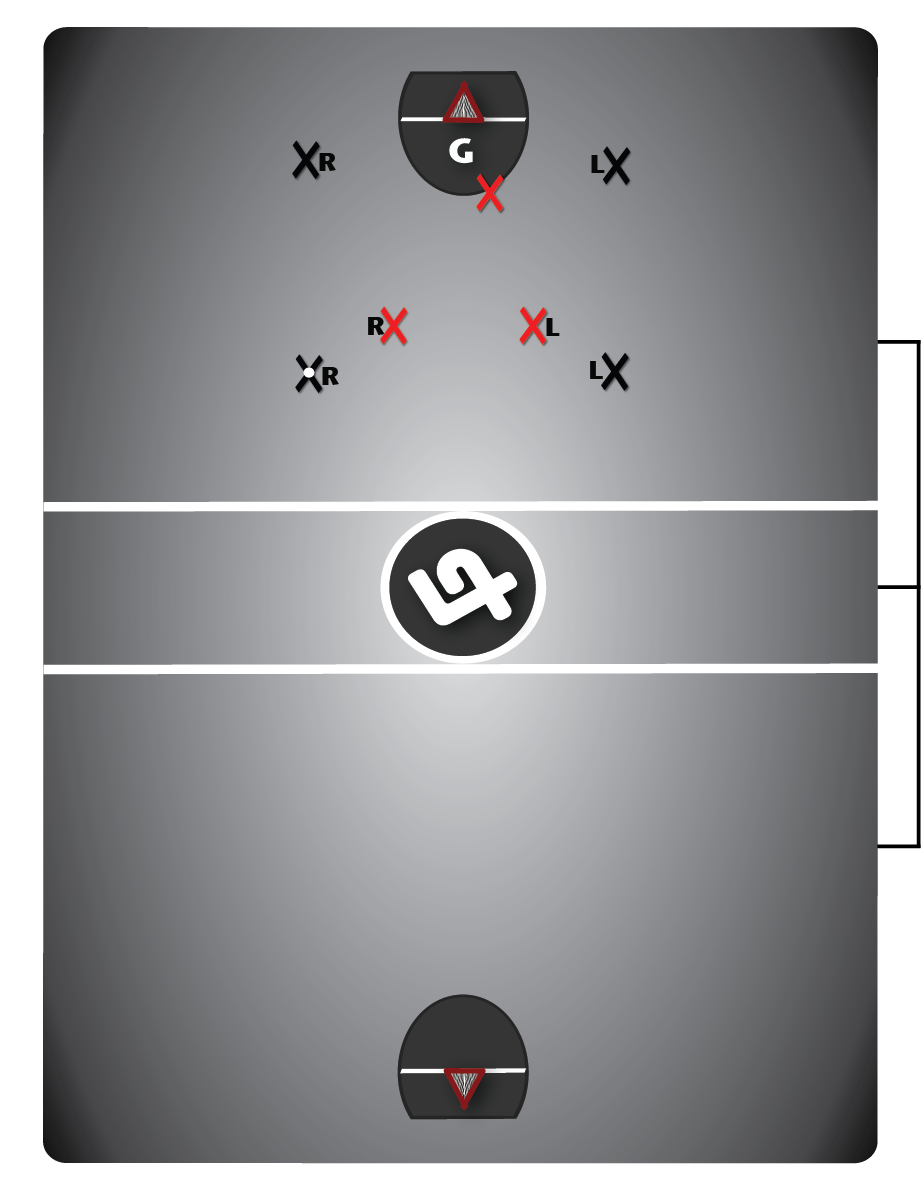 PLAY #Short-Handed (3 Vs. 4)
PLAY NAME = "2-UP TRIANGLE"
- Playing two defenders up high invites the crease players to shoot; the 2 high defenders should have their sticks towards the boards.
- With two defenders high, the low defender must cover passes from one crease player to the other (“crease-to-crease”), while playing “cat & mouse.” Positionally, the low defender should be shading ("hedging") off-ball in the passing lane wherever possible. This player needs to be your smartest player, ideally with good hands able to pick-off passes.Power Plays
PLAY #POWERPLAY
- Teams should either "draw & dump" up top (see 5-On-4 Play #0) or execute a set-play within each power-play possession (re-set), with the goal of getting an open shot in the prime scoring area.
- Most set-plays on the power-play involve some sort of overload, via a pick or multiple picks, combined with some sort of ball/player movement; all at specific times (established during practice).
- Teams should do their best to apply pressure once general coverage has been established, in order to create a 10 second call or a turnover. If they are tired or unsuccessful, the back-up (Power Play #2) unit usually then gets the next opportunity on offense (mix up the units every game to allow all players to have an opportunity).5-On-4 Box Play #0 (“Draw & Dump”)
PLAY #0. "Draw & Dump"
PLAY NAME = "SHOT"
- "Draw & Dump" or "Drag & Dump" is the primary aspect of a "FREELANCE" powerplay, which is essentially a 3-on-2 up high, with the point player and both shooters against the two high defenders in a box defense.
- The concept of "dragging" is often utilized whereby a player "draws" their check (who is splitting) out of position (by being a threat); eventually "dumping" the ball to an open teammate for an "uncontested" shot.5-On-4 Box Play #1A ("Point Drag") & Play #1B ("Point Drag - Fake")
PLAY #1A. Point - "Drag"
PLAY NAME = "D1"
*top diagram*
- The point player passes "around the horn," receives a pass back, then carries ("drags") the ball toward the strong-side shooter position.
- Just before the point player arrives at the shooter position, the shooter that is already there should seal their check down and in toward the middle.
- The point player continues dragging behind the seal for a seam shot (Option #1), or at any time skip passes to the far-side crease player who moves up to the soft spot (Option #2).
1B. Point - "Fake Drag"
PLAY NAME = "D2"
*bottom diagram*
- The point player passes around the horn, receives a pass back, then slowly backpedals ("drags") the ball toward the same-handed shooter position.
- As the point player starts "dragging" the same-handed shooter fakes to set an on-ball seal and instead sets a cross-pick for the opposite-side shooter (another variation is to "slip" to the middle). As a slight variation, this cross-pick could also be set for the opposite side crease player.
- The point player passes to the weak-side shooter a split-second before they come around the seal (or to the slip option in the middle).
- After receiving the pass, ideally the ball carrier can step overtop of the seal and into the middle for a high quality shot (Option #1), otherwise skip passes the ball to the far-side crease player (Option #2).5-On-4 Box Play #2A (“Seal The Shooter”) & Play #2B (“Pick The Shooter”)
PLAY #2A. Point - "Seal The Shooter" (On-Ball)
PLAY NAME = "PUSH"
*top diagram*
- The point player passes to the same-handed shooter, which triggers the play.
- The point player then seals for the same-handed shooter, who comes overtop and either shoots (Option #1) or passes to the off-ball shooter who cuts the middle (or otherwise stands ready to quickly catch & shoot from the outside) if the off-ball high defender tries to help ("pinch") at the point position (Option #2).
2B. Point - "Pick The Shooter" (Off-Ball)
PLAY NAME = "POP"
*bottom diagram*
- The point player passes to the opposite-handed shooter (who also has the option to pass to the same-side crease player), which triggers the play.
- The point player then picks for the same-handed shooter who either comes overtop for a shot (Option #1), or passes to the picker who rolls to the middle after setting the pick (Option #2).Penalty Kill/Short-Handed
PLAY #PENALTY KILL/SHORT-HANDED
- It is important that all players know the situation and any other special “assignments" (i.e. who the likely shooter will be).
- Players should always have their sticks up with their bodies in the shooting lanes, also aware of what is happening off-ball (head on a swivel). Defensive players need to recognize picks/seals, drags, cutters, fillers and players behind the net; communicating amongst one another.
- As a general team rule, players should not move more than “three shuffle steps” at a time, depending on the zone being played and the ball movement of the opposing team. If one player slides out of desperation, every player should slide in that same direction ("go"), effectively changing which part of the zone they are defending.
-The Goaltender is essentially the biggest difference maker while short-handed, as they are the cornerstone of any defense. Loose balls are amply important, with the goaltender playing the most significant role via rebound control. Defenders also have a huge responsibility in this aspect as well, being sure to box-out after all shots (especially the low defenders).
- Defenders need to make split-second decisions as to whether or not to pursue loose balls, some of which could potentially leave them out of position if they don’t get there first (50-50 balls). If a teammate does happen to obtain possession of the ball, defenders should run the ball up the floor “in two’s,” with all others running hard to the bench for a line change (a full change would be ideal; thus sparing the energy of the premiere penalty killers).Box
PLAY #Short-Handed (4 vs. 5)
PLAY NAME = "BOX"
- The box is structured to defend both crease players and both shooters, with the two high defenders also splitting the point player (or the player in the middle if the powerplay is in a 2-1-2). Should the point player attempt to shoot, both defenders should “pinch” tight together, trying to block the shot.
- When one of the shooters cuts through the middle, it is also the off-ball “high” defenders responsibility to follow the "cutter," eventually “passing them off” to the on-ball low defender.
- The “low” defenders’ major responsibility is to lock-off the creases, with all defenders keeping their sticks and bodies in the shooting and passing lanes.
- Generally, the “high” defenders’ sticks are towards the middle, and the low defenders’ sticks are towards the boards, in order to best defend these lanes. Although, if either "shooter" on the power-play is a significant play maker, it may warrant the high defenders' stick being on the outside (board-side).
Triangle
PLAY #Short-Handed (3 Vs. 4)
PLAY NAME = "2-UP TRIANGLE"
- Playing two defenders up high invites the crease players to shoot; the 2 high defenders should have their sticks towards the boards.
- With two defenders high, the low defender must cover passes from one crease player to the other (“crease-to-crease”), while playing “cat & mouse.” Positionally, the low defender should be shading ("hedging") off-ball in the passing lane wherever possible. This player needs to be your smartest player, ideally with good hands able to pick-off passes.
FREE
No Sign Up Beginner Content



Level #1
Content Access