Helping Player-On-Player Defense
- This defense, formerly known as the helping "man-to-man" defense, has been tried, tested and true, and is the staple defense used most often by intermediate calibre coaches/players through to advanced.
- Defenders should run to "the hole" and establish (communicate) an individual check to cover (closest opponent) as the ball enters their defensive zone.
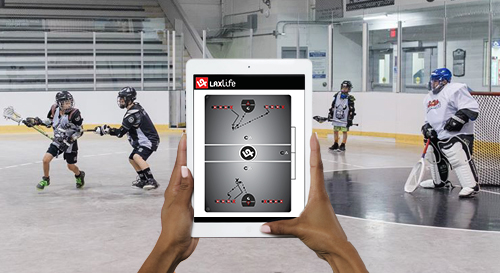
- As a team rule, beginners are usually best to just “stay” on their check wherever they go, until “switching” concepts and defensive positioning are better understood. Whereas for more experienced players "automatic switching" is the rule, unless communicated otherwise (as seen in bottom diagram). At any given point during a defensive shift players might potentially find themselves defending at any one of the standard offensive positions (crease, shooter, point), depending on where their check goes and whether or not they are able to "switch."
- For intermediate and advanced players, once all defenders have established a check individually they should: maintain “top-side” positioning on-ball (closed stance), keep an open stance off-ball, keep their sticks up (in passing lanes) and head on a swivel, stand in shooting lanes where possible while on-ball; follow cutters hip-to-hip and blow up picks where possible (be physical). "High" defenders must also close the gap on shooters and fight overtop of seals, while "low" defenders must lock off the crease (off-ball) and not get beat underneath (on-ball).
Bad things happen when the low defender on-ball chases out into the low corner, usually they either get "picked off" (with lots of space behind them to pass to the roller), or the defender simply gets beat underneath (where there's no help). The general rule for the on-ball low defender is to be as low as the lowest offensive player.
Collectively off-ball defenders should sag into the middle, "stay tight" and be prepared to help any teammate that gets beat toward the net (adjacent or off-ball), leaving their check entirely and "sliding" over if required. There is no need to chase one's check out by the boards as ultimately they will need to come to the middle and get to the net to be a scoring threat. Checking players out wide off-ball just leaves more space open in the middle for the offense to take advantage of and it limits the defenders ability to help their teammates.
The key player in the helping man-to-man defense is the off-ball high defender on the weak-side, and the off-ball "middle defender" on the strong-side (sometimes known as the "hot" defender). Whoever is in either of these positions at any given time should sag off of their check and into the middle more than any other player on the defense (adjacent defenders should also "show help" where possible). At the end of the day when you commit to helping, it's "slide to collide" as they say; with defenders encouraged to take the body as opposed to swinging their stick.
The ultimate goal of any defense is not to get scored on as a team. "I had my check," is simply not good enough. In essence, individual defenders are responsible for 1.5 players at any given time; your own check, as well as half of one of your teammates (if they need "help"). Goalies are responsible for stopping: shots from outside of the prime scoring area, shots from players on their wrong floor side, and seam shots.
Coaches also need to develop a simple communication system for players, such as: calling out the direction of picks (left, right or back-picks), switches, communicating where/who is help, and calling out one's position in "the wall" (high, middle or low).

Would you like to share your thoughts?
Your email address will not be published. Required fields are marked *
Leave a Reply
You must be logged in to post a comment.
Would you like to share your thoughts?
Your email address will not be published. Required fields are marked *
Leave a Reply
You must be logged in to post a comment.
0 Comments