Transition Drill #8A: 2-On-1 & 3-On-2 “Fast Breaks” From Centre
- Demo (1 min): “I” Formation & Splitting - Finishing Your Check vs. Hitching - Being A Threat
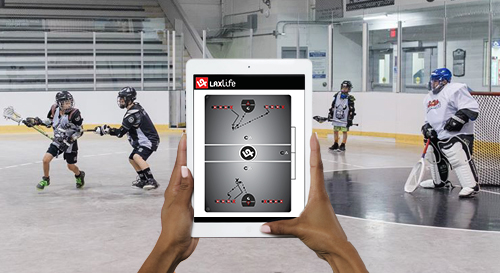
- Start with two (or three) lines of players at the restraining-line (near or far), on their proper floor side, facing one or both directions; with all lines having a chance to start with balls, or a coach sending in a pass to a different line each time.
- A volunteer defender (or two) starts a few steps below the restraining line, split between both offensive lines. For beginners and younger players, coaches should consider starting with a pylon at the top-centre of the prime scoring area, instead of a defender; eventually adding dummy defense from a coach and then an actual defender.
*Variation #1A (10 min): "Defender At Centre." Offensive players attempt a 2-on-1, with the defender starting in the middle of the floor with their "stick up," ready to "fall back." Following the first rep through the drill, the last offensive player to touch the ball is out of the drill, running out of the drill along the side-boards; while the other offensive player gets into defensive positioning for the next 2-on-1.
For beginners, start slow, around 50% of maximum speed, advancing to full speed during the latter reps through the drill. In some cases it might even be best to start at walking speed and build up to a slow jog (50%).
The ball carrier must always be a threat to shoot, and also be ready to pass if pressured by a defender.
Another key concept for ball carriers is learning how to open up their hips when making the pass. This means instead of their hips facing the end-boards (north-south) while running towards the net, opening them up 90 degrees to facing the side-boards (east-west) making for a higher percentage pass.
See Goaltending Drill #4C for "skeleton" 2-On-0's, which are a regression of this drill.
*Variation #1B (10 min): "Defender At The Bench." Same as the above variations except 2 or 3 volunteer defenders should start in a line close to a real or hypothetical defensive door. The last offensive player to touch the ball and the defender rejoins their respective offensive line and the other offensive player joins the defensive line at the bench.
All players should keep an eye for if there is a line that is visibly short and fill the line, with coaches also being sure to start the defensive players from the opposite side of the floor as well (switching sides halfway through the drill).
*Variation #2 (10 min): "Quick Stick Finish." Same as the variations above except players are asked to finish with a quick stick shot on net, or generally use quick sticks as much as reasonably possible.
*Variation #3 (20 min): "3-On-2." This is a similar set-up to Variation #1 except two volunteer players play defense and a third line of offensive players are stationed in the middle lane (with balls).
It may also be beneficial for inexperienced players to first do skeleton 3-on-2's with no defenders. In this case, players in the middle line start by running forward and not passing until they are at the cusp of the prime scoring area (marked with a pylon). The outside line that receives the first pass should make it look like they want to shoot then pass to the other outside line as they cut towards the net (which is the classic 3-on-2 breakdown). This player looks to the net as if they're shooting and shoots (Option #1), or passes to the player show started the drill in the middle lane (Option #2).
Once real defenders are added, the defensive players fall back into the “I” formation while defending the offensive players up as high as possible (matching their speed while running back to the net). Following the first rep through the drill, the last offensive player to touch the ball is out of the drill (jogging around the outside of the drill and back into line), with the other two offensive players staying in on defense (Variation #3A). Otherwise, if defenders start from the bench (Variation #3B), these players run out of the drill and to the bench, replacing the other 2 volunteer defenders who are set to participate in the drill.
The offensive player who starts with the ball should carry it to the middle, with the outside players "running their lanes" toward the crease. Once the ball carrier receives pressure they should pass the ball to either outside lane, otherwise go to the net for a shot (be deceptive). Outside players are essentially in a 2-on-1 after the first pass is made, and should either shoot or pass depending on their angle.
*Variation #4 (20 min): "Progressively Closer/Further Away." Same as Variations #1 & #3 except all players start progressively closer to the net (Variation #4A), or further from the net (Variation #4B), each time through the drill.
By moving players closer they have to make quicker decisions, and by starting them further back into the defensive zone, it adds more of a cardio element and replicates the most prevalent scenario in games.
*Variation #5 (20 min): "With A Chaser." Same as the above variations except a second or third defender (in the case of 3-on-2's) starts 3-5 metres behind the play and chases the offensive players in an attempt to bring the play back to even-strength. If they are able to bring it back to full strength, offensive players have another 10 seconds to get a quality shot before the coaches whistles the play dead.
The "chaser" should alternate between coming from the line of "lefty's" and the line of "righty's" each rep through the drill, until all players have had a turn chasing.
Following the first rep through the drill, the last offensive player to touch the ball is out of the drill (running out of the drill along the side-boards); while the other offensive player(s) get into defensive positioning for the next rep.
*Experienced defenders "identify" who they want to shoot, also accomplished via communicating with the goalie. If the player with the ball has poor stick skills, or is on their wrong side, that would be the ideal player to have shoot.

Would you like to share your thoughts?
Your email address will not be published. Required fields are marked *
Leave a Reply
You must be logged in to post a comment.
Would you like to share your thoughts?
Your email address will not be published. Required fields are marked *
Leave a Reply
You must be logged in to post a comment.
0 Comments