Transition Drill #5A: Standard Breakout Drill (“Clearing”)
INTERMEDIATE
- Start with 5 players in the Basic "House" Defense with the rest of the players on the bench at the offensive door, for either a short change (not shown in diagram) or long change scenario.
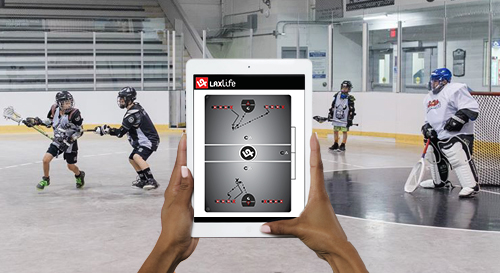
- A coach starts with a ball in the middle of the defense, taking a shot at the goalie or sending a loose ball into play to begin the drill. The goalie or a defender corrals the rebound, with all other players running (or backpedaling) to the Standard Breakout Positions relative to their floor position (whoever is closest), with their "eyes on the ball." (Draw Diagram)
The first look for the goalie, if advanced, should be down the floor to Position A (proper floor side) for a breakaway, but only if wide open.
Intermediate goalies should look to Position B to initiate a fast- break, if possible.
For beginners, Position C should move down towards the mid-boards for an easy outlet pass, with Position B replacing their old spot (the majority of breakout passes throughout the course of the game will be to this position). If the goalie doesn’t pass well, they could also just flip the ball to a good ball carrier in the crease (while continuing to work on their passing skills as the season progresses).
Position D is the key outlet, in having to make a decision whether to run to the bench or do a button-hook in the middle of the defensive zone, as an emergency outlet if all other outlets happen to be covered.
- Variation #1 (7 min): "No Pressure." The two players closest to the bench should “run hard to the bench” to try and help create a fast- break (bench assist), but only once they are sure their team has possession of the ball.
- Transitioning players should then “run the ball deep” and “in two’s,” passing the ball off to Position A or E and finishing the line change with the rest of their teammates (Variation #1A). These 5 new players then fall back back to the defensive zone after every player touches the ball and a shot is taken; breaking out and line changing the very next rep.
- The other option is for players to just stop the drill at centre-floor after breaking out, as an initial variation for beginners (Variation #1B), with 5 new players coming into the drill off of the nearest bench.
Variation #2 (10 min): "Passing Shuttle." Same as the above variation except have players start in a "Passing Shuttle" (in the middle of the defensive zone) and when the coach blows the whistle whomever has the ball rolls or passes it into the goalie and all players need to fill the standard breakout positions reacting, based on where they are when the coach blows their whistle.
Variation #3 (7 min): "Coach/Player Lock Off." Same as the above variations except coaches or players take turns locking off one or more outlets, challenging players’ decision making ability.
Keep track of successful breakouts without a turnover (make note of the team record for the season).
Variation #4 (10 min): "Half-Floor Man Press." Same as the above variations except after their turn breaking out, all 5 players go to defense and practice a Half-Floor Man Press against the group who came off the bench during the breakout and are now trying to break-out themselves on the next rep (Variation #4A). After pressuring, players exit the drill and start on the bench for future reps. To make it even more difficult, coaches can have players pressure first, break-out second and come off the bench third (Variation #4B).
Variation #5 (10 min): "Skeleton Offense." Platoon players on the bench, dividing them into both offense or defense. Repeat the drills above except after the line change offensive players should run an offensive system or set-play eventually finishing with a "quality shot" on net (Variation #5A).
Another variation is for the offense to then line change after they shoot (Variation #5B), with the far-side high offensive player having to run back to defense before they come off the floor (which mimics reverse transition responsibilities - especially during the "long change" in the second period).

Would you like to share your thoughts?
Your email address will not be published. Required fields are marked *
Leave a Reply
You must be logged in to post a comment.
Would you like to share your thoughts?
Your email address will not be published. Required fields are marked *
Leave a Reply
You must be logged in to post a comment.
0 Comments