
Transition Drill #3A: 2 Player Out & Ups (“Push” The Ball)
- Demo (1 min): Lanes, Running "In Two's"
- Start with 2 lines of players, on their proper floor sides, on both sides of the crease, at one end of the floor.
- The second player in line should be ready with a ball and the first player in line should be ready without a ball. The drill alternates from side to side with the next two players set to go in the drill waiting until the group ahead is at least half-way to the far-end before they go.
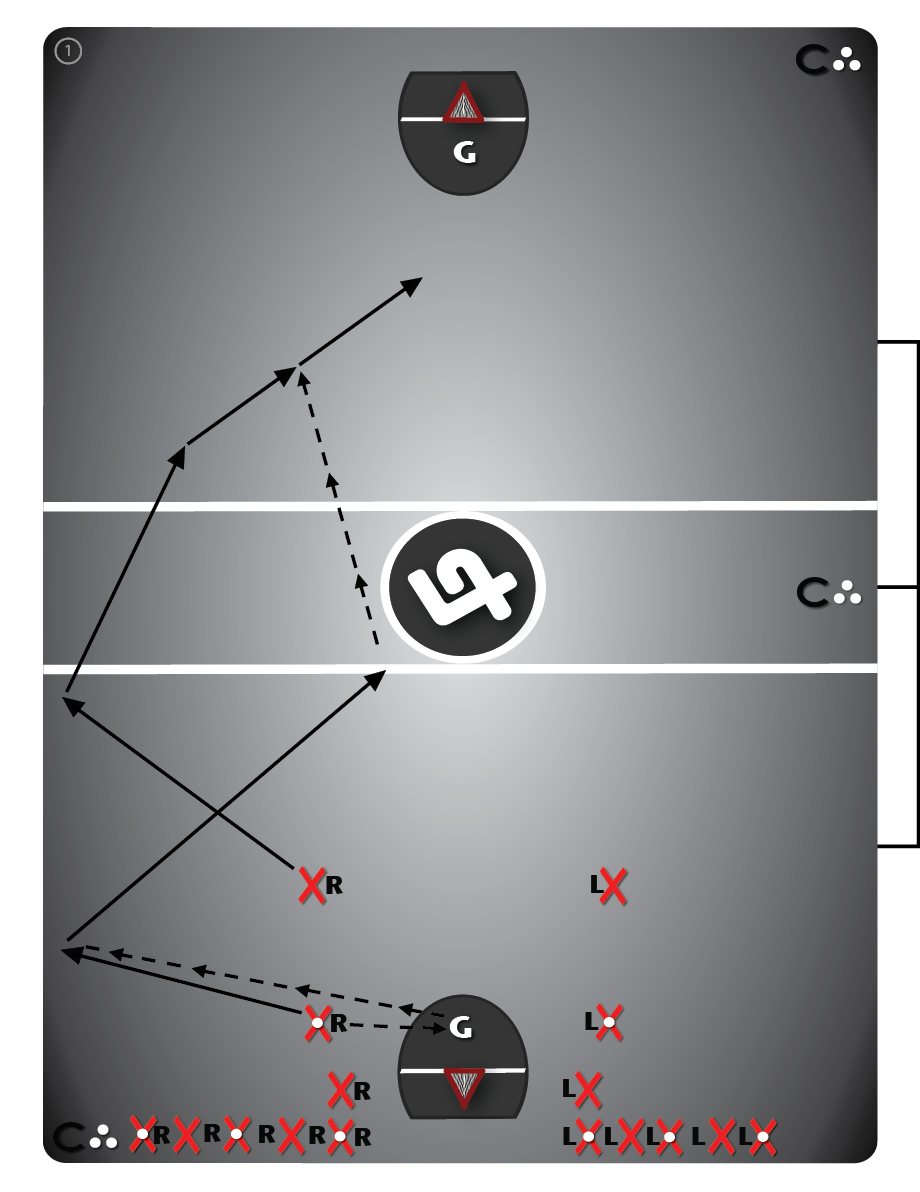
Variation #1 (7 min): "Outlet Pass." The first player in line steps out to the shooter position and the second player to the same-side crease position. The low outlet rolls or bounces the ball into the goalie and then runs (or backpedals) to the mid boards, while the high outlet runs hard near the side-boards (in the "outside lane") toward the other end of the floor (not leaving the defensive zone until the goalie has control of the ball).
The low outlet receives a pass from the goalie near the mid-boards, cuts to the middle and runs hard up-floor (towards centre-floor), making a pass to the high outlet (eye contact), who simultaneously cuts away from the boards on a 45° angle towards the net for a breakaway shot.
The low outlet then becomes the high outlet after the other side takes their turn; with a new low outlet entering the drill. Otherwise, coaches can make both players run together "in two's," with the low outlet attacking the net for rebounds or loose balls after making the initial pass.
It's worth noting that if there is one or no goalies, a volunteer player or coach can stand in place of the goalie making the initial outlet pass.
Variation #2 (7 min): "Curl @ The Half-Board." The exact same as the previous variation except the player who receives the "head-player pass" (from the low outlet or possibly from the goalie) curls out at the mid-boards (aka "half board") and hits the trailer with a pass, for a shot (Variation #2A).
The trailer may at times need to slow-up in order to not get too close to the passer. Otherwise, players should be running at full speed wherever possible.
The next time through the drill, players who were low outlets should start as the high outlet and vice-versa, in order to equally promote the skill development in both roles.
This action can also be done as fake-curl out at the mid-boards, with a subsequent re-dodge underneath (Variation #2B), which emphasizes players still looking to be a threat once they've run the ball deep. In this case, the ball carrier should first give the trailer a look and then take it to the net; with the trailer attacking the rebound.
Variation #3 (7 min): "Pick & Roll." This variation is the same as Variation #2 except the player who receives the head-player pass (possibly from the goalie) carries the ball to the mid-boards and executes a pick & roll with a same-handed player coming late into the play. This is technically the last "look" in transition before getting into a set-offense, in what's otherwise famously known as "The Peterborough Pick."
Variation #4 (7 min): "Bench-Side Recovery." Similar to the above variations except after catching the pass, the player on the bench-side cuts across centre-floor and runs the ball deep to the far-side, with the original passer becoming the hypothetical trailer coming "late" off the bench. Alternate with both lines doing a separate pattern, switching sides each time through the drill.
Variation #5 (7 min): "Light Pressure." Another variation of the above drills would be for coaches (or volunteer defenders) to apply pressure after either the low outlet (Variation #5A) and/or high outlet (Variation #5B) receives a pass, in which case the other player should support their teammate by attempting to create an open passing lane, or picking for them in order to safely clear the zone. Another option instead of a volunteer defender is for the first player(s) in line to play defense, later taking their turn on offense (after the other side takes their turn).
Another coach can also stand in the middle of the defensive zone (instead of defending the high outlet position), this time in the far-end and forcing the player going to the net to "make a move" (Variation #5C) on them.
When the low outlet gets the pass they should run it to the middle and pass it up to the high outlet if they have the chance, otherwise in a game it's "when in doubt, run it out." Further, if the high outlet is attempting to run it deep after catching a pass, the low outlet should run to where the side-board meets the far-side restraining line in the far-end, staying approximately 5-7 metres behind/beside them as they run up the floor. This is a good habit we try to build when players are "running in two's," ultimately giving a support outlet to the player who runs the ball deep at all times (until they are sure their teammate won't get pressured - at which point they can line change).
Variation #6 (7 min): "Scrambled." This variation could be applied to any of the above variations whereby players must start on a different side of the floor each time through the drill (beginning with two mixed lines of lefts and rights), ultimately leaving an undetermined number of players on their wrong floor-side; having to identify the situation and still get off a quality shot.
Variation #7 (7 min): "Game To 7." To add competition, play a game of lefty’s versus righty’s up to 7 goals, losing team does push-ups, sit-ups, body weight squats, sprints, etc.
Variation #8 (7 min): "No Drops/No Misses Game." For every ball that is dropped and/or misses the net during the drill players will have to sprint from one side-board (or end-board) to the other. For every goal that is scored, one sprint is removed from the total, with goalies having to run if the players keep their sprint total at or below zero.
Would you like to share your thoughts?
Your email address will not be published. Required fields are marked *
Leave a Reply
You must be logged in to post a comment.
Would you like to share your thoughts?
Your email address will not be published. Required fields are marked *
Leave a Reply
You must be logged in to post a comment.
0 Comments