
Transition Drill #12: Open Floor 4-On-3 Breakdown
 ADVANCED
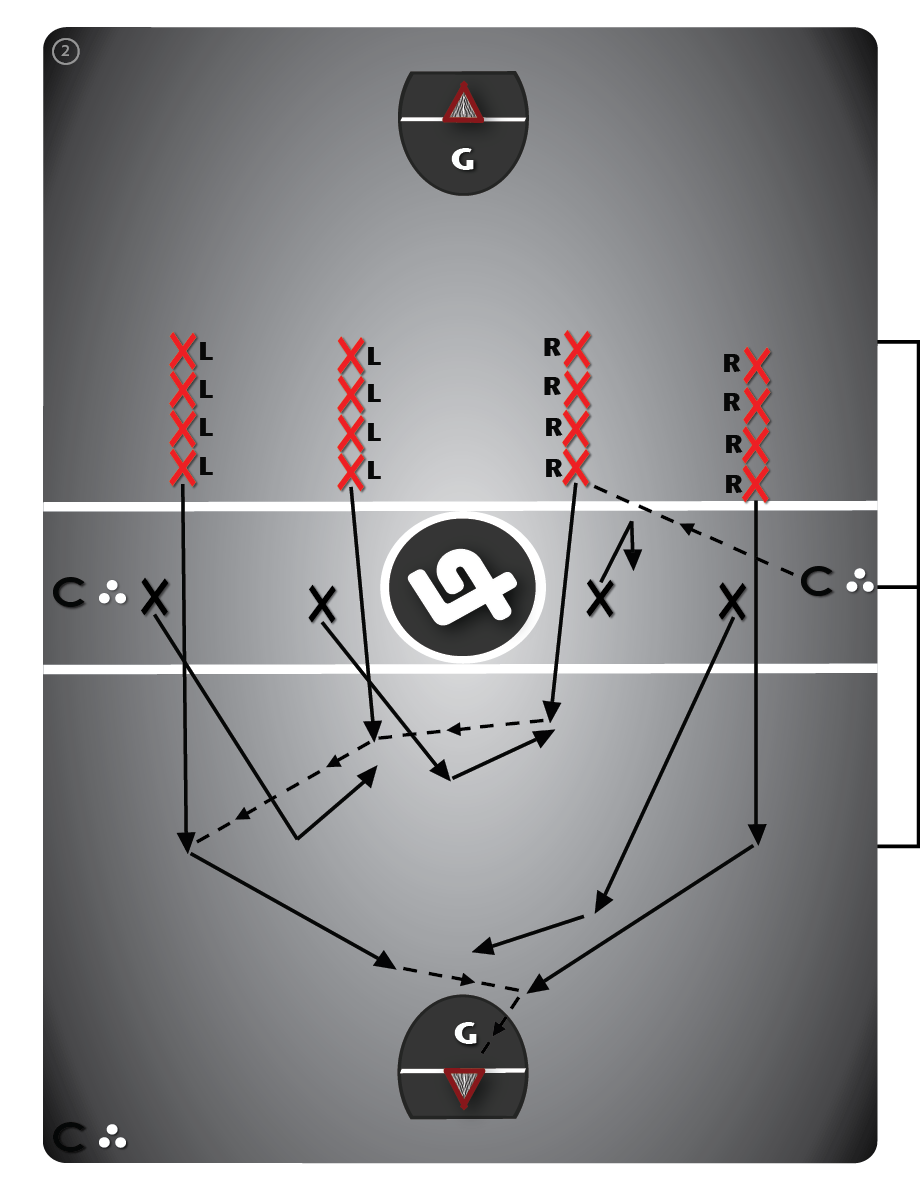
- Begin with 4 lines of offensive players behind the far-end restraining-line (4 transition "Lanes") and 3 volunteer defenders spread out evenly in the defensive zone and facing each line (eventually 4 defenders facing each line - as seen in the diagram). The coach stands by the boards at centre-floor with balls and starts the drill with a pass to any of the 4 offensive lines.
- A more remedial version of this drill is to start all players in the offensive/defensive zone, with defenders touching sticks in the middle and offensive players at the crease & shooting positions, playing more of a stationary 4-on-3. Otherwise, there can be 4 defenders starting on defense and whichever offensive player the coach passes to that defender has to run and touch the boards, attempting to get back into the play and even out the numbers.
- Variation #1 (10 min): "Defender Bow-Out." Start with 3 defenders who should try to force the play as soon as possible (then immediately bow out of the drill), which helps the offensive players establish their timing and be ready to react.
Variation #2 (10 min): "With A Chaser." Whatever line gets passed to the defender facing that line needs to run forward and touch the restraining-line, while all others fall back into a triangle, eventually sliding to force as many passes as possible. The original defender becomes the chaser, attempting to bring the play back to even-strength.
This drill is primarily for the offense in trying to break a 4-on-3 down into a 2-for-1, stringing multiple passes together at game speed. If the coach passes the ball to either inside lane, these players should stay in their lane running full-speed (being a threat) until pressured; "slowing up" to keep their spacing if they are on the back-side of the play.
If the coach passes the ball to either outside lane, these players should carry the ball to the middle of the floor (criss-crossing with the player in the inside lane on their side), which is standard protocol for eliminating suicide passes and creating effective fast-breaks. Whichever player is in the other outside lane while the play passes through the neutral zone should then sprint to the near-side post, on a 45° angle.
Defensive players should participate for three straight reps in this drill, then 4 new volunteers should jump in, until all players have had a turn to play defense. Offensive players should switch between the “outside lane” and “inside lane” each rep.
Variation #3 (10 min): "Breakout Into 4-On-3." Same as any of the above variations, except play starts with a coach taking a shot on the goalie or dumping the ball into the defensive zone, with the 3 defenders (or 4 defenders if chasing) having to breakout and then pass the ball to any of the offensive lines after they clear the zone (restraining line) with the ball.
Variation #4 (10 min): "1 Ball." Terry Sanderson's variation. Defensive players need to pass the ball back to the coach in order for the next rep to get started. This variation forces a well-supported break-out, with defenders attempting to clear the zone against open floor pressure.
Variation #5 (10 min): "Scrambled." This variation could be applied to any of the above variations, whereby players must start on a different side of the floor each time through the drill, ultimately leaving an undetermined number of players on their wrong floor-side; having to identify the situation and still get off a quality shot.
Variation #6 (10 min): "No Drops/No Misses Game." For every ball that is dropped and/or misses the net during the drill players will have to sprint from one side-board (or end-board) to the other. For every goal that is scored, one sprint is removed from the total, with goalies having to run if the players keep their sprint total at or below zero.
Would you like to share your thoughts?
Your email address will not be published. Required fields are marked *
Leave a Reply
You must be logged in to post a comment.
Would you like to share your thoughts?
Your email address will not be published. Required fields are marked *
Leave a Reply
You must be logged in to post a comment.
0 Comments