
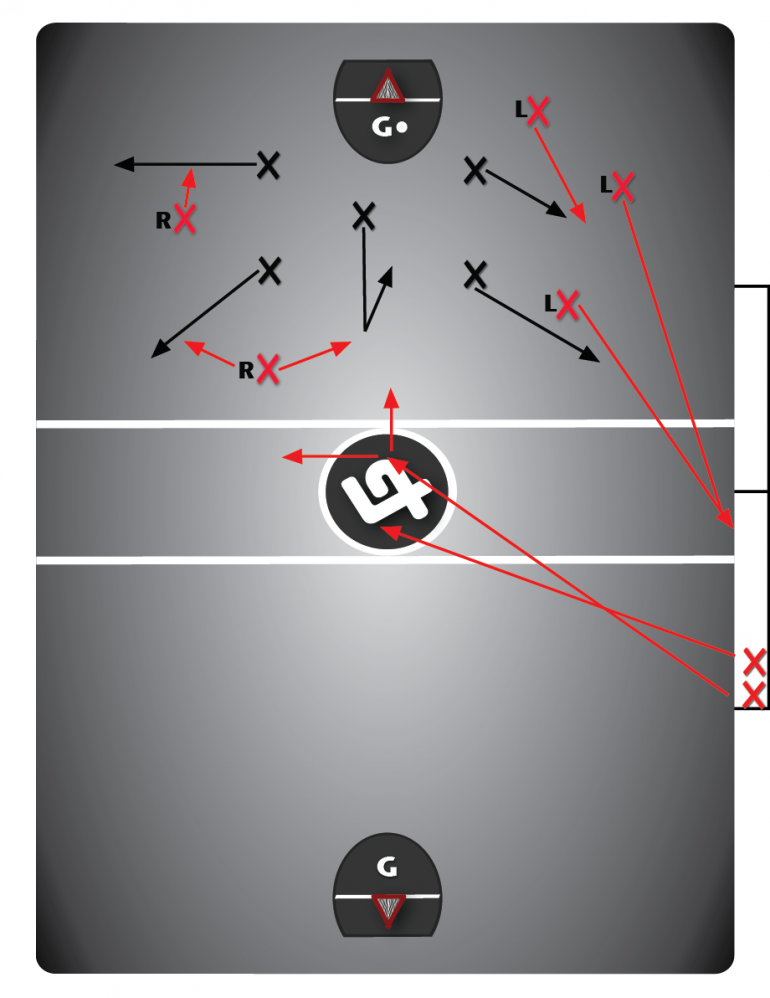
Goody’s Full-Floor Zone Press
 ADVANCED TRANSITION SET
- Generally speaking, a "full-floor press" is a transition strategy utilized after a loss of possession, with the intention to give the other team’s offense less time to set-up. This system can also be used to tire out the other team, who usually is in worse physical shape and more likely to make mistakes than the team that has been practicing it all season. Having said that, offensive specialists will be sacrificing a lot of energy (in an offense-defense transition system) and at risk of getting frequently caught on defense, so the full-floor press is best used in “timely” situations, for a few minutes or a period at a time (i.e. offensive short change).
- It is usually ideal for players to change from the defensive end (after playing defense) during this press, but there are also times when players can change if their check changes. If a team knowingly intends on playing a lot of full-floor press in a particular game, ideally they should dress more transition specialists; they should also be prepared for opponents to make adjustments to their breakout.
- Certain scenarios may encourage players to take risks and try to strip the ball from the opposing team during this "press" (i.e. when losing late in a game), using a double-team when the opportunity presents itself. If a turnover is created, players may take it to the net if it's a fast-break opportunity, otherwise it is best to make a line change and get fresh players out on offense.
Working as a team is a must in this system (players must be prepared to play “Both Ways”), and a 3-1-1 is utilized as a theoretical starting formation. The back two players should be in the I-formation (making smart coverage decisions), about 10 metres apart, with the front three players in a 2-up (wide), 1 back triangle. The two players who are "up" in the triangle lock off the low passing outlets and the player at the "back" of the triangle has to decide whether to pressure the button-hook in the middle or pressure the high outlet; usually the button hook early on. All other players must shadow their check closely and slide at the right times (anticipate) in order for this system to be effective. This is a general structure, but it rarely commences exactly how it’s drawn up.
As a general rule, players checking the ball carrier should avoid getting beat along the boards, instead forcing their check back to the middle where there is help; otherwise "pinching" their check along the boards (which acts as a double-team). A best case scenario would then be to pressure an “egg & spooner” and funnel them toward the boards, where they could then be double-teamed. If not possible, two of the offenders on the bench-side who were applying initial pressure should quickly line-change when their opponent line-changes, which in turn requires their teammates to continue pressing-up from the back-door (getting into an "I-formation" near the restraining-lines).
Coaches and players alike should remind each other by yelling "press" after losing the ball on offense. It is important that players on offense hit the net on their shots, which allows more time to set-up the press, otherwise the press may have to be abandoned on that particular shift ("off"). If any rebounds go into the corners, this is also another good time to communicate the press.
In most cases players should avoid giving up defensive positioning and taking risks, yelling "broken" should an opponent beat them and obtain a fast-break (signaling that the press is off and to get back in the hole). The last player back is otherwise known as the "safety" or "rover" and is the last line of defense if the press is broken. They must be quick and alert, able to read the player with the ball and very good at playing defense when outnumbered (a 2-on-1 against is often the result of a broken press). They can't just sit back and wait. They need to be courageous and decisive in attempting to pick-off any long passes, without fear of failure; experienced enough to know when to take a risk and when to play it safe.
Would you like to share your thoughts?
Your email address will not be published. Required fields are marked *
Leave a Reply
You must be logged in to post a comment.
Would you like to share your thoughts?
Your email address will not be published. Required fields are marked *
Leave a Reply
You must be logged in to post a comment.
0 Comments