
Force (Pressure) Down Defense
 ADVANCED DEFENSIVE SYSTEM
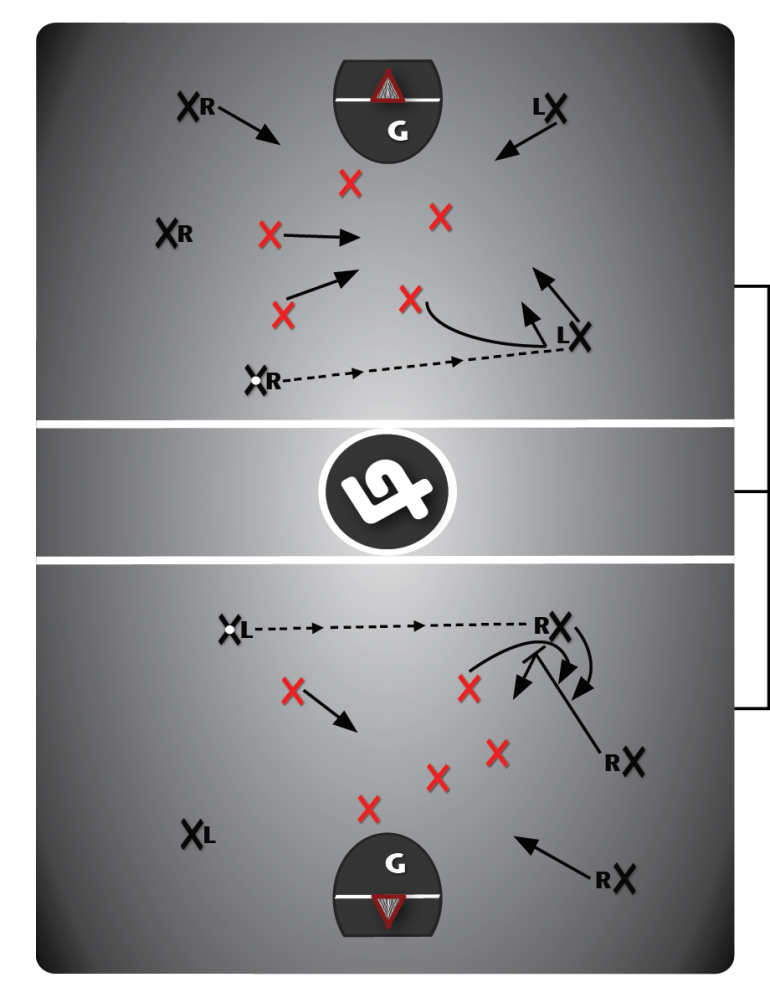
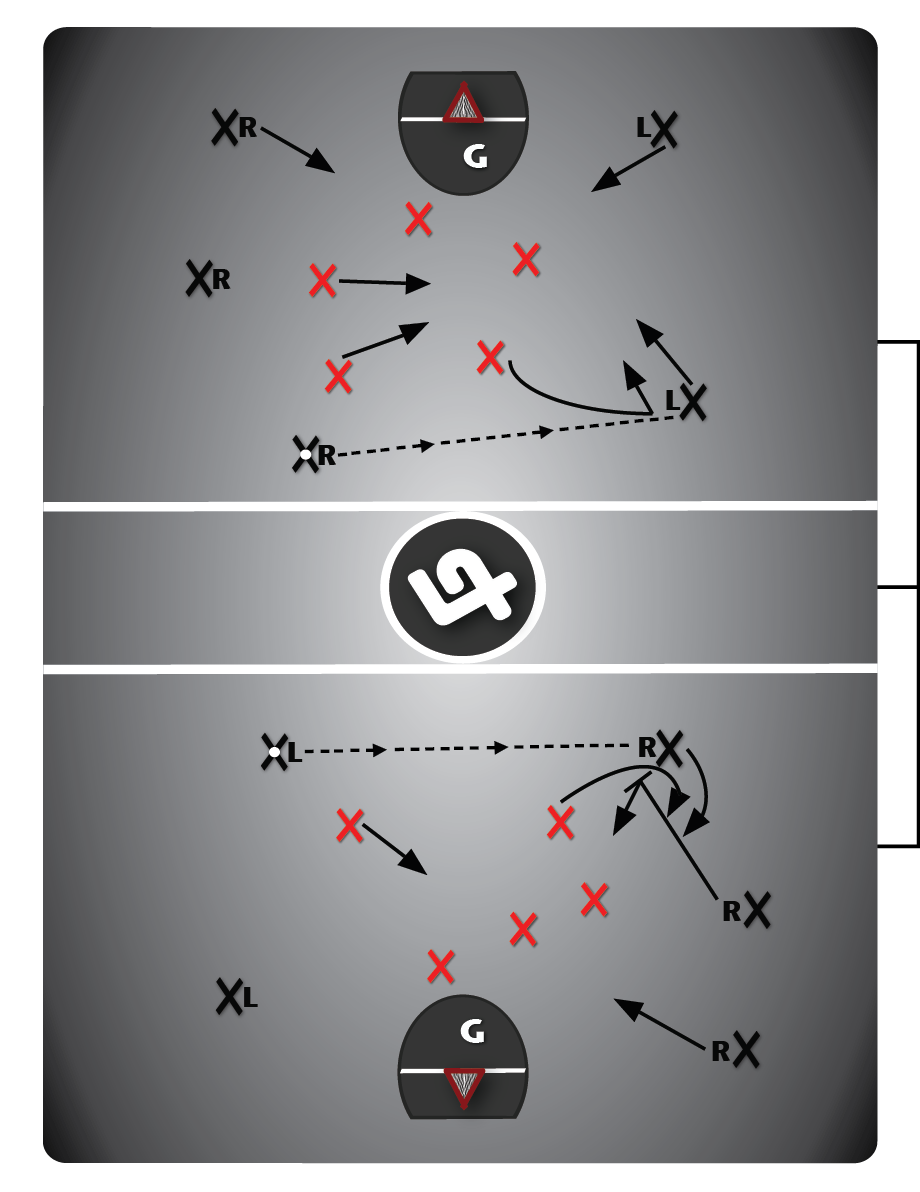
- The force down (pressure) defense is an advanced defense in which the high defender on the ball-side of the floor funnels the ball carrier down in the outside lane, while denying the top-side and applying controlled pressure. Often these "chasers" will end up in a trail check position while evading picks and "staying" on pursuit; the team's most athletic players are usually best suited for this role.
- A good cue for coaches is "position, pressure, pursuit," as Flip Sanderson teaches it. Don't pressure until in position; stay on pursuit once you've pressured; get back in position after you pursue. Defenders need to be careful not to pressure out too far, leaving the offense with a lot of space to work with. Instead they should wait until the opponent is in the "kill zone," which is two or three steps outside of the prime scoring area. Furthermore, players need to communicate with each other about when they should "fire" out, also who should fire out when the ball is on the strong-side. Sometimes the high defender will be in a better position to fire out and other times it will be the middle defender.
- When the ball is high on either side, the same-side low defender should be standing in the far-side shooting lane, sagging off of their check (inviting a pass) and splitting the ball carrier, where required. If the pass is made to the open crease player, the low defender should be able to recover and play “cat & mouse” at the crease, being sure never to get beat underneath; otherwise, the goalie is expected to make this save if either player shoots from "the seam" at any point.
This is the "quarterback" position of this defense and usually the smartest and/or bigger slower players should try to start in this position (where possible). The golden rule for the low defender is never to get shot around on a screen shot ("keep everything in front of you") and also to be "as low as their lowest player," meaning they can't be "parked" by the crease if their check goes for an up-pick, for example. In this particular scenario, if the high defender is successfully back-picked they should perform an inside roll and the low defender should switch, closing the gap and becoming the high defender and vice-versa.
The off-ball middle defender on the strong-side or high defender on the weak-side (“hot defender”) should also be “sluffed” over and ready to slide on any “flip” passes to the middle or pick and pops. Some variations of this defense see the on-ball middle defender leave their check and double-team the ball carrier in an up-pick scenario.
The off-ball low defender has one responsibility at all times, which is to stand in the passing lane and/or lock off the off-ball crease player.
Generally speaking, all defenders should cross-check players that are in the middle, get on hands of any shoppers and compete for any 50/50 balls.
The theory is that the other team can settle for a north-south shot-on-the-run, with the threat of the shot being blocked or trail checked; flip the ball to a teammate with a slide coming, or continue carrying the ball behind the net. If the ball is passed or carried behind the net, all defenders should "tighten up."
As a defense, teams must be weary of the Phoenix and other set-plays against, which have notoriously been utilized to breakdown this defensive system.
Would you like to share your thoughts?
Your email address will not be published. Required fields are marked *
Leave a Reply
You must be logged in to post a comment.
Would you like to share your thoughts?
Your email address will not be published. Required fields are marked *
Leave a Reply
You must be logged in to post a comment.
0 Comments